The history of metal detecting goes back more than a hundred years and is made of new ideas, problems to solve, and successes. According to the blog of the US retailer Modern Metal Detectors, the technology has come a long way since its beginnings. Today it is used in historical research, treasure hunting, security, and even medicine.
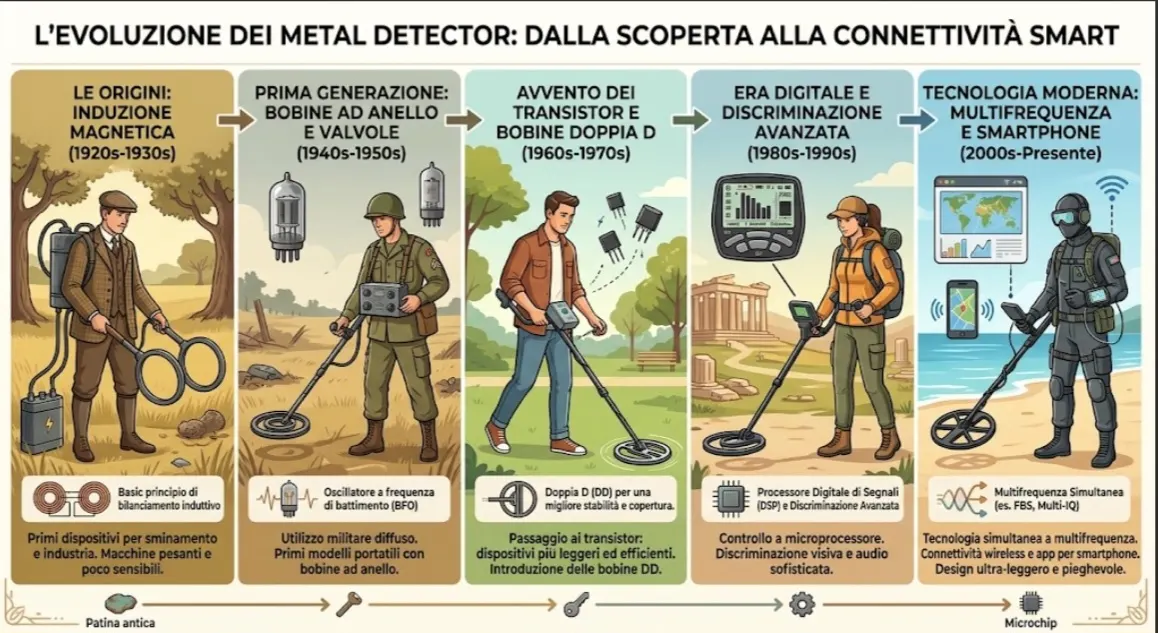
The source places the starting point in 1925. That year, the German inventor Gerhard Fischer built what is considered the first true electric metal detector. His design integrated a radio direction-finding system, that is, a method of determining direction through radio waves, capable of locating metal objects buried beneath the surface. According to the source, the device found metals better than the earlier, more complicated methods.
Fischer's project attracted considerable international attention. The source reports that the physicist Albert Einstein reportedly said that metal detectors would one day become commonly used tools. Fischer's portable model opened new possibilities in treasure hunting, archaeological investigation, and military operations.
In the 1920s, metal detectors were used to search for treasure, but they also had a practical, life-saving application: clearing the minefields left over from the First World War. Europe was dealing with the effects of the conflict, and devices able to locate hidden explosives proved valuable. This use showed the technology's usefulness beyond treasure hunting and archaeology, and made it better known.
A second breakthrough came in the 1970s with the introduction of VLF (Very Low Frequency) detectors. According to the source, this technology made it possible to detect even very small metal objects, such as gold nuggets, with greater precision. Another advantage was the ability to distinguish between different types of metal.
This capability, known today as discrimination, allowed enthusiasts to ignore scrap metals such as iron and aluminum foil. Searching thus became easier and more enjoyable. According to the source, VLF detectors not only improved the technique but also greatly expanded the market of hobbyists.
With cheaper, lighter, and easier-to-use devices, the user base grew. Previously, the activity mainly involved prospectors and archaeologists. From then on, anyone who wanted to search for coins, artifacts, and other lost objects could do so. According to the source, by the end of that decade metal detecting had become a popular pastime. It still is today, with practitioners of every age and background.
Design has also changed considerably. The first models were large, heavy, and awkward, and therefore poorly suited to prolonged use. The invention of the transistor in the late 1940s made it possible to reduce the size of the instruments. These advances made detectors more compact, with lower energy consumption and lower costs. As a result, more people were able to buy them.
An important contribution also came from improvements to search coils, the part of the instrument that detects metal. The early models could only find metals close to the surface. Later designs made it possible to locate objects deeper underground. This improved precision and search depth and made detectors more reliable for expert searchers, explorers, and security-related uses.
In the 1980s and 1990s, brands such as Garrett and Fisher began offering more advanced models. Their improved discrimination functions made it much easier to tell different types of metal apart. The introduction of digital electronics further changed the situation. A screen showed the type of object detected and its depth, giving a clearer idea of what lay in the ground.
In this way, it became easier to decide whether a dig was worth the effort. The source text, which in the material available breaks off at this point, links this advantage to greater effectiveness in both treasure hunting and archaeological excavations.
The path traced by the source therefore runs from Fischer's 1925 prototype to digital instruments. Between these two extremes lie the clearance of explosives, the arrival of VLF technology, miniaturization with transistors, and the evolution of search coils. Each step made detectors more precise, lighter, and more accessible. Those who search today, whether as a hobby or professionally, use instruments that descend directly from this long history.