French Coins in the Latin Monetary Union (1865-1927)
From 1865, the franc, lira, Swiss franc and drachma shared weight and fineness: a story that detectorists uncover in gold and silver coins.
August 15, 2026
ShareLink copied!
The government of the Empire of France. — Public domain, via Wikimedia Commons
The Latin Monetary Union was one of the first historical attempts to harmonize European currencies. According to the French blog Le Fouilleur, it was established on 23 December 1865 at the initiative of Napoleon III and remained in existence, in its various forms, until 1927. For those who practice metal detecting and come across 19th-century gold or silver coins, understanding this system helps explain why coins from different countries look so similar in weight, diameter and fineness.
The basic principle, the source reports, was standardization: the reference coins of each signatory state had to contain the same quantity of fine metal. In this way, every piece had the same precious metal content and the same legal tender value, regardless of the national effigy or the local name of the coin. The convention thus allowed the free circulation of metal coins among France, Belgium, Italy and Switzerland. A Parisian merchant, the text recalls, accepted Italian lire or Swiss francs without difficulty as payment for his goods.
It should be made clear that the agreement covered only part of the money supply. Coins minted between the Second Empire and the end of the Third Republic complied with the strict fineness standards set by the convention, but token coinage and paper money remained excluded from the international agreements. This is a useful detail to keep in mind when classifying finds: not all coins in circulation in those years followed the same parameters.
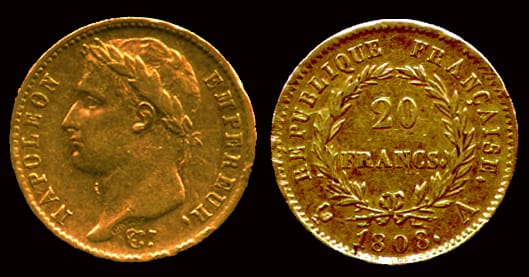
Le Fouilleur stresses that the 1865 convention did not arise from nothing, but formalized an economic reality already in place. The model was that of Napoleon I, who had imposed the germinal franc as the European benchmark. The 20-franc piece, with 5.801 grams of fine gold, already served as an unofficial standard. Belgium, since its independence in 1830, and Switzerland, in 1851, had aligned their systems with the French one to stabilize their respective economies. The 1865 agreement, according to the source, merely ratified and legally framed practices that already existed.
The system was based on bimetallism, that is, on the simultaneous acceptance of gold and silver as reference metals. But it soon had to contend with market fluctuations. The massive arrival of gold from California, Australia and Siberia changed the value ratio between the two metals: silver rose in value relative to gold, testing the stability of the fixed exchange rates desired by the signatories.
The Union expanded well beyond the four founders. Greece officially joined on 8 October 1868, extending the monetary zone to the Balkans. The convention expressly provided for the right to withdraw, but the system's appeal produced the opposite effect: a massive adhesion, formal or de facto, by numerous nations around the world. According to the source, the convention's influence reached some twenty states, creating an exchange area comparable to the modern euro zone. Some countries tied themselves in through bilateral agreements, others unilaterally aligned their currency to facilitate international trade, and the colonies of member countries adopted the system, spreading the franc standard across Africa and Asia.
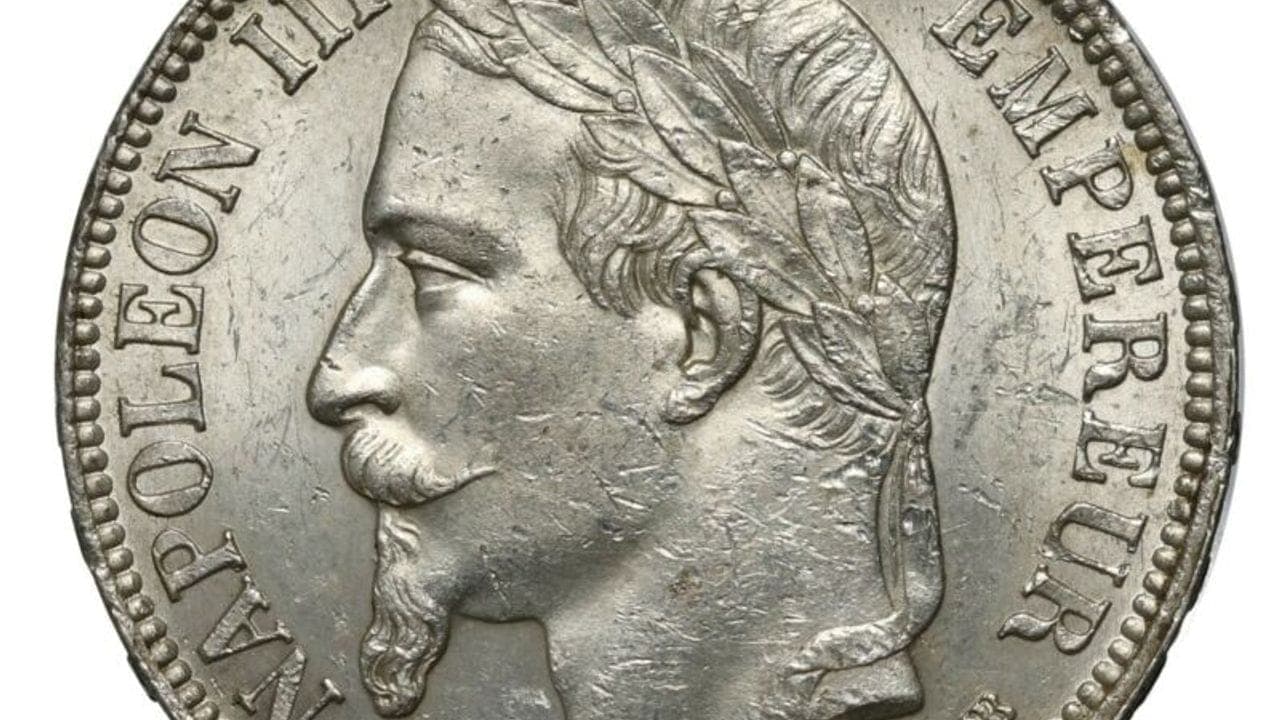
Napoleon III, promoter of the Union, left a profound mark on French numismatics with abundant and carefully crafted coinage. The gold coins issued under his reign, mostly engraved by Albert Barre, bear the emperor's effigy with a laureate head, a symbol of power consolidated after 1852. Thanks to the Union's agreements, these coins circulated well beyond French borders.
The most prestigious piece was the 100-franc gold coin, minted from 1862 to 1870. On the edge, the inscription «Dieu protège la France» is raised in relief. The obverse shows the emperor's profile, while the reverse features the imperial coat of arms. In the text available to us, the description of the reverse breaks off at this point, so no further details of the design can be reported.
For the detectorist, the value of this history lies in its context. A gold or silver coin found in the ground is not merely a metal object: it tells of a Europe that, in the mid-19th century, sought a common monetary language, with shared rules of weight and fineness. For this reason, when documenting a find, it is worth carefully noting the location and the conditions of recovery, and comparing weight, diameter and inscriptions with catalogues, bearing in mind that different mints and countries could produce equivalent pieces. Finally, it should be remembered that finds legislation varies from country to country and must always be respected.
ADV
The AI assistant for metal detecting
Custom programs, restricted-area checks, ground recognition and much more.Try it free →Get the app