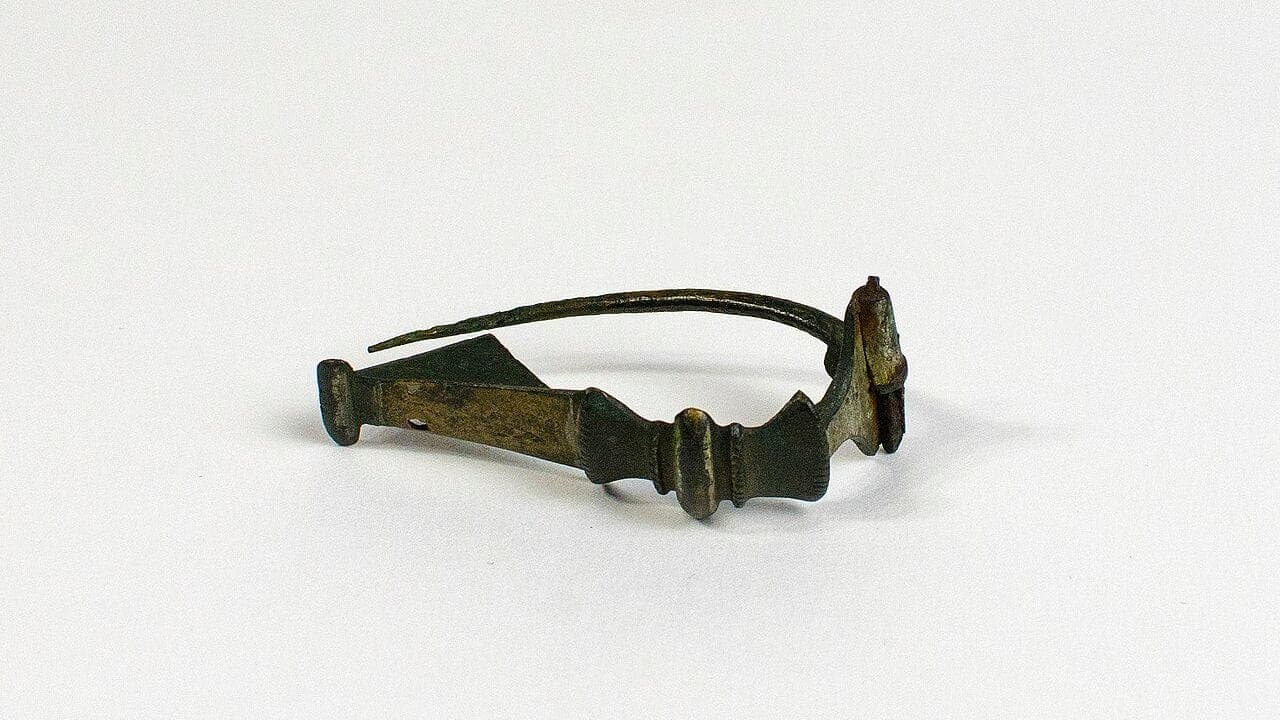
The fibula is the direct ancestor of the modern safety pin, but calling it a simple accessory would be reductive. As the French blog Le Fouilleur points out, this archaeological object replaced the traditional needle, which was often unreliable, and reflected an ancient fashion based on draping and unstitched fabrics, such as cloaks and garments. Today it is also a valuable indicator for scholars: it allows them to date excavation layers and to understand the social hierarchies, military ranks and spiritual beliefs of past civilizations.
Its original function was very practical: to fasten thick or heavy garments without damaging them. Ancient peoples wore military overcoats and tunics that required a secure fastening. According to the source, the Roman toga is a noteworthy exception, because it was held in place by a skilful arrangement of folds and required no metal fastening. Even in antiquity, however, the object quickly became a conspicuous ornament, capable of communicating much more than mere practical utility.
The decorations on the bow or on the foot (the catch-plate) of the fibula immediately revealed the identity of the wearer. An observer of the time could recognize at a glance a woman's rank, profession or marital status. Warriors and leaders displayed specific models that affirmed their power. In other words, each fibula functioned as a kind of visible identity document, pinned to the garment.
This social use was codified in particular by the Roman army. According to Le Fouilleur, some fibulae were turned into true insignia of military rank. An object born to keep a cloak closed thus became a symbol of belonging and position within a rigorous hierarchical structure, a detail of considerable documentary value for historians.
Alongside the social dimension, the source emphasizes the spiritual one. Ancient peoples attributed protective powers to these objects against the evil eye. Archaeologists frequently find them in sanctuaries or on altars, where they were deposited as offerings to the gods. This dual, social and religious function helps explain the enormous variety of shapes and materials that has emerged from excavations.
As for materials, ancient craftsmen used many. Excavations have yielded examples in iron, particularly from the La Tène period, but also in ivory or set with stones. Copper-based alloys dominate production, however: bronze (copper and tin), brass (copper and zinc) and three-component mixtures that include lead. For those who study the finds, recognizing the alloy is therefore an integral part of the analysis.
To make the most refined details, the lost-wax casting technique was used. It appeared as early as the Bronze Age and spread in the 4th century BC according to the source. The craftsman first modelled an original in wax, a malleable material that allowed meticulous finishing, and covered it with a mould of clay or refractory plaster. He then heated the mould so that the wax would melt and run out, leaving a hollow impression, the negative, into which he poured molten metal, such as silver or bronze.
After cooling, the mould was broken to free the rough object, which required long polishing and retouching. Since the wax model was destroyed in the process, each piece is unique. This is one of the reasons why two apparently similar fibulae can show significant differences in their details, which scholars read as traces of workshop or taste.
Structurally, a fibula essentially consists of a body, the bow, and a movable pin, known as the ardiglione. According to Le Fouilleur, analysis of the fastening system allows specialists to establish a precise chronology of finds. The earliest models appear at the end of the Bronze Age and use a spring to keep the pin under tension. The spring is the oldest mechanism, and there are variants, including the one-sided spring, which coils in a single direction.
The technical progression from spring to hinge is exactly what makes the fibula a reliable dating tool. For this reason a small metal object, often found fragmentary or corroded, can reveal a great deal: the period of a deposit, the status of its wearer, their role in the army or their connection with the sacred. A source, then, that speaks without words through form, material and mechanism.