Anyone who practises magnet fishing (fishing with a magnet) knows the frustration of pulling up only small, uninteresting metal objects. For this reason, the French blog Le Fouilleur has published a comparison of three high-power magnets: the Neodimio DOPPIA faccia 1100 kg, the Magnete 360° pack 1600 kg and the Neodimio 360° BARBARIAN, also rated at 1600 kg. The underlying idea is that power is the key parameter for recovering larger objects, but that more power also requires more caution.
The first criterion indicated is pulling force, that is, the magnet's ability to attract and lift metal objects. Magnets for magnet fishing generally range from 55 kg to 1600 kg, so that each angler can choose according to their own needs. A high value is more effective for recovering heavy objects, but it is not the only factor to consider.
Material matters too. Neodymium magnets are the ones used and preferred because, according to the source, they can exceed the power of ferrite or AlNiCo magnets by up to four times. They are often identified by a grade, such as N52, which indicates magnetic strength. This choice guarantees better performance and greater versatility for those who practise the activity.
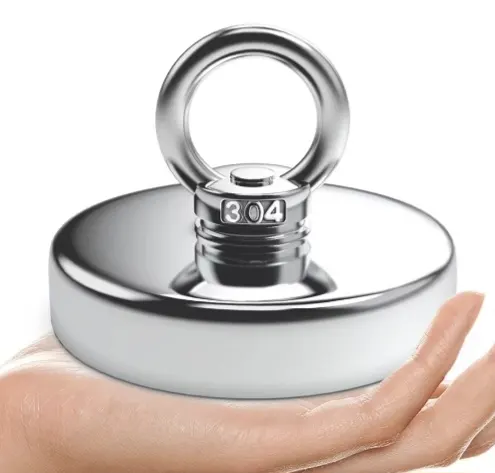
A second element is the adhesion surface. 360-degree models attract objects across the entire surface of the magnet, that is, on top, underneath and along the edge, and this increases the likelihood of hooking something with every cast. This is a substantial difference compared with magnets that have one or two working faces, and it explains why two of the three products compared adopt this configuration.
Finally, there are size and weight: in general, a larger magnet is more powerful. The source cites as an example a magnet 8 cm in diameter, capable of generating an attractive force of more than 1000 kg, theoretically enough to lift heavy objects such as a motorcycle or a household appliance. These features are designed for those looking for bulky finds.
The less straightforward side concerns risks. According to the article, magnets conduct electricity and can carry current, so handling them can be dangerous, especially for children. A very powerful magnet is also more problematic than one rated at 200 or 600 kg: if it attaches to a very heavy object, such as the shell of a car, it cannot be detached unless one goes directly underwater to free it, an operation that is not without danger.
Anyone choosing a magnet of this class must therefore be prepared to take full responsibility for the consequences. This applies both to the risk of being unable to recover the magnet and to the burden of disposing of enormous objects or vehicle wrecks, which must be taken to a recycling centre or a scrap dealer. The source reminds readers that it is always the responsibility of the angler to remove everything brought up from the water.
In short, the comparison does not identify an absolute winner. The 1100 kg and 1600 kg models are aimed at those seeking significant finds who accept managing the logistics and risks involved. For beginners, or for those who fish in watercourses where massive objects are unlikely to be found, a less powerful magnet may prove more practical and safer. Before buying, it is also useful to check the local regulations governing magnet fishing and the recovery of objects from water.