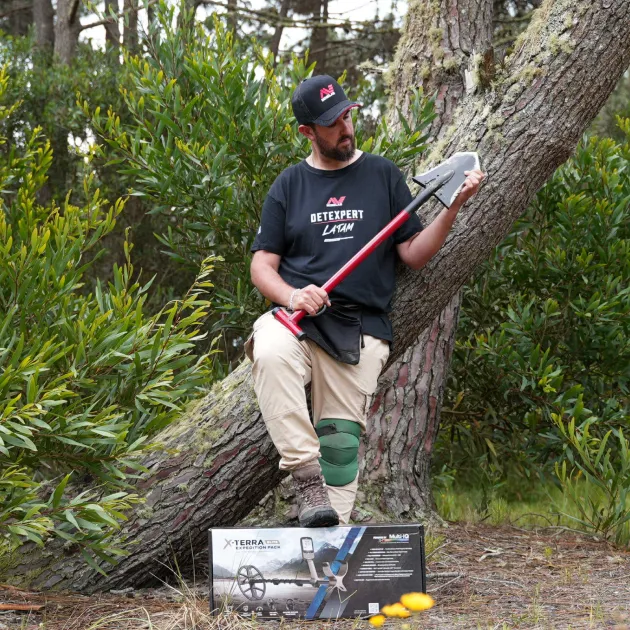
The US dealer Serious Detecting has published the results of a two-month test of the Minelab X-Terra Pro at three sites. The first is a city park that has been searched since the 1960s. The second is a freshwater beach with a swimming area marked off by a rope. The third is a plowed field where a 19th-century farm stood until recently. The test did not aim to establish whether a single-frequency detector can beat a high-end Multi-IQ, something Minelab itself does not claim. It aimed to understand what this model offers at its price and whether choosing the frequency, outing by outing, actually works in the field. The testers' answer is that it does, with one limitation.
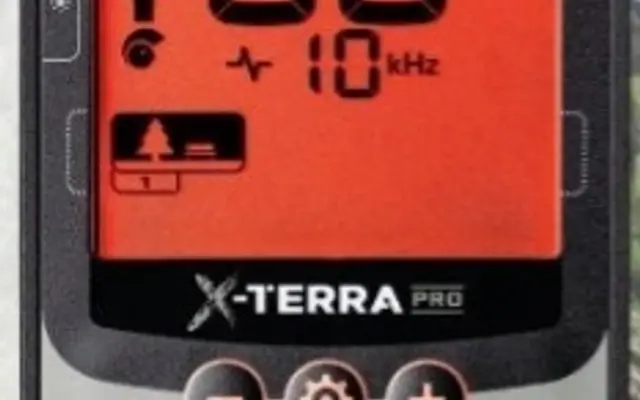
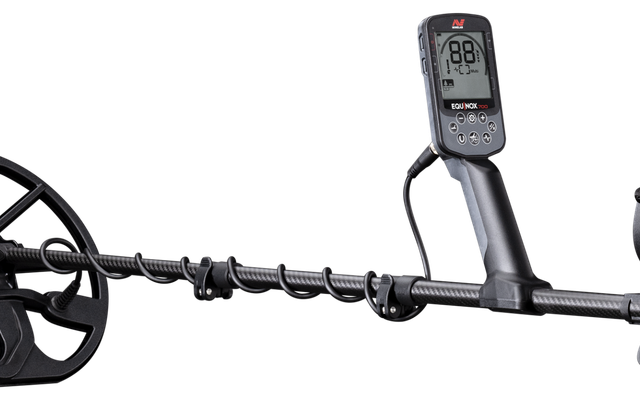
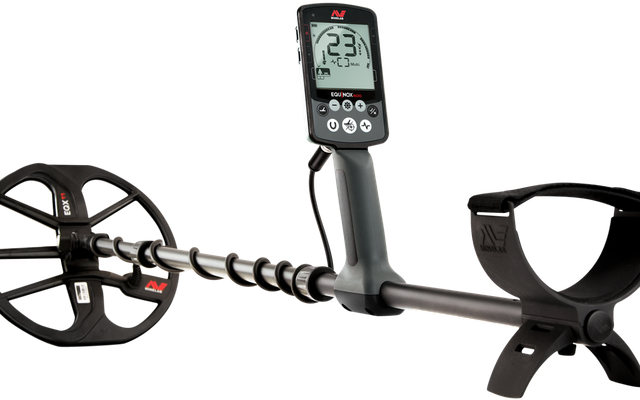
The equipment used is the standard package: the elliptical V12X Double-D coil measuring 12 by 9 inches (about 30 by 23 cm), wired headphones for use on land, and the internal speaker for use in water. The PRO-SWITCH system offers 5, 10 and 15 kHz in the Park and Field programs, while the Beach program is fixed at 8 kHz. Ferrous target IDs range from -19 to 0, non-ferrous from 1 to 99, with 30 discrimination segments that can be excluded or included. Sensitivity runs from 1 to 25, and ground balance can be automatic, tracking or manual. The unit is waterproof to IP68 up to about 4.9 meters, weighs 2.9 pounds (about 1.3 kg) and folds down to 25 inches (about 63 cm). The internal 5100 mAh battery, charged twice a week with the magnetic USB cable, never ran out during an outing.
One point needs clarifying: PRO-SWITCH is not multi-frequency. You choose a single frequency and the machine works on that one. It is a decision to make before you start sweeping, and according to the testers it shaped every outing.
At the park they used the Park 1 program at 15 kHz, sensitivity 19 out of 25, ferrous volume lowered by two steps, and All Tones. They chose the high frequency because the local trash consists of small fragments, such as aluminum and can pull-tabs, and at 15 kHz the response to small non-ferrous items is sharper and the IDs on shallow coins remain stable. Under a power line the machine was disrupted. They solved it by repeating noise cancellation from the menu and lowering sensitivity from 22 to 19.
Over nine hours spread across four outings, they recovered 52 clad coins, six wheat pennies, a worthless ring and a 1936 Mercury dime, found about 6 inches (15 cm) deep near a sidewalk. The dime gave IDs of 86-87 from every sweep angle, while the copper pennies read 80-82 everywhere. The testers see this consistency as the real value of the 1-99 scale: once you learn where targets fall, the numbers become useful. The limit is depth. Beyond 7 inches (about 18 cm) the IDs start to bounce. A memorial penny at 8 inches swung by fifteen points before digging, so beyond that depth the numbers are only indicative.
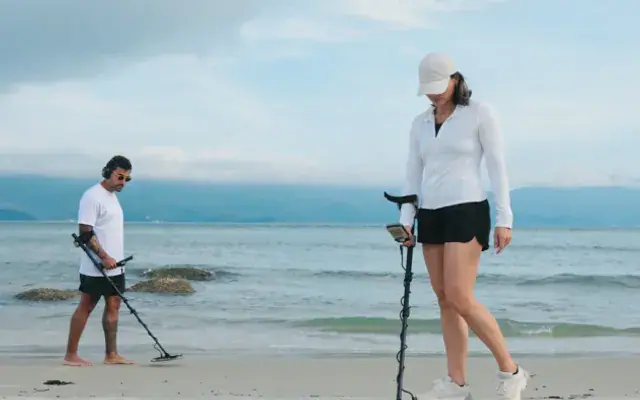
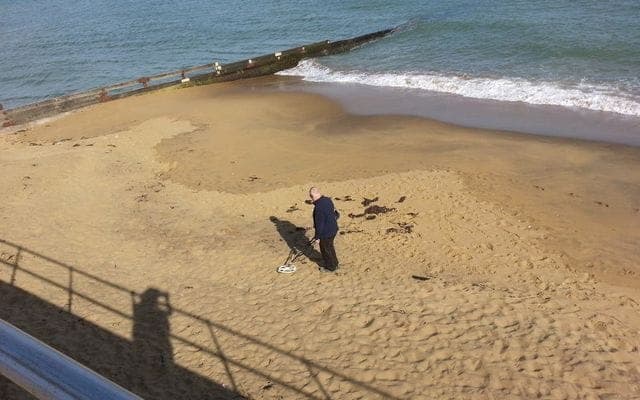
On the beach they used Beach 1, sensitivity 21, automatic ground balance, vibration on and speaker only. Minelab's fixed 8 kHz is calibrated for mineralized wet sand, so the frequency choice is already made here. They swept the towel line first, then the marked-off area, in water up to chest depth, with the control box submerged several times. There was no fogging or water ingress.
In six hours they dug up more than 70 clad coins, four fishing sinkers, a toe ring and a thin 10-karat gold wedding band at about 4 inches in the wet sand. The small gold responded with IDs in the pull-tab range, as happens with any metal detector, and the signal bounced. For anyone searching for gold on swimmable beaches, the testers warn, the only way is to dig those numbers too.
It should be noted that the test comes from a dealer, not an independent laboratory. Moreover, the available report does not include results from the plowed field.
In short, the X-Terra Pro presents itself as a single-frequency detector with selectable frequency, reliable down to about 7 inches and sturdy in water. Those aiming for maximum depth and stable IDs on deep targets will have to look elsewhere.