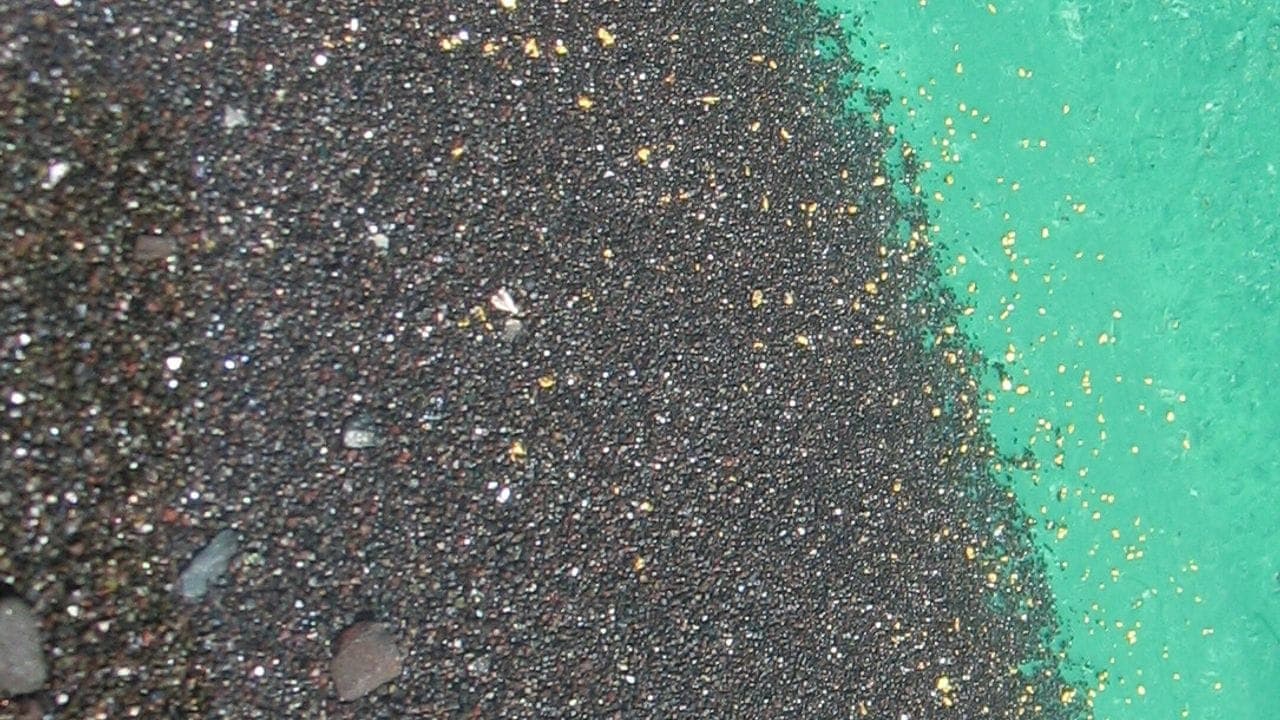
The Blue Bowl separates gold flour from black sands using a water vortex: here's how to prepare and use this concentrator.
August 8, 2026
ShareLink copied!
Ted Scott of Goldplacer.com 1. — Public domain, via Wikimedia Commons
Anyone who prospects for gold knows the problem well: after a sieving session the larger flakes are easily recovered, but gold dust, the so-called gold flour, remains mixed with the black sands and requires a dedicated method. The Blue Bowl concentrator was created precisely for this purpose and is used as a finishing tool for material that has already been concentrated.
The working principle is based on a vortex. Water, fed into the bowl, begins to spin in a way similar to what happens in a bathtub that is draining. Centrifugal force and the difference in weight do the rest: the lighter materials are pushed out past the central cone, while the gold, being heavier, settles in the bowl at the base of the cone.
Before first use, the bowl must be prepared. The inside of the bowl must be dry and free of the greasy substances that may be present after factory processing. To remove them, wash it with dish soap, repeating the operation several times until no visible residue remains.
For the water supply, the source indicates a submersible 12-volt pump, suitable for a low-pressure flow, as the usual choice. The connection involves a T-fitting at the pump outlet and an 86 cm length of tube on the outer side of the T; it is then completed by connecting a garden hose to the unit's ball-valve connector. Using the pump is recommended over mains water or a garden hose, because the air bubbles coming from the latter can stick to the walls or bottom of the bowl, slowing separation and causing some loss of gold particles.
The bowl must be placed on a plastic tray containing water and must be perfectly level. The upper part has triangular inserts that make it easier to rest on the leveling feet; a spirit level can be used to check the setup.
Preparing the material is equally important. Dry concentrates must never be introduced: they should be wetted with water and a few drops of dish soap, even just a few teaspoons, to reduce surface tension and prevent the micro-particles from floating and being lost. Concentrates coming from sluices must also be screened to 0.8 mm at most. Finer screening allows purer gold to be recovered, but lengthens preparation times. Generally, the material is classified using screens of 0.6, 0.3 and even 0.15 mm: the finer the mesh, the longer the treatment, but the better the recovery of extremely fine gold.
Moving on to the operational phase, the water flow is adjusted with the valve so that the level stays just below the outer edge of the bowl, without overflowing. Concentrates should be poured slowly, avoiding overfilling the container: if the load is excessive, the material tends to accumulate toward the base of the central cone, whereas for good separation it must remain on the outer part. To correct this, a small jet of water can be applied with a syringe to push the concentrates toward the side of the bowl.
Open the valve cautiously until the water starts to turn, forming the vortex. From there, gradually increase the flow, carefully observing the effect on the material, until the lighter components are seen being expelled from the cone while the gold remains at the base. At this point, shut off the water and suction up the accumulated gold with a pipette. If the flow is uneven or too strong, it is advisable to slow it down, because there is a risk of washing away much of the concentrate.
The Blue Bowl does not replace primary processing tools, but completes the chain: it is the final stage designed for those who do not want to lose the finest part of the haul, provided they accept longer preparation times and a careful setup in terms of level, flow and cleanliness.
ADV
The AI assistant for metal detecting
Custom programs, restricted-area checks, ground recognition and much more.Try it free →Get the app