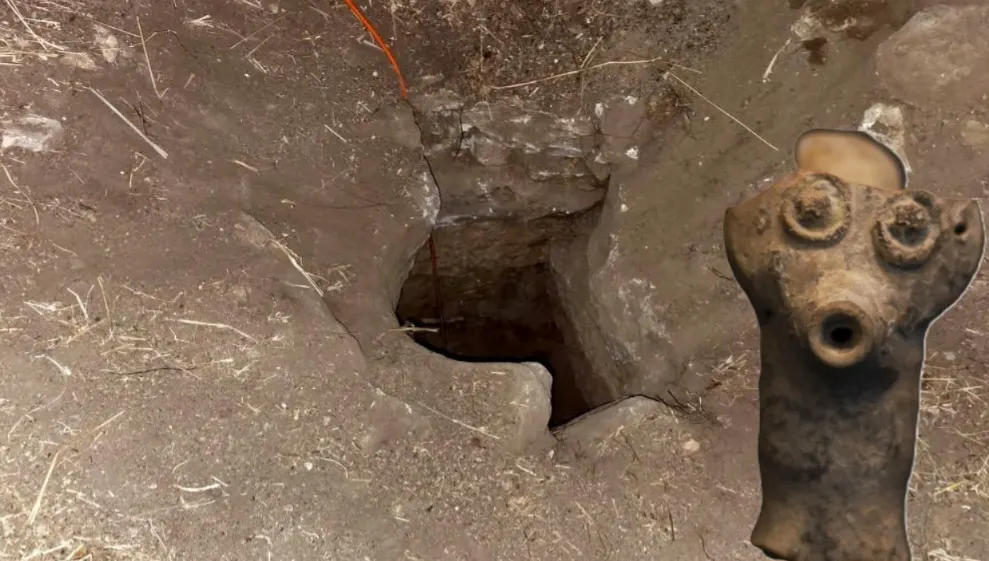
A lit fire, people gathered outdoors and the look of a countryside outing. According to Stilearte, reporting on November 18, 2026, an illegal dig was under way beneath that scene. Six suspects were arrested by inspectors of the Israel Antiquities Authority. Investigators say they were searching for possible treasure in an ancient cistern, about nine meters below ground level. To reach it, the group had brought a generator, an electric demolition hammer, drilling equipment, digging tools, a long ladder and a lighting system. The others, who remained on the surface beside the fire, were reportedly tasked with making the entire operation look like an innocent picnic.
The operation took place over the weekend at Horbat Adash, a recognized and protected archaeological site. It lies near Mevo Beitar, in the Judean Hills, within Begin Park, west of Jerusalem. The operation was led by inspectors from the Israel Antiquities Authority's Antiquities Theft Prevention Unit, which works to counter the looting of archaeological sites.
Inside the cistern, inspectors found fragments from hundreds of ceramic vessels, several stone containers and a portion of a zoomorphic vessel. It is a container in which part of the shape reproduces anatomical features of an animal. The recovered fragment retains an neck modeled with animal features and is attributed to the early Islamic period, between the 7th and 8th centuries CE.
This concentration of materials from different periods points to something about the history of the structure. Originally built to collect and store water, the cistern later lost its original function and became a sort of waste dump. According to the source, this kind of transformation is far from unusual in ancient residential contexts. The finds in the fill thus document a later phase in the life of the settlement.
That very deposit is a source of historical information. The arrangement of the fragments, their position relative to one another, and their relationship to the fill layers and surrounding structures allow archaeologists to reconstruct the phases of a site's occupation. An object removed without documentation may retain its beauty, but it loses much of the information that makes it historically meaningful.
According to the Israel Antiquities Authority, the digging caused extensive damage to the structure, affecting the walls and floor of the cistern. Ancient plaster layers preserved for centuries were also broken. The use of mechanical equipment in a confined underground space would have compromised parts of the ancient installation. These are pieces of evidence that simple restoration cannot recreate.
The nine-meter depth shows how well prepared the operation was. As the source notes, this was not an occasional search with a metal detector during a walk. The group had tools to demolish, drill and light an underground space, as well as a generator. The people gathered around the fire were there to mask the activity.
For metal detectorists, this is a useful reminder. A protected archaeological site is not a place to search, and deep digging with mechanical equipment has nothing to do with amateur detecting. This article reports an event that took place in Israel and does not describe Italian rules. The sources do not indicate the charges or the outcome of the proceedings, and we say nothing on those points. Before heading out with your detector, always check the local regulations in force where you are and contact the competent authorities, such as the Soprintendenza in Italy.