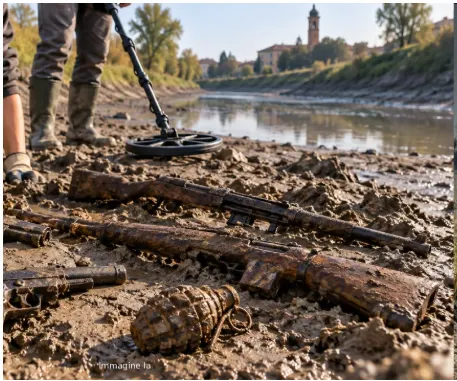
An exploration with a metal detector in a canal in the Modena area turned into a security operation. According to Stilearte, reporting on October 7, 2026, a group of kids went down to the bottom of a waterway after the water level had dropped. Using small metal detectors, they located two pistols, two rifles and a British L23 hand grenade, all material dating back to World War II. To protect the area and the people involved, this article does not give the exact location of the find; the source places it in the Modena area, in Emilia-Romagna.
At first, a single unexploded device was suspected. For this reason, the municipality had ordered the closure of a nearby stretch of road, pending localization and identification operations. When specialists reached the area, however, the picture proved more substantial: among the sand on the riverbed, what the source describes as a small arsenal had emerged, with weapons that may have remained hidden in the canal for decades.
The greatest attention went to the British hand grenade, which was treated as potentially dangerous. On the morning of October 7, bomb disposal experts called in from Piacenza detonated it safely at 10:58. The available sources do not report any further information on the fate of the recovered firearms or on the subsequent procedures.
The question of how those weapons ended up in the canal remains open. Stilearte notes that they could have been hidden during or immediately after the conflict and that, in the postwar period, someone may have decided to get rid of them by throwing them into the water. This is, however, a hypothesis: at present there is no evidence to establish who used or abandoned them, and based on the available information it is not possible to link them to either partisans or military forces. We therefore avoid any reconstruction that goes beyond what has been reported.
The case is a reminder of a reality still present in the Emilian plain: eighty years after the end of the war, the ground can continue to yield weapons and ammunition that remained buried or hidden. Low water levels, as in this case, can make normally submerged areas accessible, but for precisely this reason they call for even greater caution.
For metal detector enthusiasts the message is clear, and the source stresses it: when faced with an object that could be an explosive device, do not dig or touch anything. Move away and immediately alert the police. It should be remembered that the search coil and discrimination settings indicate the presence and type of metal, not the condition of an object: a metal detector cannot tell whether a piece of war debris is still dangerous, and neither can a pinpointer. For this reason, an unusual signal, or a metal object with a suspicious shape, must be handled with the utmost caution even when the search is done out of simple curiosity.
As Stilearte observes, this time the kids' curiosity brought to light an unexpected piece of the area's history, but faced with a bomb that was still potentially dangerous, what looked like a treasure hunt could have had very different consequences.
A note on regulations: the cited source does not refer to specific provisions on the use of metal detectors or the handling of finds of war materiel, and we do not add any. Anyone who practices metal detecting is advised to check the national and local rules in force in their area, for example with the municipality or the competent authorities, before going out in the field and, above all, before intervening on a doubtful find.