Those who search for gold in watercourses are used to thinking in terms of sands and gravels to be washed. There is, however, a more targeted approach, called crevicing (orpaillage nelle failles in French), which aims to recover gold particles trapped at the bottom of the bedrock's crevices, that is, the rocky floor over which the river flows. According to the source consulted, this technique works precisely where classic bank washing fails for lack of concentration: little material is handled, but it is very rich.
To understand why it works, we need to start with the makeup of a riverbed. Bedrock is not a smooth surface: it is irregular and dotted with cavities known as potholes or crevices. They form through mechanical erosion: the current and the constant movement of pebbles wear down the stone, and over time these openings become stable containers, capable of holding the heavier materials carried by floods. When the flow is intense, the bottom is disrupted and light material is swept away, while heavy elements tend to sink.
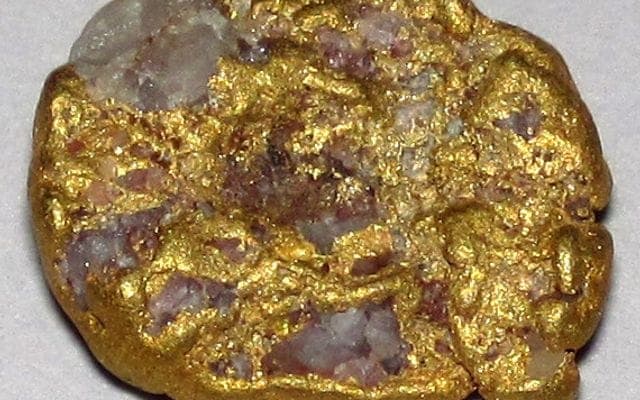
Here, physics comes into play. Gold has a high density, which pushes it toward the lowest point available. A flake that enters a crevice filled with gravel slowly sinks between the gaps until it touches the rock wall, and there it stays, protected from surface currents by the layer of sediment above. The process is self-sustaining: the contact zone continues to deform and the crevice deepens, never closing, because the gravel continually refills it. The result, in the source's words, resembles a scar in the stone, and that is where the metal finds its resting place.
An aspect often underestimated concerns size. Rough walls create strong friction that blocks the progression of heavy sediments, so a crevice only a few millimetres wide can hold a surprising amount of metal relative to the volume of sand. The source cites the case of a three-millimetre gap with dozens of flakes concentrated in a handful of sediment, and of a five-centimetre-long fissure capable of hiding a notable concentration. The practical conclusion is that the size of the crevice is not a reliable indicator of the deposit's richness: it is better to observe the shapes of the rock carefully.
Which cavities deserve the effort? Those that do not close up. They keep their depth because sand prevents the rock from eroding evenly, and for this reason they work as lasting traps. Treating the surface gravel is secondary: the upper layers need to be removed only to reach the substrate, since once in contact with the bedrock, gold no longer sinks. The reward, the source reminds us, is systematically found at the bottom of the mineral funnel, and emptying it completely requires patience.
Thin tools are used to extract sediment from such narrow spaces, in particular a hook designed for crevices (the crochet à failles mentioned by the source), which allows scraping and collecting concentrated material from the bottom without handling large volumes. It is the opposite logic to mass washing: less material, but selected at the point where gravity has already done the concentrating work. According to the source, this precision often outperforms, in yield, the washing of large quantities of gravel.
The river's configuration also affects the quality of the crevices. Slow-moving areas downstream of a major obstacle are favourable: the water loses force and deposits heavy elements in the first available hollows. Reading fluid dynamics, identifying potholes and recognising the most promising mineral scars are part of the craft, and above all require observation before equipment.
In short, crevicing rests on a simple principle: the river works for centuries to concentrate gold at precise points, and the prospector must know how to recognise them. Anyone approaching this practice would do well to devote time to reading the bedrock, choosing crevices that are still active and patiently cleaning out cavities, rather than focusing on the quantity of material washed. As always, before digging or removing sediment from a watercourse, it is advisable to check the local regulations in force.