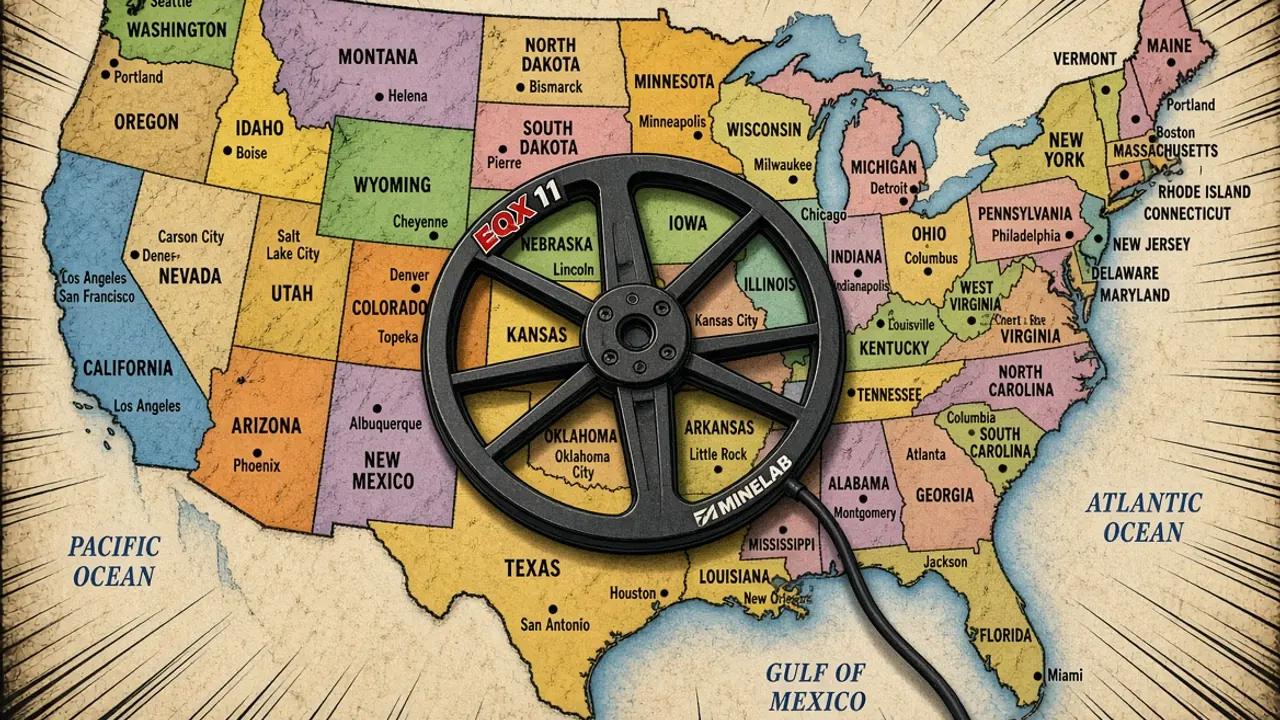
When it comes to where to search with a metal detector, the same question always comes up: are some places better than others? The American blog Metal Detecting Life has tried to answer with a ranking of the ten US states most interesting for anyone hoping to make an important find. The piece is more popular than scientific, and it is best read that way. Beyond the ranking, it is useful for understanding which criteria a detectorist should consider when evaluating an area: the history that has passed through it, the accessibility of the sites, and the state of preservation of the finds.
The first example is Ohio, which according to the author does not immediately evoke the idea of treasure but is a small treasure trove for those who search. The state was home to ancient Native cultures such as the Hopewell and the Adena, who left burial mounds and ceremonial artifacts. It later played a role in westward expansion, with wrecks of settlers and soldiers, and it preserves Civil War campsites and old trade routes. The blog also recounts a legend: the gangster John Dillinger supposedly buried part of his loot in rural areas near his hideouts. These are rumors, and the location remains unknown. More concrete is the case of 2018, when a man working in his garden found a hoard of nineteenth-century silver coins. It confirms that finds sometimes lie just a few inches from the places we visit every day.
New Mexico represents a different context, where three historical layers overlap: the Spanish conquistadors, the Native civilizations and the gold prospectors. According to the source, Spanish trails cross the state, making the area a reference point for colonial finds. The Pueblo Revolt of 1680 and the clashes that followed left numerous traces, while ancient mining centers such as Mogollon and Chloride are cited as rich in forgotten history. Here too a legend appears, that of the Lost Padre Mine, a mine rich in gold and jewels said to lie in the mountains near Taos. According to the story, Spanish priests hid the treasure to keep it from looters, and the location was lost over time. Among the finds documented by the blog is one from 1990, when a detectorist recovered a seventeenth-century Spanish silver ingot near Santa Fe.
Alaska is the most extreme case. The source describes it, almost literally, as a goldmine: the late nineteenth-century gold rush drew hordes of prospectors, and its remote areas mean that many sites have not been touched by modern researchers. The harsh climate, the author stresses, preserves finds exceptionally well. As a concrete example, the blog cites a prospector who in 2021, using a metal detector, found a nugget of over 10 ounces near Fairbanks.
Alaska is also the setting for a story that mixes fact and hearsay. Northwest Flight 4422 took off from Merrill Field in Anchorage after refueling, bound for New York. On board were 24 merchant seamen coming from Shanghai. The plane crashed into Mount Sanford and no one survived. It was said to be carrying a secret cargo of gold from China, worth about 3 million dollars, but, the source reports, to date there is no record of any recovery. It is an example of how such stories should be handled with caution: the verified part is the crash, while the cargo remains a rumor.
The available part of the article also mentions Massachusetts, described as immersed in the American history of its origins and therefore suited to colonial coins and military artifacts. The text available to us breaks off there, so it is not possible to report the rest of the ranking, nor which state the source places first.
What can those who practice searching in Italy take from this? The reasoning is transferable: a good starting point is the historical stratification of the territory, that is, the presence of several overlapping eras, as in the case of New Mexico. Environmental conditions also matter, since they influence how metals are preserved, as does the distinction between documented finds and legends, which should always be kept separate. Rules on metal detecting vary from country to country and, in Italy, are very restrictive: before going into the field, it is essential to learn about the current regulations and the permits required, and to report any find of historical interest to the competent authorities.
Finally, it is worth remembering the nature of the source: a blog that declares it takes part in affiliate programs and that adopts a deliberately enthusiastic tone. Rankings of this kind are useful as a spark for curiosity and study, but they do not replace documentary research on the individual site, which remains the true foundation of a good outing.