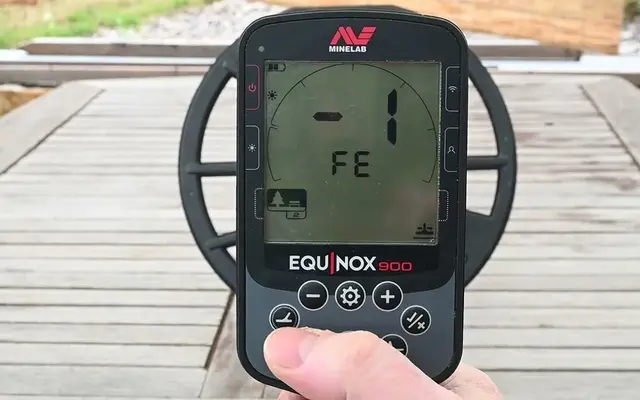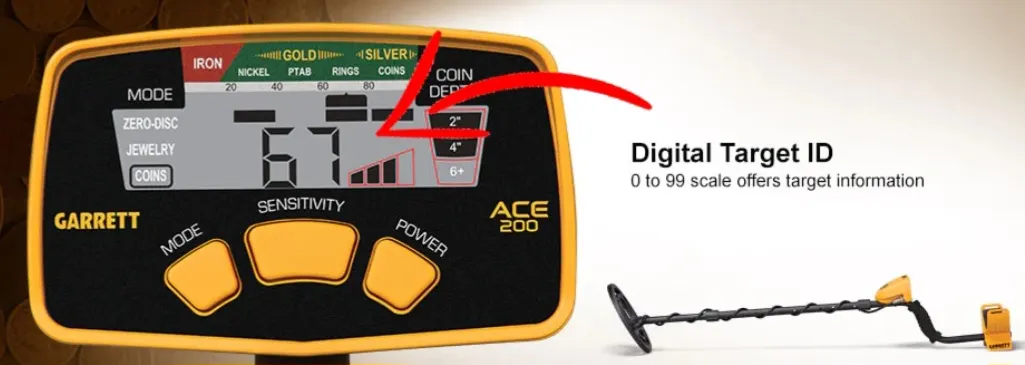
Anyone who gets into metal detecting quickly learns to watch the number that appears on the display when the coil passes over a signal. It is the Target ID, also called VDI (visual discrimination indicator). It should be read for what it is: an estimate of how conductive the buried object is, not an identification of the object. A guide published by Serious Detecting offers a good starting point for reviewing the basic principles.
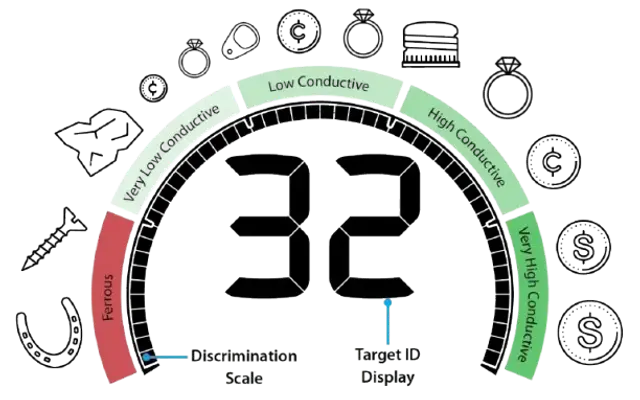
The mechanism is simple. The magnetic field emitted by the coil hits the metal, which responds with a small field of its own. The detector measures how far that return signal lags behind (the phase shift) and converts the delay into a number. The same value can therefore belong to very different objects, which is why the display can never tell you with certainty “this is gold.” It tells you where the object falls on a conductivity scale, and many other metals sit at that same point on the scale.
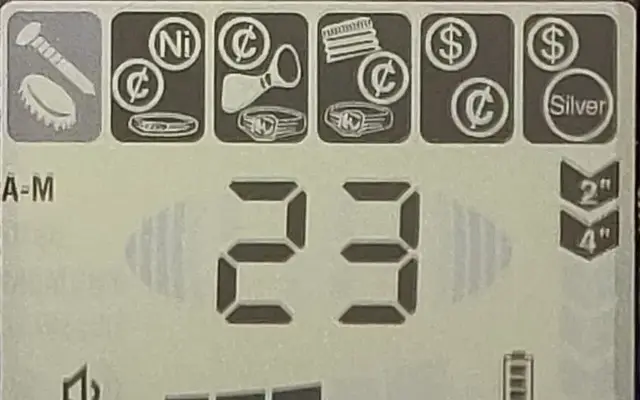
Each manufacturer designs its own scale, so a “25” on one machine does not mean the same as a “25” on another. Most brands use a scale from 0 to 99. Current Minelab machines run from -19 to 99, with iron in the negative range, while the old Minelab scale ran from -9 to 40. The order, however, is always the same: low numbers indicate iron, the middle range holds gold, nickel, foil and pull tabs, while copper and silver sit at the top. There are exceptions too: the Fisher Gold Bug 2 has no numeric Target ID and is audio only. The new Nokta Simplex Lite, BT and Ultra use a scale from 1 to 99 that does not match that of the Simplex+.
If your machine does not appear in the reference tables, the advice is to open the manual and find the scale and the factory-set iron discrimination limit. Knowing where iron ends is more useful than memorizing the value of a single coin. Without precise numbers, it is best to reason by order of rows: foil just above iron, nickel just above foil, zinc pennies below copper, silver at the top.
To give an idea of how values are distributed, the source reports some readings collected by Simplex Ultra owners in Coin mode, referring to US coins: nickel 48, zinc penny 68, clad dime 78, copper penny 90, clad quarter 91. Bottle caps sit around 68, in the same area as zinc pennies. These are typical values obtained in medium ground and at moderate depth, drawn from manufacturers' manuals and field tests. They should be used as a starting point and then corrected with your own machine in your own ground. Corroded zinc pennies, for example, read low on any detector.
Then there is the best-known problem for jewelry hunters: the overlap between gold and trash. The rows for gold and those for pull tabs almost completely coincide. No setting and no number separates a wedding ring from an old “beaver tail” pull tab, the kind with a ring and a tail. Jewelry hunters must therefore dig through a lot of junk, while those who discriminate out the middle range to avoid trash rarely find gold.
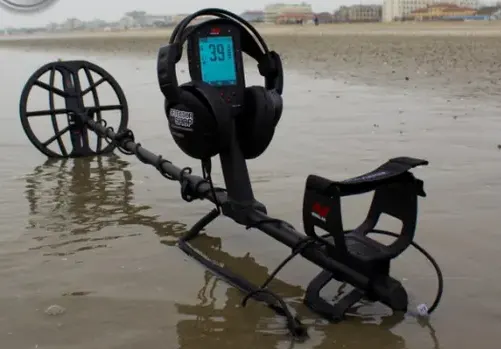
Many detectors divide the scale into audio zones: a low growl for iron, a medium tone in the center, and a high, clean tone for good conductors. The point where one tone gives way to another is called the tone break, and on most machines it can be moved. Experienced hunters listen to the tones first and look at the display only afterward. This is also why listening quality matters. The built-in speaker tends to blur weak, deep signals and brief iron blips, and wind or traffic masks the rest. With good headphones you can tell a clean high tone from a high tone with an iron “grunt” hidden underneath, and many digging decisions depend on that difference.
The stability of the number is information too. A value that wobbles between two nearby digits is normal. One that jumps half the scale is signaling something: the original guide lists the usual causes, including ground and depth problems, where multi-frequency detectors make the biggest difference by transmitting several frequencies at once. In the part of the article available to us, the discussion stops right here, so we will not go into details.
In practice, the Target ID is a good clue but not a verdict. The most sensible method is to learn your machine's scale, keep the iron limit in mind, calibrate your expectations to your own ground, and read number, tone and signal repeatability together before putting the spade into the soil. Those who dig only what the display judges “good” risk leaving in the ground precisely the finds hidden in the overlap zone.