Among detectorists, it is not unusual to meet someone who uses a pendulum instead of a search coil. The topic has returned to the spotlight thanks to an article from the French blog Le Fouilleur, which explains how to use it to locate buried objects. It is worth reading carefully, separating what the author describes from what can be considered proven.
The blog claims that locating buried objects with a pendulum would be possible, but it stresses that the practice has nothing magical about it. According to radiesthesia, the body would perceive radiation emitted by shapes and matter, and every object, from a water source to a gold coin, would have its own vibrational frequency. This is the thesis of practitioners, and it is right to present it as such: the article offers no measurements or independent evidence of these alleged emissions.
The more interesting part is the mechanism the source itself invokes: the ideomotor effect. According to this explanation, the brain receives the information being sought and sends a minimal impulse to the muscles. This produces micro-tremors, invisible to the naked eye, that travel down the arm to the fingers. The cord and weight of the pendulum amplify them and make them visible as swings. In other words, the pendulum would act as an amplifier for the unconscious movements of the person holding it. If so, the movement originates with the operator, not with the ground. The blog itself insists on mental neutrality for precisely this reason.
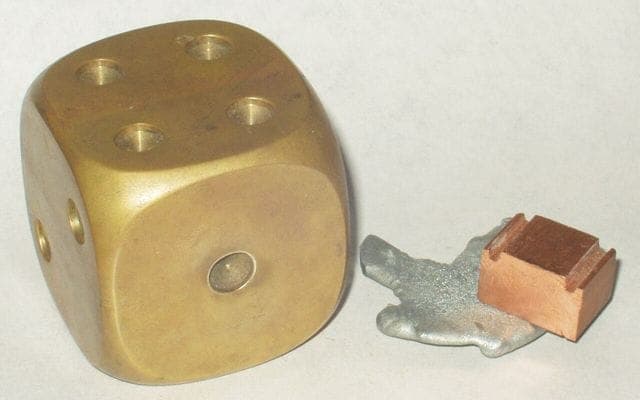
Anyone who wants to try, the article notes, must first choose the tool. Metal pendulums, usually brass or copper, are presented as the best performers for finding other metals. They would be energetically neutral, and therefore not very sensitive to residual emotional charges, with a quick and clear response suited to beginners. For outdoor use, the blog recommends a heavy model, because a lighter one is deflected by the wind and distorts the reading. Stone or wooden pendulums, by contrast, would more easily absorb the energy of the user and are intended for other uses, although the blog suggests that a wooden one may create a useful bond when searching for a family heirloom.
Some models have a screw-off cavity called a "witness chamber", where a sample of what is being sought is placed: a fragment of pure gold, if you are looking for gold. The stated purpose is to help the mind focus on that single target, isolating it from other vibrations. If the pendulum is hollow, the witness is held in the same hand as the cord. Once again, this is a psychological device: the sample serves to direct the attention of the operator, not to emit a signal detectable by an instrument.
According to the source, every session begins with a calibration phase. Before asking any question, a code must be established between conscious and subconscious mind: the pendulum is asked to show "yes", and one observes whether the motion is circular or linear, then the same is repeated for "no". The code is personal and may differ from one person to another, and even from one session to the next. This last detail is significant: a reference that changes at every session is not a repeatable measurement.
The blog identifies self-suggestion as the main trap for the radiesthesist. If you desperately want the treasure to be in a certain spot, your hand will produce the expected movement. The proposed solution is absolute mental emptiness: ask the question and wait for the answer like an external observer, without expectations. This is an important admission, because it shows how much the result depends on the state of the person holding the cord. For this reason, any indication obtained this way should be treated as a hypothesis to be verified, not as a confirmation.
On a practical level, the article also points out that success depends on field method: running at random across a field rarely leads to a find, and the approach must be structured to cover the area in an orderly way. The available text, however, breaks off at this point, so the subsequent guidance cannot be reported. The blog also refers to French legislation, which strictly regulates digging into the ground. In metal detecting the same principle applies in every country: before digging, it is advisable to find out the local rules, the permits required, and the obligations in case of a find.
For those who practice metal detecting, the lesson is twofold. On one hand, the discipline described (method, orderly coverage of the ground, control of one's own expectations) is useful with any tool. On the other, a detector with its discrimination and ground balance settings returns a real electromagnetic signal that can be checked and repeated, whereas the pendulum, by the source's own admission, merely amplifies the micro-movements of the person holding it. It may remain a curiosity or a concentration exercise, but to truly search underground, the detector and pinpointer remain the tools, always used in compliance with the law.