Most metal detectors are sold with a general-purpose coil, designed to perform adequately across a wide range of conditions. That does not mean it is the best choice for every type of ground. On a field full of iron, a smaller coil can completely change what you are able to hear; on acres of relatively clean pasture, a larger coil lets you cover more ground and, potentially, improves your chances of picking up deeper targets. The right question, then, is not which is the largest coil available, but which one is best suited to the ground you are working.
To understand why the choice matters, it helps to remember that the coil is the part of the detector that interacts with the soil. Inside it are windings that transmit an electromagnetic field and receive the response generated when that field meets a metal target. The detector processes the signal and turns it into audio, Target ID and other information. Replacing the coil, therefore, does not only change the physical footprint at the end of the shaft: it changes the way the system 'sees' the ground.
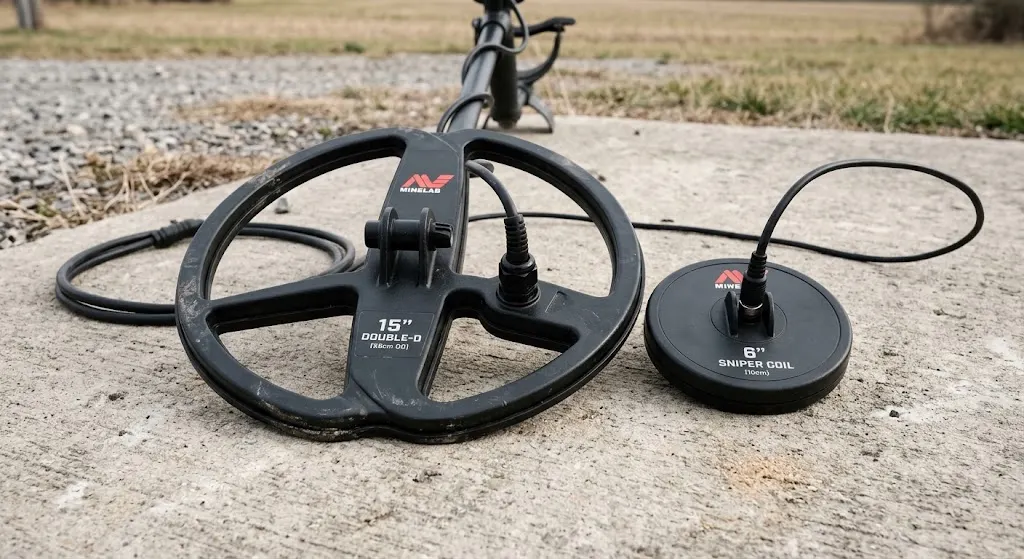
There is no official definition, valid across the entire industry, of a small, medium or large coil. Sizes should therefore be read as rough orders of magnitude, and they vary from model to model. Elliptical coils are often described with two measurements instead of one, such as 8 x 5.5 inches or 15 x 12 inches. Modern detectors generally offer accessory coils that cover much of this range. The Minelab MANTICORE platform, for example, includes the compact M8 at 8 x 5.5 inches, the M9 at 9 inches, the M11 at 11 inches, which is the standard size, and the larger M15 at 15 x 12 inches. Nokta takes a similar approach with the LEGEND 2, which offers several coils suited to different search styles.
Anyone used to sweeping an 11-inch coil may see the small one as a step backward. In certain conditions, however, the opposite is true. The main advantage of a smaller coil is its ability to investigate ground where several targets lie close together. Consider a small silver coin a few centimetres from an iron nail: with a large coil, both objects may fall within the active search area at the same time, and the strong response from the iron can interfere with the detector's ability to recognise the desirable target lying beside it.
A smaller coil scans a smaller portion of ground at any given moment, which makes it easier to isolate the non-ferrous target from the surrounding iron. It is also one of the reasons why, by switching to a smaller coil, you can sometimes recover finds in an area you thought had already been thoroughly searched: the problem may simply have been that the detector struggled to separate the useful signal from everything around it. It should be noted that closely spaced targets can also make Target IDs less stable or misleading, so the number displayed should be interpreted with caution in these situations.
Small coils can also perform very well on small targets, such as tiny hammered coins, minute fragments of non-ferrous metal and other weak signals that would otherwise be difficult to isolate. Be careful, however, not to draw overly firm conclusions: this does not mean that a small coil is automatically more sensitive to every tiny object than any larger coil. The detector's design, operating frequency, settings, ground conditions and the coil itself all matter. The important point is another one: a small coil often allows you to work with greater precision.
On a heavily used site or one rich in metal junk, being able to isolate a tiny target can be worth more than maximum absolute depth. This is where the fundamental trade-off becomes clear. A large coil offers coverage and, potentially, greater depth on clean ground; a small coil favours signal separation and precision where the soil is crowded. Neither is superior in every case, and the source itself advises against assuming that the bigger one is always the better one.
A further advantage of smaller coils is practical: they physically fit into spaces where a large coil cannot squeeze. If you use a Minelab and are unsure which accessory coils are compatible with your model, it is worth checking the manufacturer's compatibility charts before buying.
In short, the standard coil is a good starting point, but it should not be considered a final choice. Before heading out, it is worth asking what kind of ground you will be tackling: a lot of iron and closely spaced targets suggest a small coil, while wide and relatively clean areas may justify a large one. Having several sizes available lets you adapt the equipment to the site, rather than adapting the site to the equipment.