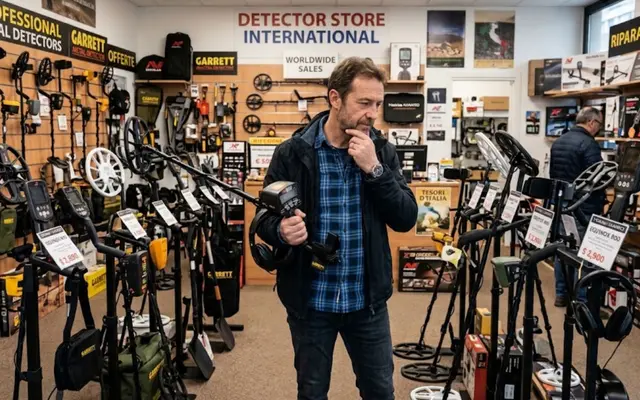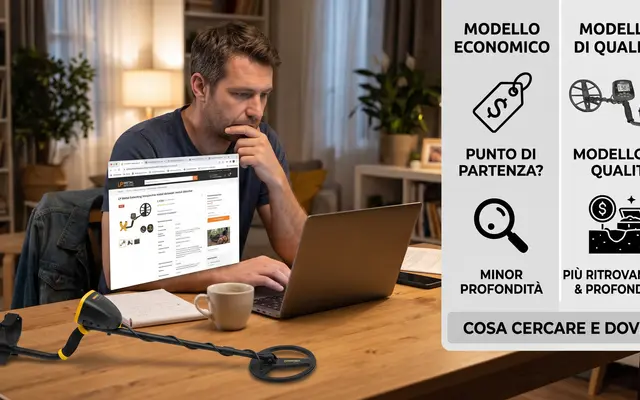
Anyone approaching metal detecting immediately faces a choice that affects everything else: which machine to buy. The American site Metal Detecting Life, run by detectorist Ace Covey, offers a beginner's guide on this topic. We summarize its essential points, keeping the facts separate from the author's personal opinions.
Covey says he has practiced the hobby for more than ten years. His first silver coin was a 1944 Mercury dime, found about five inches (roughly a dozen centimeters) deep in a park near his home. After that first strong signal, he recovered all kinds of finds: American Civil War relics, gold jewelry and hundreds of items from a World War II prisoner-of-war camp in Michigan. These are his own experiences, but they illustrate well the variety of what one can encounter, from coins to historical artifacts.
On the popularity of the sector, the article cites recent surveys according to which metal detecting grew by 35% in 2024, with many new enthusiasts. The figure is reported by the source and we have not verified it independently, so it should be taken as an indication of a trend.
According to Covey, the most common mistake is buying a very cheap detector at a general-purpose store. You don't need to spend huge sums, but adequate equipment improves results and satisfaction. For beginners, Covey recommends an entry-level model in the 200 to 400 dollar range. He cites as examples the Garrett Ace series, the Minelab Vanquish and the Nokta Makro Simplex+, machines that offer good performance without overwhelming newcomers with complicated settings. His first “serious” detector was a White's M6, which in his view covered all the features one could want in a machine.
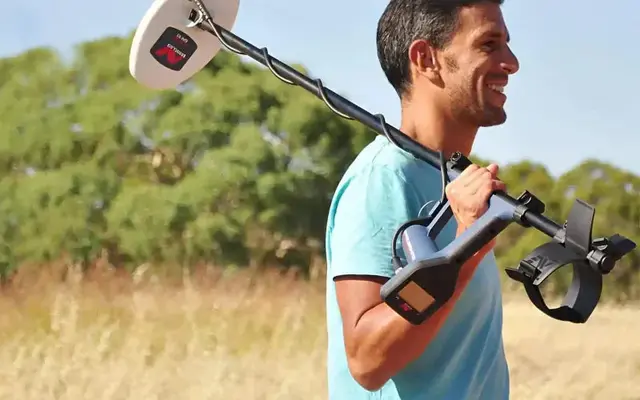
The second step is understanding the technology, and here the guide distinguishes three families. VLF (Very Low Frequency) detectors are the most suitable for starting out: versatile, relatively inexpensive and effective in most environments. They are Covey's recommendation for almost all new detectorists.
PI (Pulse Induction) detectors are specialized machines that perform best on beaches and in gold prospecting. They cost more and, Covey warns, are not the ideal choice for everyday use, especially at sites full of metal junk, because they discriminate poorly. As a result, they signal many unwanted objects and force you to dig more.
Multi-frequency machines operate on several frequencies at the same time. They offer superior performance, but at a higher price. Covey says he switched to a multi-frequency, the Minelab CTX 3030, only after thirteen years of detecting. This is useful information for anyone worried about making the wrong purchase: you can learn a great deal with an affordable VLF, postponing an upgrade until you truly know your needs.
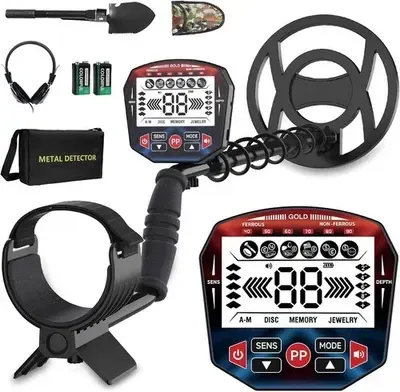
Beyond the detector, a few accessories are needed. The first is the pinpointer, a small handheld device that helps locate the object precisely inside the hole. Covey uses a Garrett Pro-Pointer and says it has saved him a great deal of time. Next comes the digging tool: a good shovel or a sturdy trowel is needed, and he recommends a stainless steel digger with a serrated edge, such as the Lesche.
Then there is the finds pouch, useful for storing what you recover. Covey uses one with multiple pockets to keep different types of objects separate. Headphones are essential for catching the weakest signals, and he prefers wireless ones so he can move around without hassle. Finally, gloves: after cutting a hand on broken glass years ago, he never searches without them.
To sum up the suggested path: start with an entry-level VLF, add a pinpointer, digging tool, headphones and gloves, and leave the more specialized machines for later. A PI makes sense for beaches and gold, while a multi-frequency suits those who already have experience and want superior performance.
A note of transparency: the original guide contains Amazon affiliate links, and the models cited are the author's personal choices, not comparative tests. Before buying, it is advisable to compare several reviews, check prices in your own market and, when possible, try the machine or ask advice from experienced detectorists in your area.
The source text, in the part available to us, ends with the section on equipment and maintenance, so it contains no information here on regulations, permits or search techniques. Beginners should look up the rules in force in their own country separately before going out with a detector.