Metal Detecting for Beginners: How to Choose Your First Detector
Budget, search modes and permits: what to consider before buying your first machine and what to expect from your first signals.
November 9, 2026
ShareLink copied!
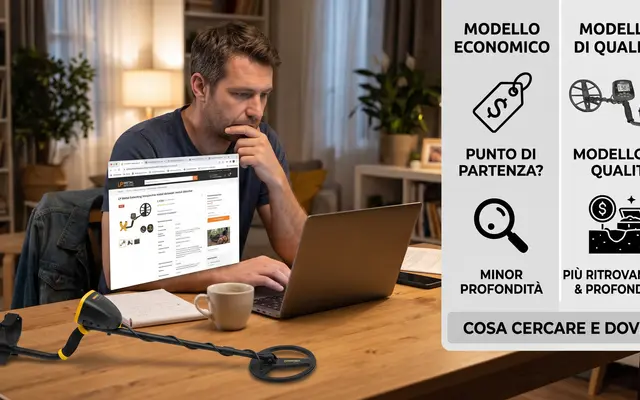
Anyone approaching metal detecting almost always asks the same question: how much should I spend? According to British retailer LP Metal Detecting, which we draw on for some of the data, entry-level models have improved a great deal. You don't need the most expensive detector on the market or years of experience behind you: what matters is choosing a machine suited to your budget, the terrain where you intend to search and the level of adjustment you feel comfortable with.
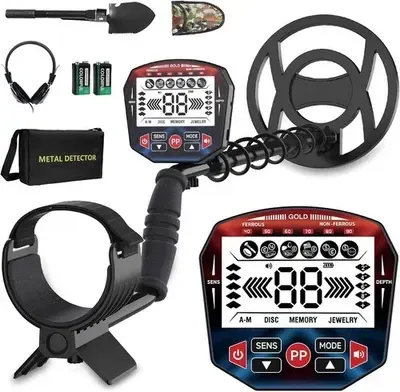
Many entry-level devices now offer features that were once reserved for higher price brackets: waterproof construction, rechargeable batteries, digital target identification (the so-called target ID) and preset search programs. The latter are the real help for beginners, because they allow you to focus on learning to read signals instead of getting lost among menus and settings.
Search programs, or modes, adapt the machine to the terrain. The most common labels are Field, Park, Beach and All Metal. The last one drops discrimination and responds to all metals, and is useful for those who want to better understand what lies hidden in the ground. Some models also add a dedicated jewellery mode. Before buying, it is worth checking that the machine offers programs suited to the places where you will search most often.
LP Metal Detecting cites three models as starting points. The Nokta FINDX Pro is described as a machine designed for simplicity, with straightforward controls and automatic search. It offers Field, Park, Beach and Jewellery modes, adjustable sensitivity, a display with target identification and an integrated pinpoint function, that is, the precise location of the point where the object is.
The second is the Nokta Simplex Lite, described as lightweight and waterproof to five metres. It has Park, Field, Beach and All Metal modes, a display with clear target ID and a rechargeable battery. According to the retailer, it suits those who want a simple setup without immediately feeling the need to change machine.
The third is the Minelab Vanquish 360, which stands out for its Multi-IQ technology, based on the simultaneous use of multiple frequencies. Put simply, the detector responds to a wide range of metal targets in different conditions without the user having to manually choose the working frequency. It offers Park, Beach and All Metal modes, a rechargeable battery and a light weight. It should be noted that these assessments come from a retailer and therefore also have a commercial nature: trying the machines or comparing several opinions remains good practice.
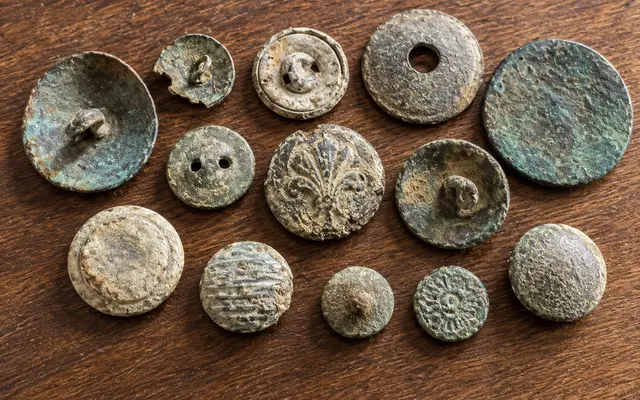
The value of metal detecting, however, does not lie only in the equipment. The source recalls that Britain has thousands of years of history, from the Roman occupation to Saxon settlements, and from medieval communities to more recent generations. In every era, objects have been lost, discarded or buried, and some are still there. With patience you can find buttons, buckles, coins, tokens and other artefacts. The same holds true for Italy, with the difference that the regulatory framework there is much more restrictive: before setting out, you need to inform yourself about local and national rules on searching for and finding items of historical interest.
The source also underlines a point every beginner must bear in mind: not every signal leads to a find. You will come across many nails, pieces of aluminium and other metal waste. This is a normal part of the activity, and each signal remains a small mystery until you dig. This phase teaches you to interpret target ID, to use the pinpointer and to train your ear, skills that grow with practice.
Finally, there is the simplest aspect: metal detecting gets you outdoors, encourages you to explore new places and gives you a reason to delve into the history of your own area. To get started, then, all you need is a simple machine suited to your budget and the willingness to learn patiently. As for permits, before every outing the advice is always to obtain the permission of whoever manages the land and to comply with current legislation.
ADV
The AI assistant for metal detecting
Custom programs, restricted-area checks, ground recognition and much more.Try it free →Get the app