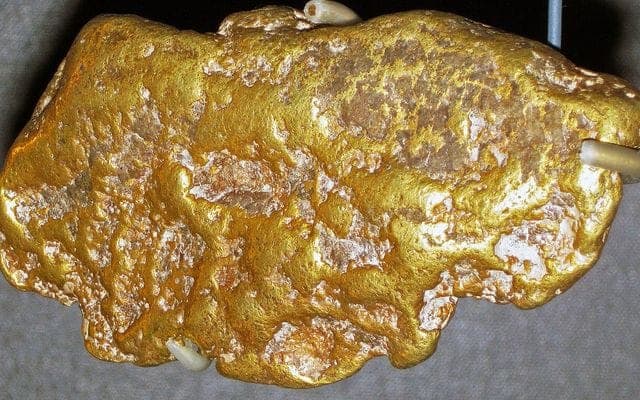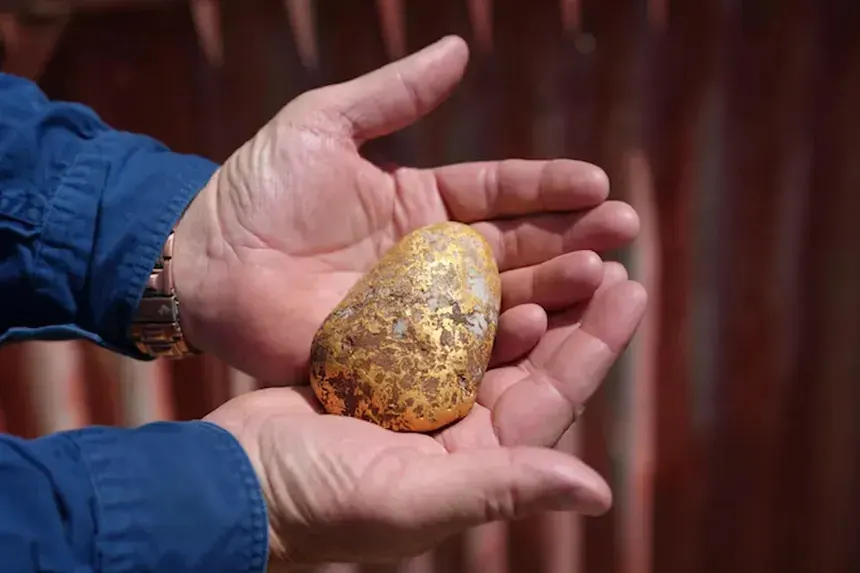
In October 2026, a Broken Hill prospector who asked to remain anonymous dug up a 1,218 g (about 2.7 lb) gold nugget at Mount Stuart station, near Tibooburra, in the northwestern corner of New South Wales. The story was reported by Australian broadcaster ABC News. The nugget, already nicknamed the "Tibooburra Spud", is speckled with quartz. Tests indicate about 940 g of gold, just over 30 troy ounces, worth AUD 150,000-160,000 on the gold content alone, a figure that could rise if sold to a collector.
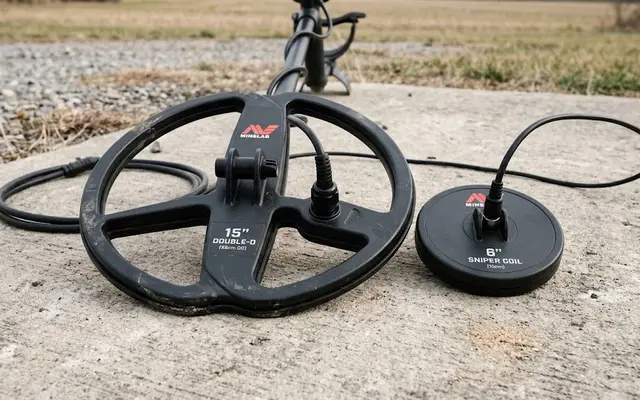
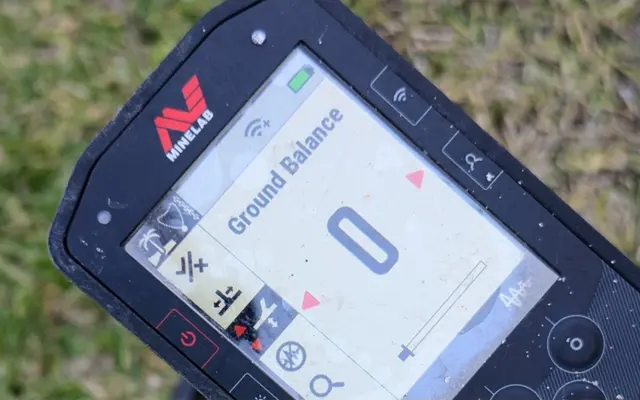
The most instructive detail, however, concerns the signal. The prospector was using a Minelab GPZ 8000 and, according to his account, the target did not sound like a large piece. It was near the end of the day. At about 100 mm depth the machine "screamed" and, at the first or second shovel scoop, a bright yellow speck appeared in the center of the hole. The source does not explain why the signal was weak, so what follows is a general overview of the reasons a large gold piece can sound smaller than it is.
The first factor is distance. The coil sends a magnetic field into the ground and listens to what the target sends back. Both paths weaken with distance, and the response falls off much faster than the distance increases. Near the limit of what the detector can hear, a few centimeters can separate a clear target from something barely distinguishable. This is also why a faint signal can become decisive after a few layers of soil are removed: each scoop shortens the field's path.
The second factor is composition. The detector responds to metal, not to the rock around it. Gold dispersed in quartz, in veins or in flecks can give a weaker response than a compact nugget of the same weight, because the metal is not one continuous piece. Gold is also very heavy: a sample can be mostly quartz by volume and mostly gold by weight, feeling in the hand larger than the signal suggests. The Tibooburra Spud is about 77% gold by weight and is visibly speckled with quartz, but the source does not say whether the quartz played a role in the weak signal.
The third factor is the shape of the response. A small piece of surface gold usually gives a quick, sharp sound. A large, deep target, or one only partly coupled with the coil, instead produces a slow, broad response: the threshold swells as the coil approaches, peaks over a wide area, and then fades. In mineralized ground this behavior closely resembles that of the soil itself when crossing a "hotter" zone, a clay vein or a dip. That is why many signals of this kind end up dismissed as noise or false positives.
Evan K, author of the Serious Detecting article from which the story draws, describes his experience this way: a large, deep target often gives no strong, obvious response at all, but a faint, prolonged swelling that is easy to miss at normal sweep speed. What matters, in his view, is that the signal repeats. If it returns after rechecking the ground balance and the coil position, dig it rather than writing it off as ground noise. The same author warns, however, that hot rocks and buried iron can sound very similar, so not every soft, repeatable signal is gold.
Soil also plays a role. Ironstone-rich soils, like those of many Australian fields and of the western United States cited by the source, produce more background noise, and it is that noise that buries a faint signal. The GPZ 8000 offers four ground settings for different conditions, and according to the source, choosing the one that keeps the threshold stable matters more than pushing sensitivity to the maximum: an unstable threshold turns every weak target into a gamble.
In practice, the Tibooburra story suggests a simple method. When a soft, broad signal appears in mineralized ground, it is worth checking whether it repeats, verifying the ground balance and coil position and, if the response persists, opening the hole. A few centimeters of digging can be enough to change the response and, as in this case, reveal that there was far more under the coil than the sound suggested.