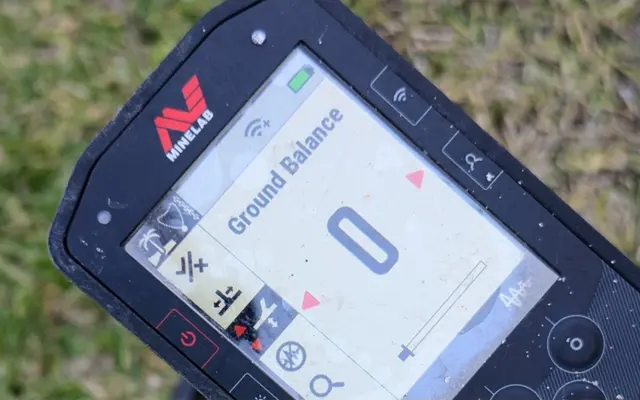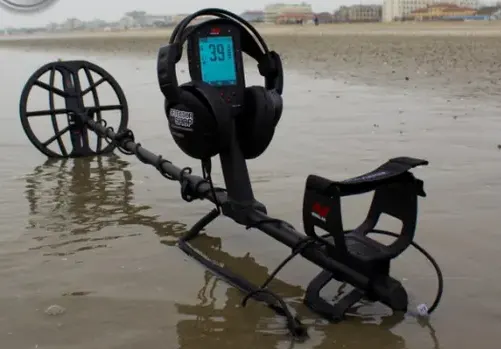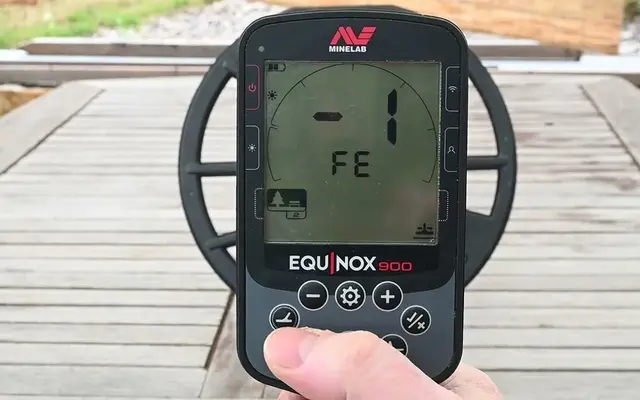
Among the settings on a metal detector, ground balance is one of the most important and least understood. Many detectorists spend hours tweaking sensitivity, discrimination and recovery speed, while completely neglecting ground balance. Yet understanding what it does, when to intervene and how the different systems work can noticeably improve the machine's performance. The result is finding more targets and reducing false signals, which are among the most frustrating things in the field.
In short, ground balance is the adjustment that makes the detector ignore the minerals naturally present in the soil. Ground is rarely neutral: it contains variable amounts of ferrous minerals, salts and other conductive materials. If the machine is not balanced, it can mistake these minerals for metal targets. The consequences are unstable operation, false signals and reduced depth. An effective way to think about it is this: balancing means teaching the machine how the ground sounds, so that it can focus on genuine metal objects.
The harder the ground, the more important balancing becomes. Many farmland fields contain natural iron oxides, and areas with red or orange soils can be heavily mineralized. There are also so-called hot rocks, stones with a higher level of mineralization than the surrounding soil, which can give responses similar to a metal target. Salt and wet sand create another challenge: salt is conductive and, if not compensated for, makes the machine unstable. Finally, areas with ash, charcoal, clinker or remains of old fires often produce complicated search conditions.
Modern detectors usually offer several balancing methods. The first is fixed ground balance, set at the factory by the manufacturer. It is usually found on entry-level machines and on some specialist models, including many devices designed for beginners and general-purpose searching.
The second is manual balancing, in which the user adjusts the value. Typically, you raise and lower the coil over a stretch of clean ground, increasing or decreasing the value until the machine stabilizes. Experienced users often prefer it because it allows fine-tuning to the specific conditions of the site.
The third is ground grab, or automatic balancing: the detector analyzes the ground and chooses the most suitable setting on its own. According to the source, it is the option preferred by most detectorists, because it offers a good balance between performance and practicality. The fourth is tracking, which continuously monitors the soil and corrects the balance while searching. It is a feature found on many gold prospecting detectors and on advanced multi-frequency machines.
Procedures vary from manufacturer to manufacturer, but the principle is the same. First, check by passing the detector over the area that there are no buried targets at the chosen spot; otherwise you balance on the metal rather than the ground. Then move the coil up and down, roughly between 2 and 20 centimeters from the ground. If the balance is correct, the machine should become quieter and more stable as the coil gets closer to the ground.
When should you repeat the procedure? It is good practice to balance every time you arrive at a new site. Moisture can change how the soil behaves and require adjustments. The most obvious case is the beach: moving from dry sand to wet sand up to the waterline, conditions can change dramatically. Conversely, the source warns that many detectorists correct too often: if the machine is working smoothly, there is often no reason to rebalance it.
A frequent question remains: is ground balance still needed on the most modern machines? Many simultaneous multi-frequency detectors handle mineralization very well, and models such as the latest XP, Nokta and Minelab perform excellently even with minimal adjustments. Ground balance nonetheless retains an important role, especially in the most challenging situations, and even the most advanced machine, when well balanced, generally works better.
In practice, the starting point for a detectorist is to recognize the type of ground in front of them and choose the most suitable method accordingly: fixed, manual, ground grab or tracking. If the machine becomes noisy or unstable, the soil is the first suspect. The source text breaks off right at this point, and the complete operational instructions remain those in your detector's manual.