For years, beginners to metal detecting were given a simple rule: balance the ground before you search. With single-frequency VLF detectors, this made sense. Soil mineralization could generate false signals, reduce depth and distort target identification. Those who had been searching for a while rarely started without first adjusting the ground balance.
Today the picture has changed. Simultaneous multi-frequency machines such as the Minelab Manticore, the Minelab Equinox series, the XP Deus II and the Nokta Legend do not read the target on a single frequency. They assess the response across several frequencies at the same instant, which gives the electronics far more information about both the object and the ground. Signal processing can thus handle most situations on its own. The Manticore, based on Multi-IQ+ technology, is one of the most advanced examples of this approach.
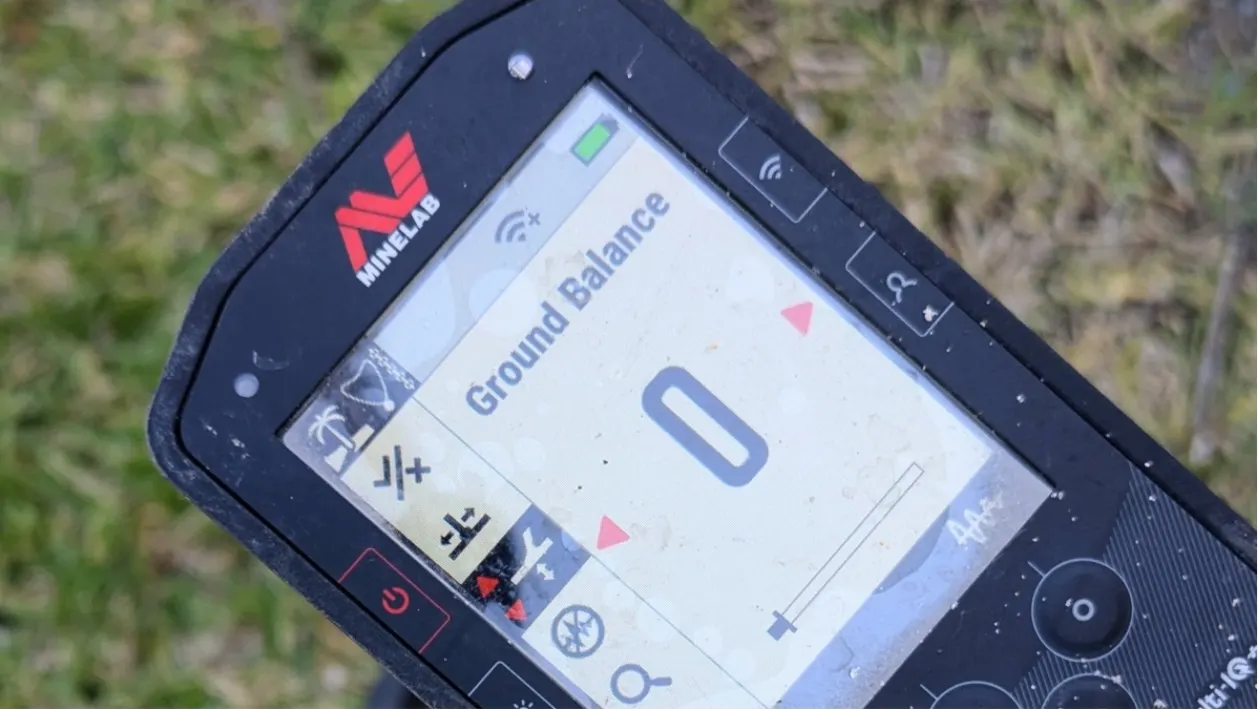
Among Manticore users circulates a piece of advice attributed to Minelab technicians: keep Ground Balance at zero whenever site conditions allow. For those who grew up with the idea of mandatory balancing, it sounds almost heretical, and the author of the source admits he thought that way too. It should be noted, however, that these are reported comments, not an official position documented in the article.
The logic, in any case, is straightforward. If the detector already handles the ground well internally, why intervene? In parks, school playgrounds, residential lots, cultivated fields and historic find sites in the United States, many experienced users report simply performing a noise cancellation (Noise Cancel) and starting the search right away. Some also argue that unnecessary balancing can reduce sensitivity to very weak non-ferrous targets. This thesis is still debated, but not without foundation. Every filter and every compensation system involves trade-offs, and if the ground response is already minimal, compensating for it further may provide no measurable advantage.
This does not mean ground balance has become useless. The physics has not changed. Highly mineralized soils, black sand beaches, saltwater environments, volcanic soils, magnetite-rich ground and gold fields remain situations where good balancing can make a difference. Minelab itself confirms this: on the Manticore, the specific Goldfield and Beach Surf & Seawater modes use Tracking Ground Balance by default, that is, balancing that follows changes in the soil. For the manufacturer, then, active ground management still has a precise role in certain contexts.
How do you tell whether it is really needed? The check is quick. Choose a clean spot with no metal targets, leave Ground Balance at zero, and do the classic pumping motion with the coil over the ground, lowering and raising it calmly. If you hear little or nothing, there is probably no reason to waste time adjusting. If instead the ground responds strongly, balancing can improve stability and performance. In many cases, as the source notes, the ground itself tells you what it needs.
Another aspect that receives little attention is the risk of over-balancing. Many detectorists assume that more adjustments automatically lead to better performance, but that is not necessarily the case. The available text breaks off just at the start of this line of reasoning, so we cannot report its conclusions. The underlying idea, however, is consistent with what has been said so far: every correction applied to an already clean signal can take something away rather than add anything.
In practice, for Manticore owners, the operational advice that emerges is a gradual approach. Start from zero, run Noise Cancel, test the ground response on an area free of metal, and adjust the balance only if needed. In the difficult conditions listed above, and in the modes designed for gold and beach, active ground management remains a tool to be used with confidence.
It is worth stressing that these are indications based on the experience of many users and on reported statements, not an absolute rule. Every site has its own soil and every searcher has their own habits. Testing methodically, comparing the ground response with and without adjustment, remains the best way to understand what works on your own machine and in your own grounds.