Ask ten detectorists how deep their machine goes and you'll get ten different answers, often all plausible. The reason is simple: detection depth is not a fixed value printed in the manual, but the result of four elements interacting. They are the detector's technology, the search coil fitted, the ground and the target itself. Understanding how these factors combine helps you choose equipment better and read manufacturers' figures with a critical eye.
To get oriented, according to the guide published by Serious Detecting (a US retailer, and therefore a source with commercial interests), most hobby detectors, with the standard coil, pick up an object the size of a coin between roughly 15 and 30 centimeters in average soil. Larger objects go deeper. A relic, a jar lid or a target such as a cannonball can be detected at 30 to 50 centimeters and beyond. Models designed for deep searching can locate large deposits and metal masses several meters down, or in any case beyond one meter. These are orders of magnitude, not promises: a difficult ground or an unfavorable target is enough to shift them in one direction or the other.
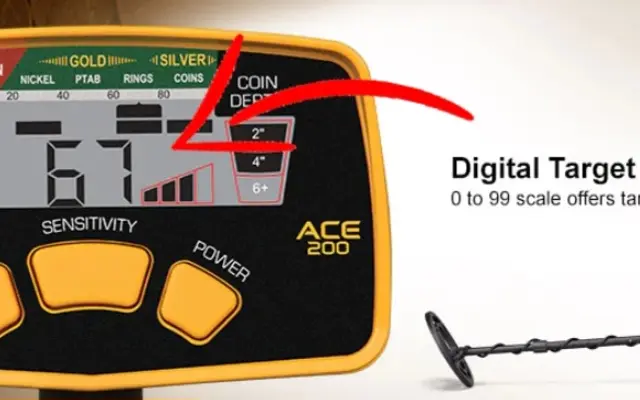
The first factor is circuit technology, which sets the maximum achievable limit. VLF (very low frequency) single-frequency detectors are the workhorses of the sector: inexpensive, lightweight and good at separating useful metal from junk. Models such as the Garrett AT Max or Fisher F75 offer, according to the source, a depth on coins of about 15-25 centimeters in most soils. Their limit is highly mineralized ground, which absorbs part of the signal and can significantly reduce depth.
Multi-frequency detectors transmit several frequencies together and process the returns in a combined way. This makes it possible to maintain depth and target identification stability in mineralized ground and on wet, salty sand, where single-frequency machines struggle. For coins and relics, the source cites as reference points the Minelab Manticore, Minelab Equinox 900, XP Deus II and Nokta Legend 2. Among budget options it names the Minelab X-Terra Pro and Garrett ACE Apex.
Pulse induction (PI) detectors largely ignore soil mineralization, which is why they are the most effective in iron-rich goldfields and on black-sand beaches. The Garrett Axiom and Minelab GPX 6000 outperform a VLF in bad ground, while the Minelab GPZ 7000 pushes depth further on gold nuggets. The trade-off is limited discrimination: a PI signals everything, iron included, and therefore increases the digging workload. There is also a more recent category of SMF + PI hybrids, which aims to combine depth and identification in a single machine.
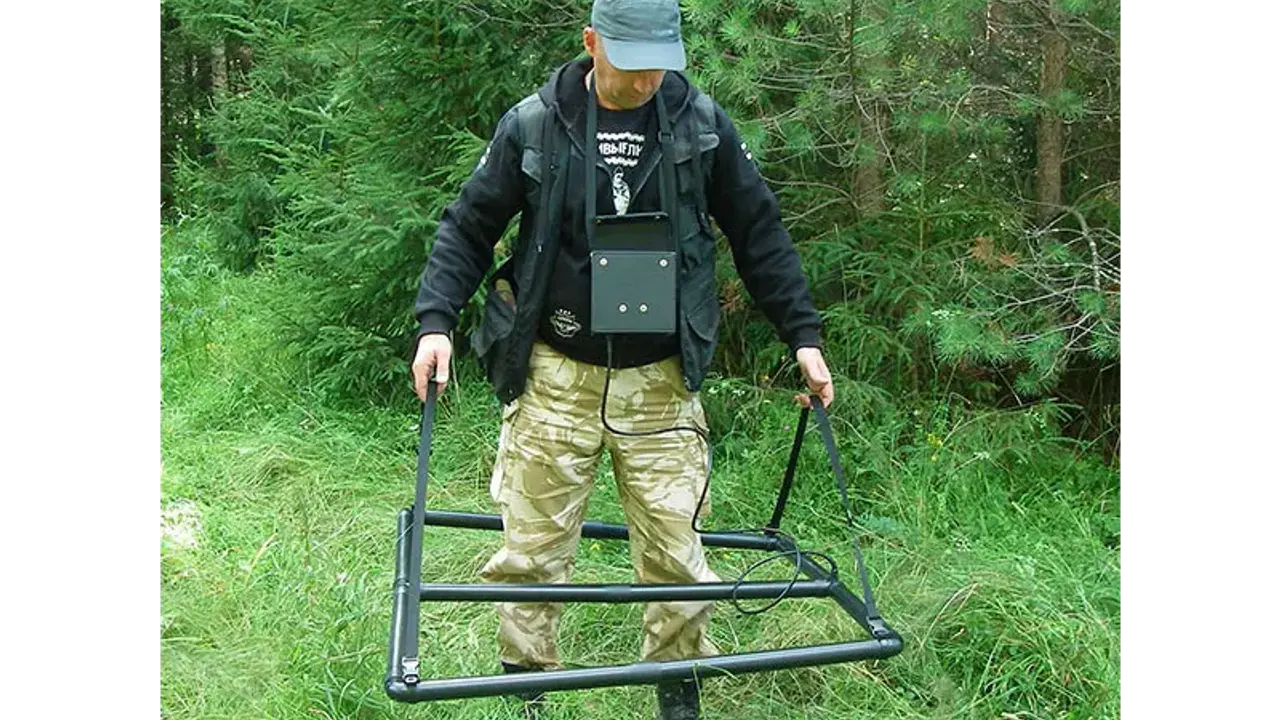
For deposits, hidden treasure and large deep finds, there are long-range detectors such as the Nokta Deephunter. They give up sensitivity on small objects in exchange for the ability to find large metal at 90-180 centimeters and beyond. At the specialist extreme are OKM devices and the Groundtech 3D ground scanners, capable of displaying large deep anomalies well beyond the reach of a traditional coil.
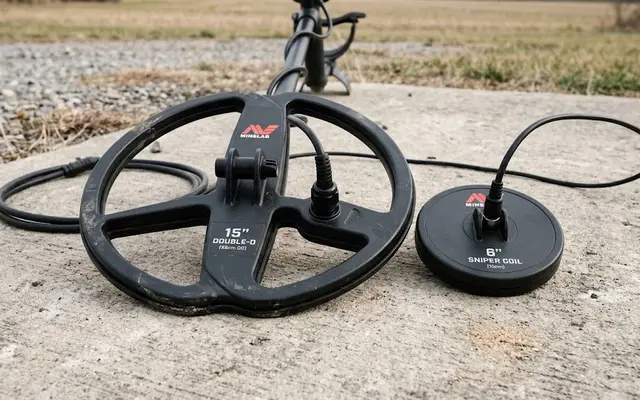
The second factor, and the easiest to change, is the search coil. As a rule of thumb, a coil detects a coin-sized target at a depth roughly equal to its diameter, and larger objects a little deeper. Shape matters too: DD coils handle mineralized ground better than concentric ones, which is why most modern machines come with them as standard. In practice, before thinking about changing detector, it may be worth evaluating a different coil for the equipment you already own.
Finally, there is the operating frequency. Low frequencies, between 3 and 7 kHz, penetrate more and favor highly conductive targets such as silver and copper. High frequencies, from 18 kHz up, perform best on small, poorly conductive objects, such as tiny gold nuggets and thin jewelry, but give up some depth. This explains why gold machines work at high frequency and coin machines at lower ones. It also explains the success of simultaneous multi-frequency detectors, which cover both extremes.
The advice that follows is to be wary of absolute numbers. Useful depth depends on what you are looking for and where: a coin in a mineralized field, a relic in a forest and a deposit under a meadow are different problems, requiring different equipment and coils. Knowing your machine, the type of soil and the most likely target remains the most reliable way to make the most of what you already have.