Metal detecting has always been a balance between experience, intuition and evolving technology. From the first “beep and dig” devices to modern multi-frequency machines, each generation has improved the way we interpret what lies beneath the surface. An article published by the website Focus Speed looks ahead to what it calls a possible “quantum era” of searching. Before talking about the future, however, it is worth understanding what happens today under the plate.
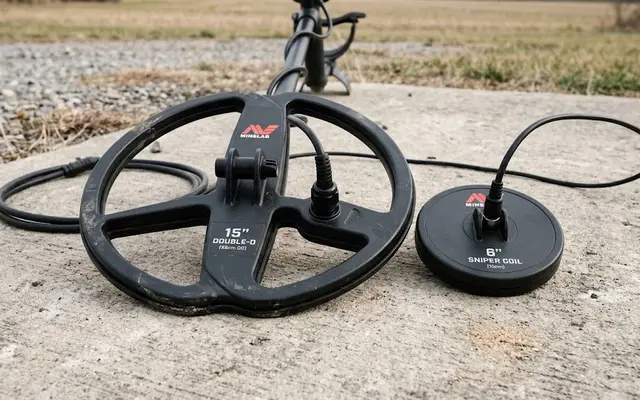
The starting point is the Double-D (DD) coil, made up of two separate windings shaped like overlapping “D”s: a transmit (TX) winding and a receive (RX) winding. According to Focus Speed, the two windings are not electrically connected. The TX coil generates an electromagnetic field that penetrates the ground and also extends above it, while the RX listens for any disturbance in that field. Where the two windings overlap lies the zone of maximum response, described as a sort of blade or narrow detection strip.
The key idea is that TX and RX become functionally linked only when a conductive object enters the field. The transmitted field induces eddy currents in the target and, to a degree, in the salts present in the surrounding ground, which explain the so-called aura effect. These currents produce a secondary field that the RX coil picks up: in practice, the metal acts as a bridge between transmission and reception. Without targets only ground noise remains; in their presence, energy passes from TX to the object and then to RX.
As the target crosses the “blade”, the signal changes in intensity, phase and character. The author recalls some basic correspondences: phase lag reflects conductivity, amplitude depends on the object’s size, depth and orientation, and eddy currents build up and decay at different rates depending on the metal.
Iron complicates the picture. Because it can both conduct and retain magnetic energy, it produces unstable and often misleading responses. For this reason, notes Focus Speed, seekers are well acquainted with false iron signals, especially at the edges of the detection zone, where the geometry of the field becomes more complex. A practical reminder: an uncertain signal at the edges of the plate should be rechecked by passing over the target from several directions before trusting the number displayed.
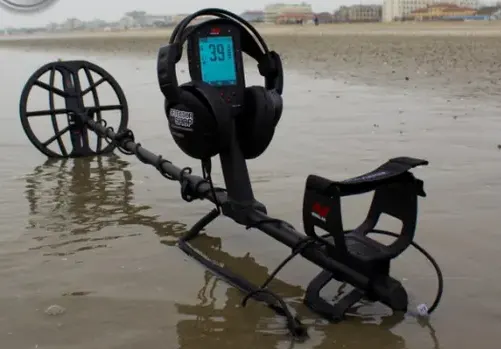
All this behavior, in today’s detectors, is condensed into VDI numbers, tones and, on some models, track-style displays. According to the article, these are simplified interpretations of a much richer signal environment, and this is precisely where quantum computing comes into play. Quantum computers, the author explains, use qubits to process many possibilities at once; in a very simplified comparison, he likens them to a thousand of today’s supercomputers working together on the same problem.
Beware of one misunderstanding, however: Focus Speed specifies that these systems will not end up in portable detectors any time soon. Their role will be different, namely to simulate electromagnetic interactions with a level of detail that is impossible today. Engineers could thus model the response of different metals with far greater precision as depth, soil type, orientation and proximity to other objects vary, across thousands of scenarios. This data would feed artificial intelligence systems capable of interpreting signals differently than in the past and, downstream, would reach the operating-system chips of future detectors, for more robust target identification. The text available to us breaks off at this point, so we do not know any further developments or concrete examples from the author.
It should be stressed that this is a forward-looking vision, expressed by Focus Speed with phrases such as “I believe” and without dates or announced products: the sources contain no commercial model adopting this approach. The article’s main value lies in reminding readers that discrimination is an estimate derived from a complex signal, not a direct measurement of what is in the ground.
For those searching in the field, the immediate lesson remains practical. Understanding that the target closes the circuit between TX and RX helps you read the response better as the plate moves, distrust the edges of the sensitive zone, and avoid attributing more certainty to the VDI than it can provide. If the future brings more accurate models and refined algorithms, the physical basis will remain the same. Knowing it today is the best way to interpret tomorrow’s technologies, too.
Finally, the Focus Speed article also contains a piece of common-sense advice that jewelry finds deserve: keep a precious-metal test kit in your finds bag, so you can check rings and chains and tell gold, silver, plated items or plain costume jewelry apart before deciding whether to keep, sell or display them.