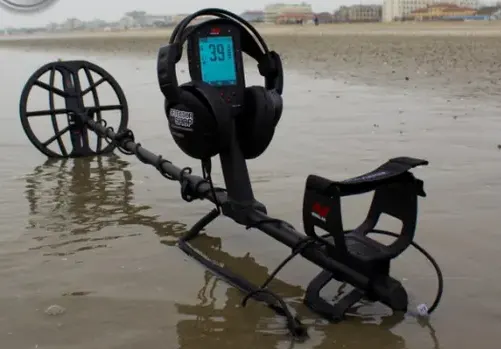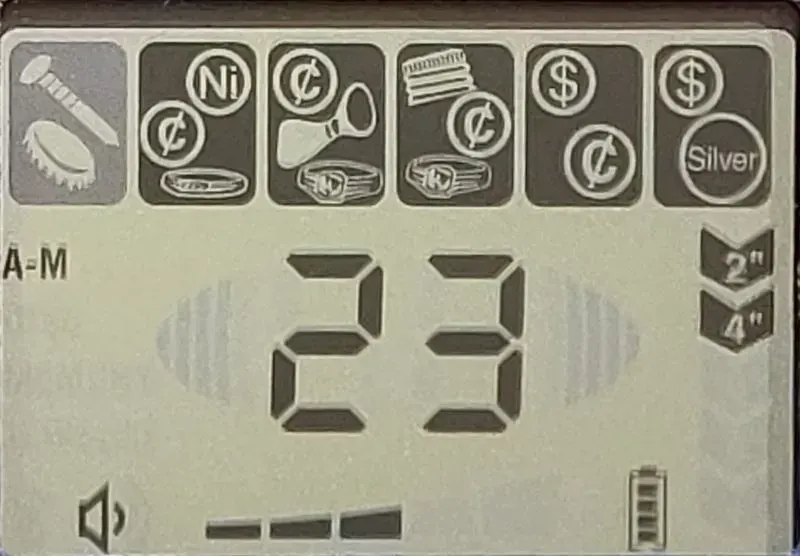
Anyone who starts metal detecting quickly notices the number that appears on the display when the search coil passes over a target. Sometimes it is low, sometimes much higher, and in some cases it seems to jump between several values. That number is called the Target ID, or sometimes VDI (Visual Discrimination Indicator), and it is one of the most useful and most misunderstood functions of a detector.
The starting point is a simple distinction: the Target ID indicates how the detector is interpreting the signal, not a guaranteed identification of the object. Understanding this changes how you approach a search, because it turns the number from a verdict into a clue.
To see why, it helps to recall how the machine works. The detector transmits an electromagnetic field into the ground through the search coil. When the field meets a conductive object, currents are induced within it, and the target in turn generates an electromagnetic response that the coil picks up. The detector analyzes the characteristics of this response and translates them into a numerical value. The result gives the searcher one more piece of information to help distinguish between different types of target.
Conductivity plays an important role, but it is not the only factor: size, shape and orientation of the object also affect the response. For this reason, the Target ID should never be read as a direct measurement of the type of metal buried. A small object and a large one of the same metal, or the same object lying in a different position, can return different numbers.
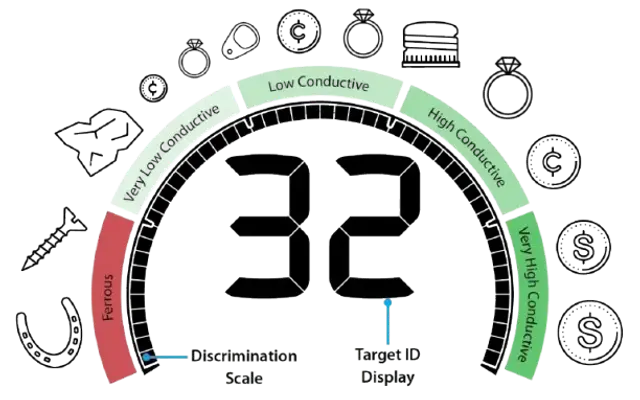
A second misconception concerns the scale. In general, detectors spread responses across a numerical scale, with ferrous targets in one portion and non-ferrous ones separated according to the response detected. But there is no universal scale: the same number on two different machines does not necessarily mean the same thing. Even within the same brand, scales can change. A concrete example cited by the source is Nokta: the original LEGEND uses a 60-point system, while the more recent LEGEND 2 adopts a 99-point scale. The principle is similar, but the values are not interchangeable.
There are also differences in approach between manufacturers. Some machines use relatively compact numerical ranges, while others divide responses across much wider scales. Certain detectors also offer information beyond a single number: the Minelab MANTICORE, for example, uses a two-dimensional identification map that places the target's response by cross-referencing conductivity and ferrous data, rather than relying on a single value. XP, Nokta, Garrett and Minelab each also have their own philosophy, both in identification and in audio response.
The practical consequence is that a Target ID chart found online should be considered only a rough guide, and it is truly useful only if it refers to the model you have in hand. A chart designed for another machine may be largely meaningless for your own.
The most important limitation, however, concerns reliability: the Target ID provides useful information, but it cannot tell you with certainty what an object is before you dig. Two completely different targets can produce similar responses. Some pieces of aluminium, for example, can fall into Target ID ranges close to those of desirable non-ferrous targets. Small gold objects, for their part, can give medium-low responses in terms of conductivity and overlap with foil, can pull tabs and other everyday waste.
That is why memorizing a list of good numbers and bad numbers is a risky shortcut: it easily leads you to ignore precisely the targets you were hoping to find. The number should be used as one of several elements of evaluation, together with the audio signal and your knowledge of your own detector, not as a filter that decides what is worth recovering.
That leaves the question many beginners ask: why does the Target ID appear stable when you pass over a target from one direction and start to shift when you approach it from another? The source explains that, as the target gets deeper, the signal received by the detector tends to weaken. With less information available, identification becomes less reliable. An unstable number, therefore, does not necessarily indicate a problem with the machine: it is often the consequence of a weak signal or of an object with an unfavorable shape and orientation.
In short, the Target ID is a valuable tool if you read it for what it is: an estimate based on the electromagnetic response, which depends on the scale of the individual model and loses precision with depth. Learning how your machine responds, rather than relying on generic charts, is the most concrete way to turn those numbers into genuinely useful information in the field.