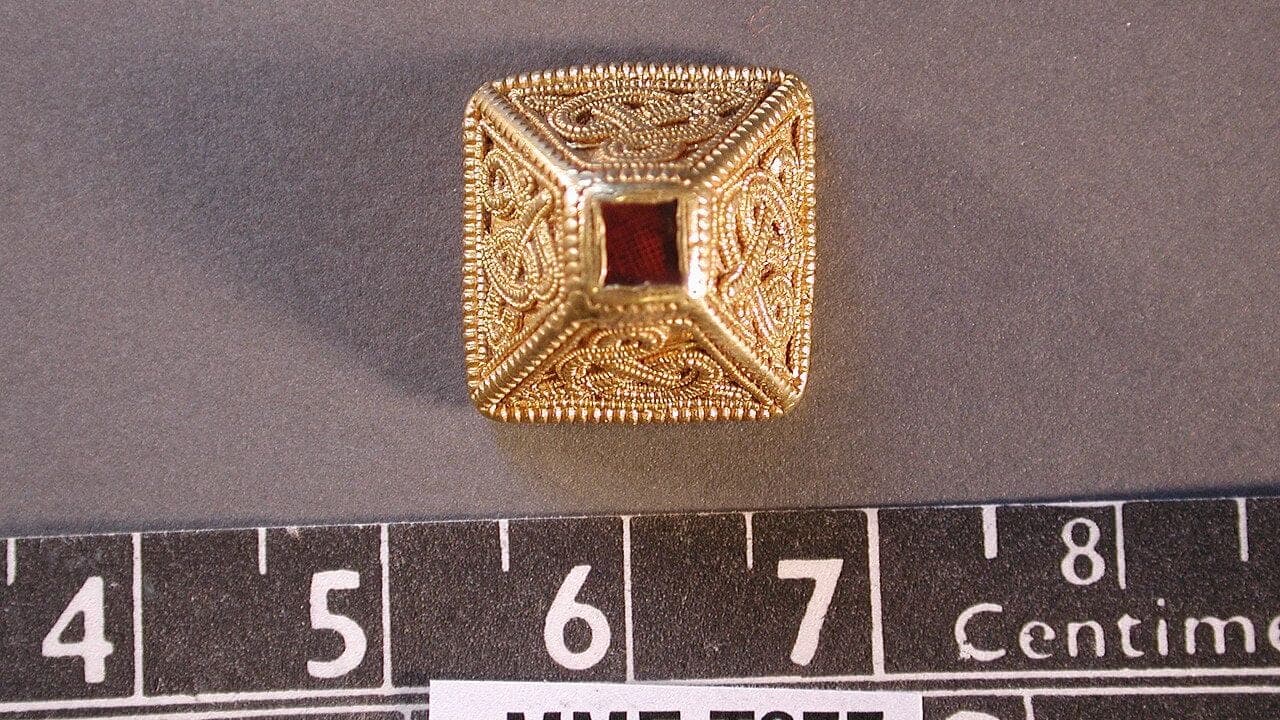
A metal detectorist has recovered in England, in the county of Norfolk, a small pyramid-shaped object that may have belonged to a high-ranking warrior. According to Live Science, in an article by Owen Jarus published on August 20, 2021, it is a so-called "sword pyramid," an element mounted on the upper part of a sword scabbard. The find dates back about 1,400 years.
The object is very small: it measures about 6 millimeters in height and 12 millimeters in length at the base. It is made of gold with garnet inlays. According to the source, the stones may come from India or Sri Lanka and would have reached Britannia through long-distance trade routes. Eleanor Blakelock, a researcher at the Institute of Archaeology at University College London and an expert in historical metallurgy, told Live Science that these artifacts are "rather rare finds" and that this example appears to have been made with considerable care.
The context of the discovery is one of its most interesting aspects. Helen Geake, national finds adviser for the Portable Antiquities Scheme (PAS), the program run by the British Museum and National Museum Wales, said that no known archaeological site is associated with the find. In her view, the object seems to have been lost by chance "in the middle of nowhere": it was not buried and did not come from a waste area of a crowded settlement. For metal detectorists, this is a useful reminder: reporting finds to the PAS is encouraged and, in some cases, mandatory, and it is precisely these reports that make it possible to document even isolated finds.
Pyramids of this type have also been found in the Sutton Hoo burial, which dates to more or less the same period. It is a medieval ship burial, so elaborate and mysterious that it has been linked to the world of the Anglo-Saxon epic poem "Beowulf"; in all likelihood it contained the remains of a high-ranking figure, such as a king.
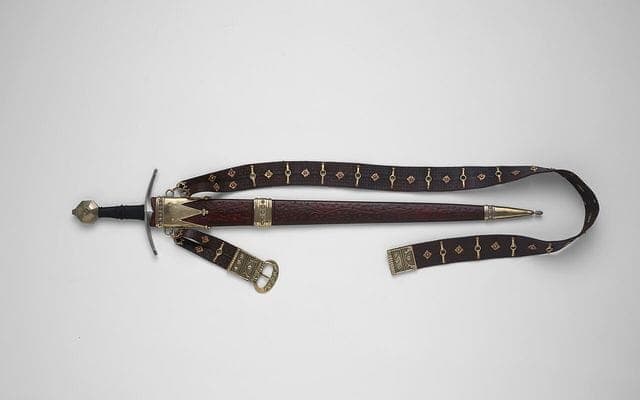
Researchers have put forward several interpretations of these objects' function. Geake notes that in graves, sword pyramids are always found at the top of the scabbard. One theory interprets them as a kind of "peace band," a safety strap that made the sword harder to draw, since the pyramid first had to be removed.
John Hines, professor of archaeology at Cardiff University, has proposed a different reading. In his view, these pyramids appear to have been studs used to attach a kind of retaining strap to the scabbard, so that the sword would not swing too much when carried hanging from a belt. Hines also stresses that by the mid-7th century, when this pyramid was made, the sword was a prestige weapon. At that time, he explained, it was probably carried only by high-status warriors authorized by the king to bear it.
Paul Mortimer, an independent scholar and co-author of the book "The Sword in Anglo-Saxon England: from the 5th to 7th century" (Anglo-Saxon Books, 2019), also emphasizes the object's social value. He describes it as an element of "the highest status" and believes that part of its purpose was to signal how high in society the wearer stood. According to Mortimer, it could indicate membership of a particular group or mark an achievement reached.
The case shows how a find only a few millimeters across, recovered far from any known site, can add to our knowledge of weapons, trade, and social hierarchies in early medieval England, provided it is recovered carefully and reported to the competent authorities.