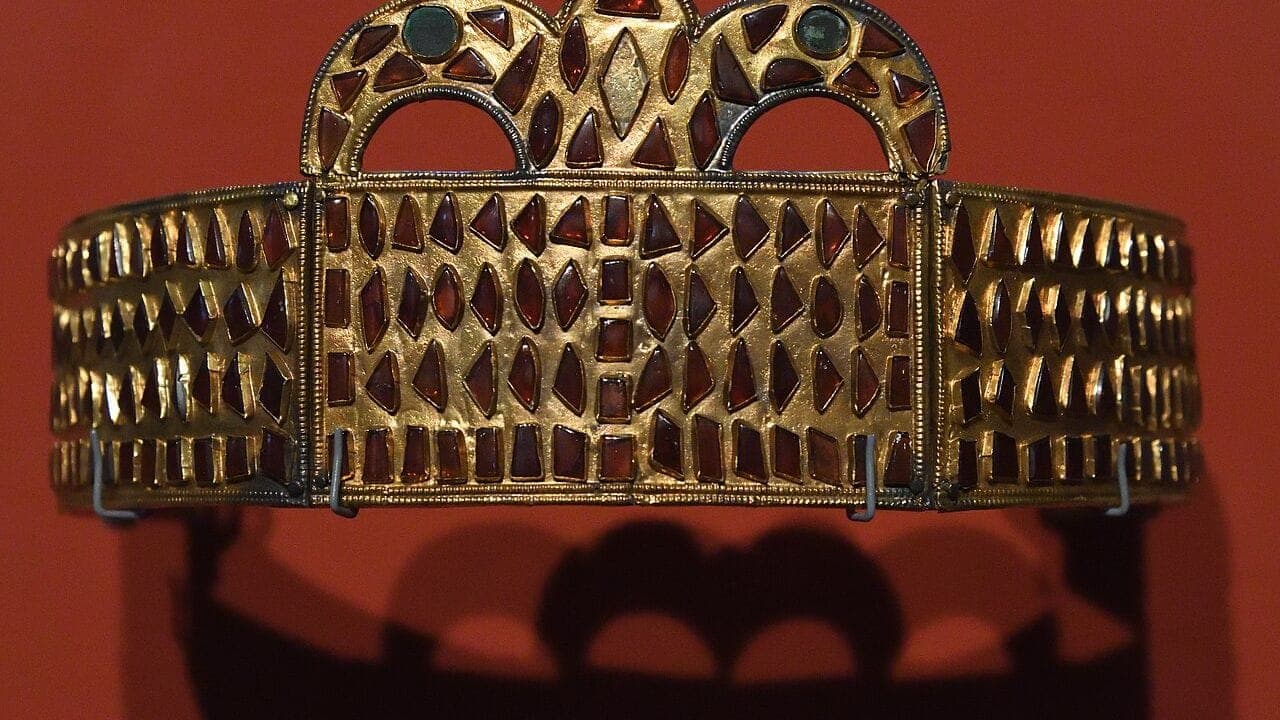
Among the most spectacular finds linked to the world of the Huns is the so-called Kerch Crown, a gold diadem decorated with set stones and depictions of birds of prey. According to Live Science, in an article written by Kristina Killgrove, the object dates back about 1,600 years. It was found more than a century ago in the burial of a high-ranking woman in Crimea.
The modern history of the piece begins in the early twentieth century. In those years, a German art collector acquired dozens of artifacts from a Russian-led excavation of an ancient Hunnic settlement in Crimea. The Kerch Crown was the most spectacular piece in that group of objects. Today it is preserved and displayed at the Neues Museum in Berlin.
From a structural standpoint, the diadem is made of three bronze plaques covered in gold and more than 250 cells (the so-called cells) that hold stones, including garnets. The band is about 4.4 centimeters high. It is a rare object, associated with the formidable nomadic warriors known as the Huns, who moved westward from the Don River, in present-day Russia, at the end of the fourth century AD.
According to the museum, the crown was found in the tomb of a woman of high status buried at Pantikapaion, the ancient city located on the present-day Kerch Peninsula. Pantikapaion had been founded as a Greek colony in the sixth century BC and was conquered by the Huns towards the end of the fourth century AD. Later, in the sixth century, the city was incorporated into the Byzantine Empire by Emperor Justinian I.
The main decorative motif consists of two stylized bird-of-prey heads, probably eagles, flanking a central floral motif. Round green stones mark the birds' eyes. Again according to the museum, these animals were meant to represent power and authority among the Huns and other groups, and were a very widespread symbol on jewelry and accessories of the period. Similar birds of prey appear, for example, in the female jewelry of the Visigoths in sixth-century Spain.
In the early twentieth century, a vast necropolis was excavated at Pantikapaion, with as many as 2,000 burials. Of that campaign, however, only a few artifacts and some skulls survived. This explains why the find context of the crown is known only in part and why the available data largely come from later studies.
One of these is the 1956 study by the German archaeologist Joachim Werner. The scholar wrote that the crown was found in a burial chamber, near the skeleton of a woman with an artificially modified skull. Werner believed the diadem was not made solely as a grave good: in his view, high-ranking Hunnic women wore it regularly during their lives, perhaps with a cloth headdress or veil attached to the band.
Today there are about two dozen examples of similar gold diadems. For this reason, Live Science notes, the Kerch Crown should not be considered technically as a queen's royal regalia. It is rather an ornament worn 1,600 years ago by a woman of the ruling Hunnic elite.
The case is a good example of how decisive context is in the study of an ancient object. Only a few pieces remain from the Pantikapaion excavation, and for most of the burials it is no longer possible to reconstruct where and how the materials were placed. Reconstructions such as Werner's are therefore based on the few surviving pieces of information and on comparison with similar diadems. For those who work in field research, even as amateurs, it is a reminder of the importance of documenting every find and its position with precision.