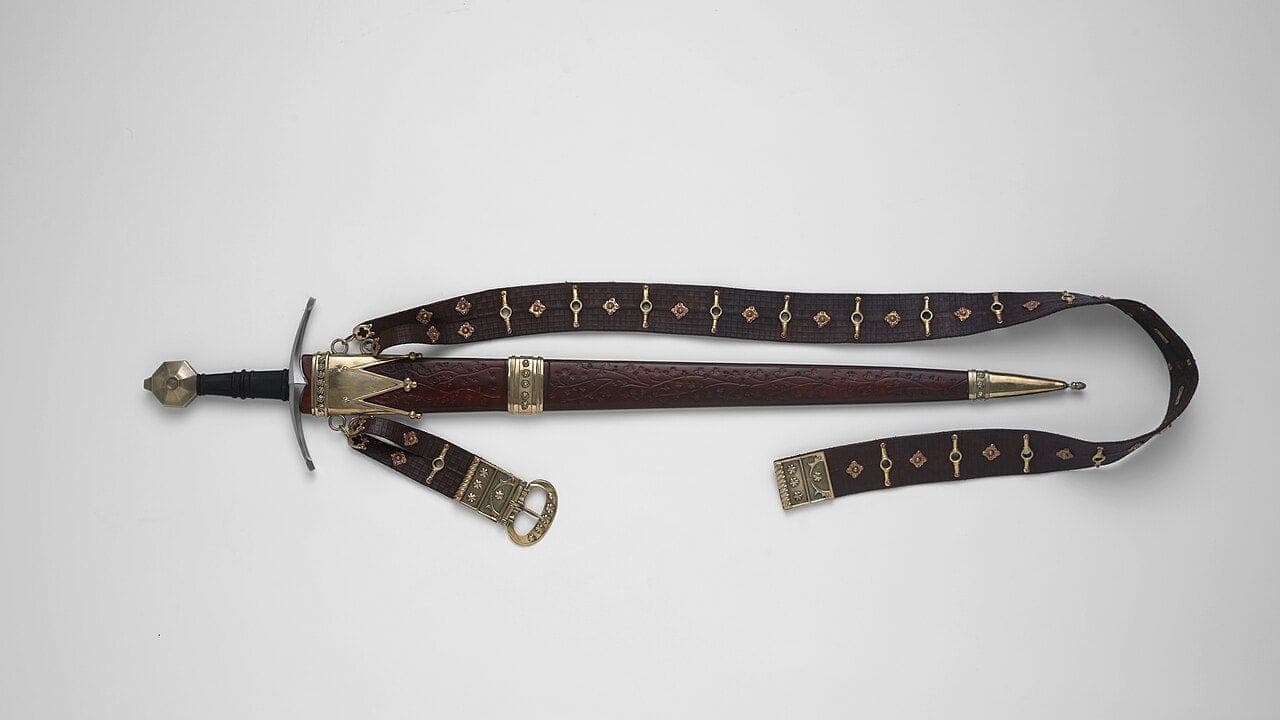
A man using a metal detector has unearthed a medieval sword that may have been used during the Battle of Grunwald, fought in 1410. According to Live Science, which cites a press release from the Marshal's Office of Warmia and Masuria, the find was made near Olsztyn, in northern Poland. The discoverer is Alexander Medvedev, an amateur archaeology enthusiast. Along with the sword, remains of the scabbard, a belt and two knives were recovered; the knives originally hung from the belt itself. Archaeologists, according to the translated press release, described such a find as something that occurs "once every few decades."
Despite more than six centuries underground, the weapons are reported to be well preserved, Medvedev himself explained. The amateur researcher chose to donate the artifacts to the Museum of the Battle of Grunwald in Olsztyn. Archaeologists now plan to conserve and study the sword, a necessary step to determine whether the link to the 1410 clash can be confirmed. For now, it remains a hypothesis, not an established fact. The Battle of Grunwald took place on July 15, 1410, near the Polish villages of Stębark (also known as Tannenberg), Grunwald and Ludwigsdorf. According to the Encyclopedia Britannica, cited by Live Science, around 66,000 men took part. The clash ended in victory for the Polish-Lithuanian forces over the Teutonic Knights, an order founded during the era of the Crusades in the Holy Land that later became the dominant power in the region then called Prussia.
The political context was a long conflict between the Teutonic Knights and their non-Christian neighbors, including the Grand Duchy of Lithuania. The Lithuanian grand duke, still a pagan, converted to Catholicism and married the Polish queen Hedwig (Jadwiga). After her death, he became king under the name Władysław II Jagiełło, remembered for uniting Poland and Lithuania in a period of great prosperity. The Teutonic Knights, however, doubted the sincerity of the conversion, and in 1409 Grand Master Ulrich von Jungingen declared war on Poland and Lithuania.
After a day of fighting, von Jungingen died after being struck in the throat by a lance, and his troops retreated. Also according to the Encyclopedia Britannica, of the approximately 39,000 Polish-Lithuanian soldiers, around 5,000 were killed; of the approximately 27,000 Teutonic troops, 14,000 were captured and 8,000 fell. After the defeat, the power of the Teutonic Order went into decline.
For those who practice metal detecting, the case shows the value of collaborating with institutions: the donation to the museum and the study by archaeologists make it possible to place the find in a verifiable historical context. What comes out of the analyses remains to be seen: only the study of the material can tell whether the sword really belonged to a combatant at Grunwald or whether it nonetheless dates from that period.