What remains in the sediments of a river that for centuries has been crossed by travellers, merchants and soldiers? According to Stilearte, reporting on 15 November 2026, the answer comes from Powick Old Bridge, a medieval bridge in Worcestershire, in central-western England, on the outskirts of Worcester. Here, archaeological investigations linked to the restoration project have brought to light three finds of particular interest. They consist of a copper-alloy seal ring, a lead musket ball and a half-penny coin bearing the effigy of Queen Victoria, dated 1899. These objects were lost at different times and together document the long use of the river crossing.
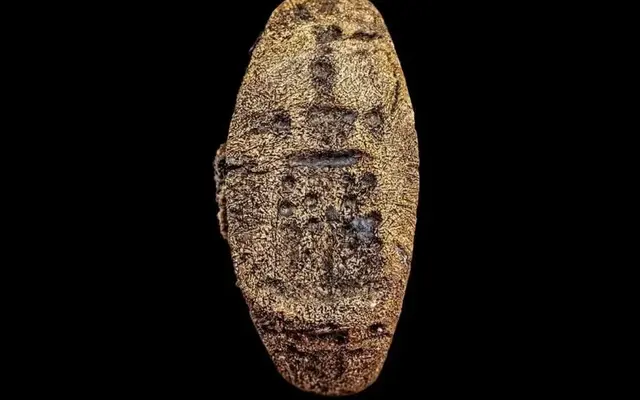
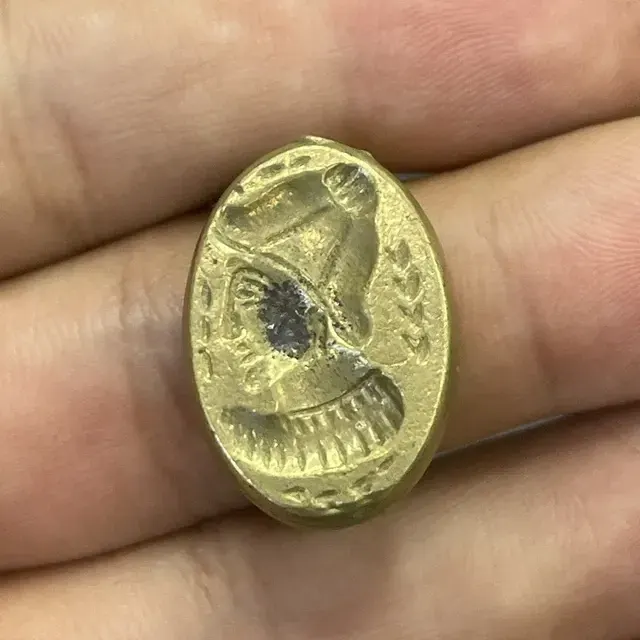
The most significant find is the ring, recovered from river sediments immediately downstream of the bridge, along the course of the River Teme. It is dated between the late 15th and the 16th century. The object is made of copper alloy and today shows signs of corrosion. It has a flat, circular upper face, on which a letter R is engraved in reverse.
It was not a simple ornament. The letter, cut in mirror image, was used to make an impression in a small amount of wax, producing an image that could be read the right way round. The seal could be applied to letters to guarantee their authenticity and make the sender recognisable.
According to the source, the ring probably belonged to a merchant. Before the spread of modern authentication systems, such small personal objects played a concrete role in managing business, correspondence and commercial relationships. The find therefore suggests a link with the economic activities that took place around the bridge, understood not only as a structure for crossing from one bank to the other, but as a point of transit for people, goods and information. The ring is a material trace of that world, but on its own it does not allow us to identify its owner or reconstruct the circumstances in which it was lost.
The second find tells a different story. Archaeologists recovered a lead musket ball, deformed on one side. Its shape is not perfectly spherical and it bears the marks of an impact against a hard surface, which indicates that it was indeed fired.
The location makes the object particularly interesting. Powick lies in an area directly involved in the English Civil War. In 1642, near the bridge, a clash took place between Royalist forces, loyal to Charles I, and Parliamentary forces. The skirmish at Powick Bridge is considered the first armed engagement of the English Civil War. Moreover, in 1651 the nearby city of Worcester was the scene of the final battle of Charles II's campaign, when he was defeated by the forces of Oliver Cromwell.
The musket ball could therefore belong to that historical context. The source text available to us breaks off just as it introduces the necessary distinction between this possible hypothesis and what can be demonstrated: for this reason, in the absence of further data, the link to the military events should be regarded only as a suggestion and not as an established fact.
For those who practise metal detecting, the story offers food for thought. Metal objects lost along fords, bridges and riverbanks, from seals to ammunition to more recent coins, are valuable clues, but their historical value depends on the context of discovery. Here the recovery took place within archaeological investigations linked to a restoration project, and this made it possible to associate the finds with a precise location, downstream of the bridge along the Teme.
The coin bearing Queen Victoria, dated 1899, completes the picture and extends the chronology to the late 19th century. From the late 15th-century seal to the Victorian coin, the Powick finds cover roughly five centuries of use, confirming that a bridge is a place where history settles, object by object, on the bottom of the river.