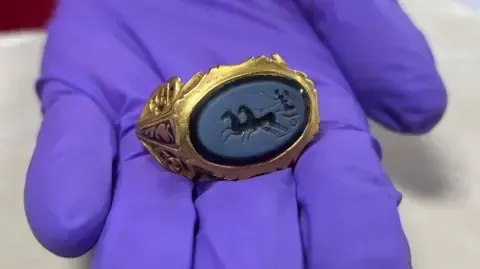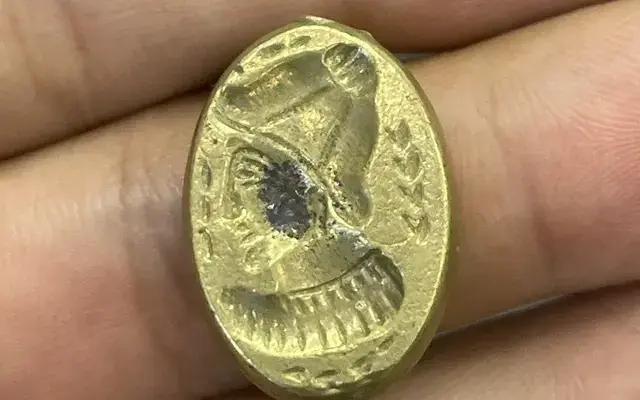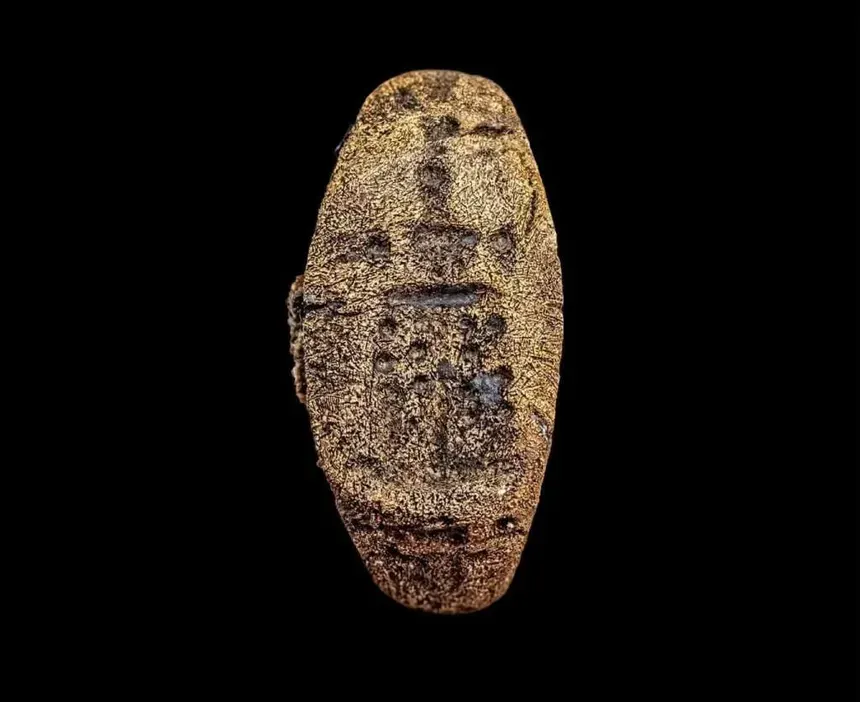
A bronze seal ring engraved with the image of the famous Lighthouse of Alexandria, one of the Seven Wonders of the ancient world, has been discovered in the harbor of the Egyptian city. According to The History Blog, it is the first depiction of the Lighthouse ever found on a seal ring, which makes the object unique among the finds from ancient Alexandria.
The artifact was recovered by underwater archaeologists during an exploration of the submerged island of Antirhodos, which was part of the Eastern Harbor of ancient Alexandria. The find site is far from marginal. Antirhodos was in fact home to a Ptolemaic royal palace, documented by the geographer Strabo, who visited Alexandria between 29 and 25 BC.
Along with the ring, other materials were recovered from the same area: pottery, glass, tableware, amphorae, bottles, lamps and other everyday objects. These finds cover a very broad span of time, from the 4th century BC to the 4th century AD. What emerges is the picture of a context frequented and lived in for centuries, where common objects and finer artifacts settled on the seabed over time.
To understand the symbolic value of the engraved image, it is worth recalling what the Lighthouse was. It was built on the island of Pharos, at the entrance to the Portus Magnus, the great harbor, during the reign of Ptolemy II Philadelphus, in the 3rd century BC. The structure rose on three levels: a square base, an octagonal body and a circular tower topped by the great fire. The flames were fed with wood and resin and amplified by metal mirrors. According to the source, the light was visible from at least two dozen miles away and guided ships safely along the coast to the harbor entrance.
The Lighthouse was a symbol of Alexandria and its commercial success, as well as a renowned architectural masterpiece. It is therefore no surprise that its image appeared on other supports: depictions of the Lighthouse are known on coins, both in the Ptolemaic period and under Roman imperial rule. The newly discovered ring adds to this series a type of support previously without parallels, namely a personal seal in metal.
It was precisely the comparison with coinage that made a dating possible. The image engraved on the ring is similar to those appearing on 2nd-century coins, and for this reason archaeologists have provisionally dated the ring to that period. This is therefore a provisional chronology, which may be refined by future studies of the artifact and its find context.
For those interested in research and metal finds, the case is useful for a couple of reasons. It shows how much a small bronze object can hold in terms of valuable information, including iconography, function and dating, provided its place of origin is known precisely. And it reminds us that discoveries of this significance come from archaeological investigations carried out methodically, in documented areas of historical interest, where every object is recovered and recorded together with its position.
The source provides no further details, for example on the dimensions of the ring or on the precise methods of recovery. We therefore limit ourselves to what has been reported: a bronze seal bearing the Lighthouse, found in a location linked to the Ptolemaic court, and a provisional dating to the 2nd century that may be confirmed or revised by future research.