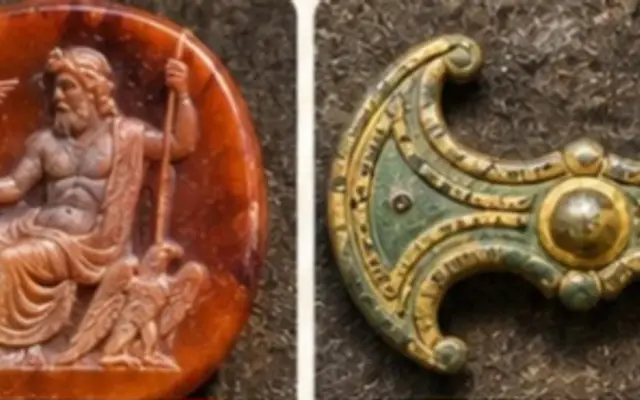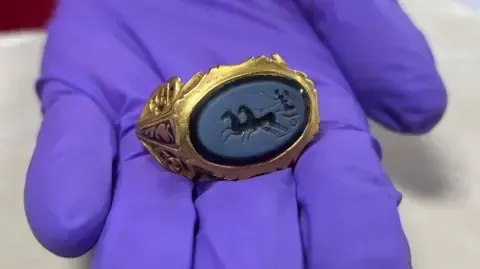
A Roman-era gold ring, decorated with an engraved stone, has been unearthed in a field in southern England. According to Live Science, which in turn cites the BBC, the find dates to July 29, 2018 and was made by Jason Massey, a member of the Detecting for Veterans group, during a survey of land near the town of Crewkerne. The jewelry weighs about 48 grams (1.7 ounces) and is believed to be 24-carat gold. Ancient craftsmen set a black onyx on the bezel, engraved with the Roman god of victory riding two horses. The ring has not yet undergone formal analysis, but experts at the British Museum, again according to the BBC, most likely date it to between 200 and 300 AD.
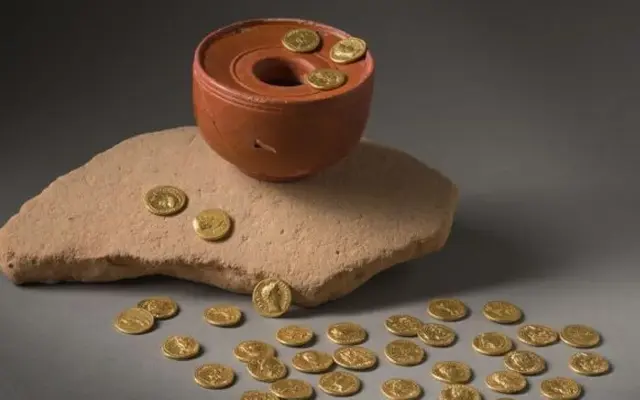
The circumstances of the recovery are unusual. Massey told the BBC that he initially thought he had found a gold coin, because the signal came from the center of a group of about 60 Roman coins buried in the field. Only when he dug did he realize he had something different and far more significant in his hands, an object that is not a simple coin but a piece of remarkable craftsmanship. The site had already proven generous. The previous November, again according to the BBC, Massey and his companions had found a lead-lined coffin in the same field along with more than 250 coins from the Roman Imperial period. The overall finds, according to Massey himself, suggest that a very high-ranking Roman villa once stood there.
The villa, more than the ring's economic value, is what most interests the detectorist. Massey said that various figures are circulating about the ring's possible worth, but that for him and his group the priority is to understand who lived in that residence, where they came from, and who the person wearing the jewelry was.
An assessment of the object's historical value comes from Ciorstaidh Hayward-Trevarthen, Finds Liaison Officer for the counties of Somerset and Dorset. Speaking to the BBC, she explained that Somerset has a couple of gold rings from that period, but that they are not common. As is still the case today, she added, gold indicates that the owner was probably a fairly wealthy person.
The case is part of a series of archaeological discoveries made by enthusiasts and amateurs. Live Science recalls, for example, that in 2015 a man using a metal detector uncovered a Roman-era grave in excellent condition in a village north of London, and that in 2013 a group of non-professional archaeologists identified an extensive network of tunnels beneath Emperor Hadrian's villa in Tivoli, Italy.
For those who search with a metal detector, the story offers a concrete lesson: a signal similar to that of a gold coin can conceal a very different object, and the presence of a group of coins is often a clue to a broader context. Once again, the value of a find lies above all in the information it helps reconstruct about the place where it was made, as Massey himself stresses when speaking about the villa and its inhabitants.