A hoard of 37 Roman gold coins is still in the hands of thieves. According to Stilearte, the loot was stolen last July from the archaeological center in Montans, in the French department of Tarn, and has not been recovered so far. The investigation has, however, taken a turn: on 6 November, four people were formally placed under investigation after an operation involving 90 gendarmes and police officers.
The theft is believed to have taken place during the night between 30 June and 1 July 2026. The thieves broke into the archaeological center, reached the room where the hoard was kept, and carried off 37 of the 40 coins on display. The financial loss has been estimated at around 120,000 euros, although the historical and archaeological value of the find is much harder to quantify.
The investigation was carried out by the research section of the Strasbourg gendarmerie, together with the central office for combating trafficking in cultural property. Investigators linked the case to another robbery, carried out on 5 July at the Lalique museum in Wingen-sur-Moder, in Alsace. On that occasion, 27 jewels were stolen, with an estimated value of 4.5 million euros.
After four months of inquiries, the operation involving 90 investigators led to the arrest of six people. Four of them, aged between 23 and 51, were brought before the investigating judge and formally placed under investigation. Two are in pretrial detention, while the other two are subject to judicial supervision. Investigators are keeping quiet so as not to jeopardize the continuation of the inquiry.
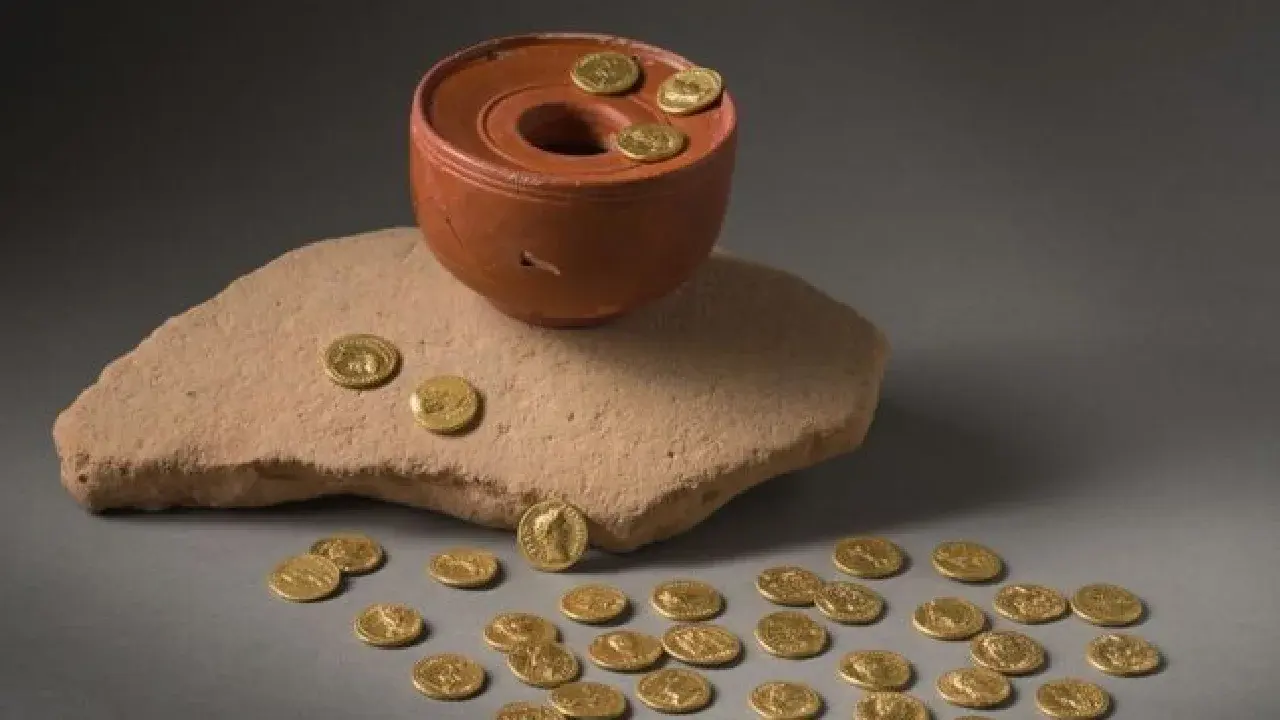
The story of the hoard begins well before the theft. The treasure was discovered in 1992, during archaeological excavations of the foundations of a 1st-century AD building. It originally consisted of 40 aurei, the gold coins of the Roman Empire. They were gathered in a small sealed ceramic container, just six centimeters high and nine centimeters in diameter.
According to the catalogue entry of the Occitanie Musées network, cited by Stilearte, the container was probably used as a sort of ancient piggy bank. Its owner would have accumulated a considerable sum in it. Thirty-nine of the coins had been minted in Lyon, one of the main monetary centers of Roman Gaul, while the fortieth came from Pergamon, in what is now Turkey.
The obverse of the coins bears the portraits of four emperors of the Julio-Claudian dynasty: Augustus, Tiberius, Caligula and Claudius. The reverses instead show allegories, references to military victories and images linked to the legitimization of imperial power.
The value of the hoard was not only symbolic. According to museum documentation, ten aurei were roughly equivalent to one year's pay for a Roman legionary. The forty coins therefore represented a considerable fortune, hard to explain as a simple ritual offering buried in the foundations of a building.
It remains unclear why the owner hid the money and why he never returned to retrieve it. It is precisely this circumstance that has made the hoard a valuable witness to the economic life of Montans, an important craft center of Roman Gaul, known above all for its pottery production.
For now, the 37 coins have not been found. There is still hope they can be recovered before they are dispersed on the illegal market for archaeological artifacts. The case is a reminder of how much the context of discovery and the protection of cultural heritage matter: a stolen artifact loses much of its value as knowledge.