Seven centimetres of gold, formed from very fine rings interlaced with high-jewellery techniques, have lain underground for nearly two thousand years. They were brought to light by Elise Zallu, an archaeology student, during her first day of excavation at Redesdale, in Northumberland, along the northern edge of Roman Britain. The news was picked up by Stilearte on 19 November 2026.
According to Stilearte, the discovery was announced on 18 November 2026 by Newcastle University. The university has been conducting investigations in the area for years together with the Redesdale Archaeology Group and the company The Archaeological Practice. The 2026 campaign involved 52 first-year students, divided into two groups and working in the field for two weeks each. The dig, carried out in summer, is part of a research project launched in 2021, which follows a long period of investigation that began in the 1990s.
The gold chain is the most spectacular find. Researchers say it is so well preserved that, if it were complete, it could still be worn. It was made using the Roman loop-in-loop technique: small metal elements shaped like figure eights are bent and interlocked to create a structure that is flexible, strong and compact. The final effect is that of a metal fabric, designed to move with the body and catch the light.
Archaeologists propose three possibilities: an elite piece of jewellery, a decorative element linked to the military environment, or an accessory that belonged to an officer or a member of his family. However, attribution remains to be proven, because the chain alone does not identify its owner or clarify his role. The presence of gold on a northern frontier nonetheless raises questions about the circulation of prestige goods and individual wealth.
A second find is a small folded lead strip, identified by Shannon Wood. Traces of Latin cursive writing can be seen on its surface, still partly illegible. Scholars interpret it first and foremost as a possible commercial seal, perhaps linked to property, taxation, handling or delivery of goods within the military supply network. The Roman army required a constant flow of provisions, materials and equipment, and controlling goods also meant controlling people and economic structures. A further interpretation of the strip also remains open.
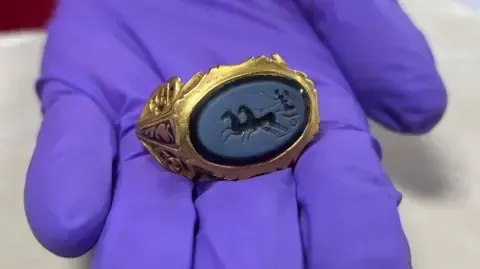
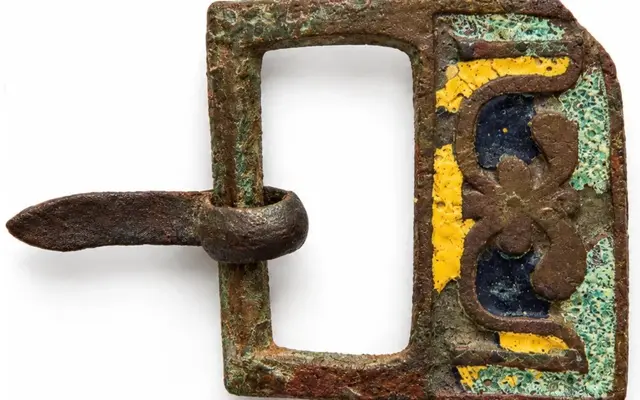
The same soil has also yielded a military bronze ornament that is still gilded, a gem engraved with the image of Jupiter, and pottery fragments that probably preserve the name of a man who lived almost two thousand years ago. Together they evoke a world of officers, soldiers, craftsmen, merchants and families, and show how complex life was around the large Roman military installations.
For those who practise metal detecting, the case offers a useful reminder: small and fragile objects such as a thin chain or a folded lead strip reveal a great deal only if their findspot context is known. At Redesdale the finds emerged in a stratigraphic excavation carried out by a research team. This is precisely what makes it possible to link them together and to formulate hypotheses about their meaning, without hasty attributions.
Many questions remain open: the full reading of the inscription on the lead, the name on the pottery fragments and the identity of the person who wore the chain. The next analyses by the Newcastle University teams may clarify whether these objects belonged to a single social environment or to different presences over time.