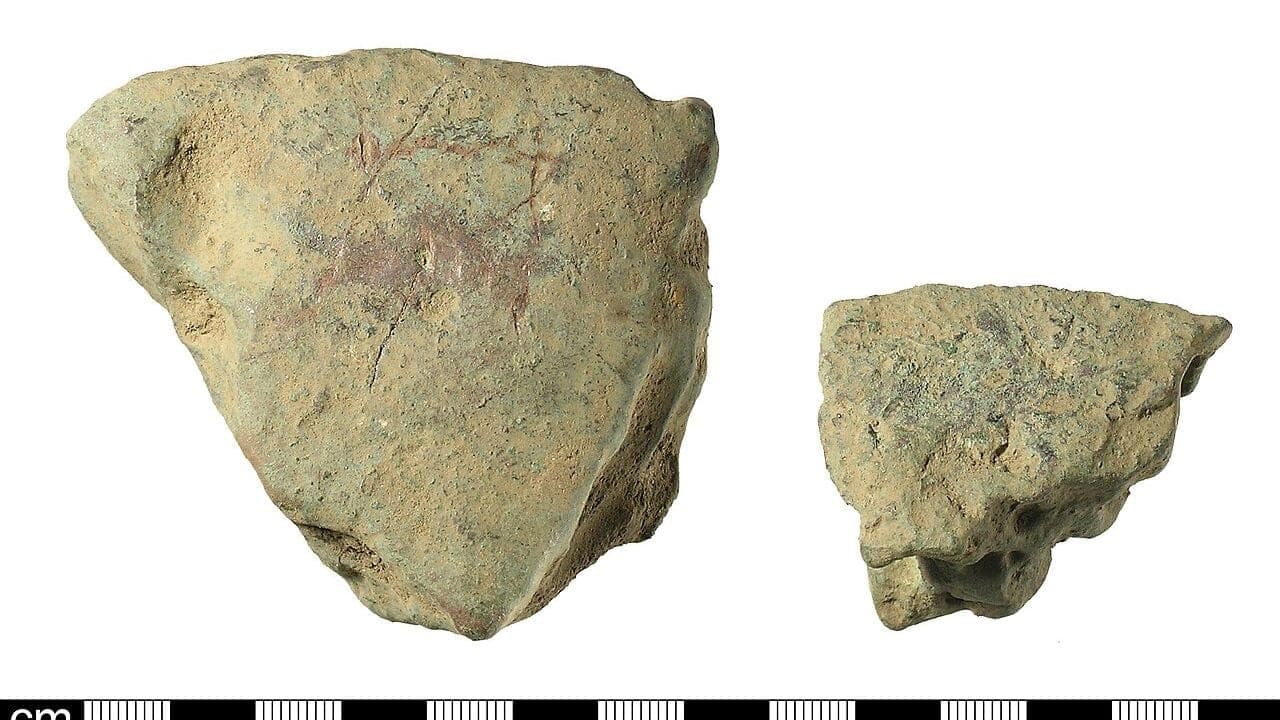
A Bronze Age hoard discovered near Blyth Bridge, in the Scottish Borders, is attracting the attention of archaeologists for the rarity of the materials it contains. According to The History Blog, the so-called Blyth Hoard includes the first copper ingot ever found in Scotland from this period and fragments of moulds used to cast decorative objects.
The find dates back to 2022 and is credited to metal detectorist Mariusz Stępień, the same man who had located the famous Peebles Hoard, just seven miles away. The latter is considered the most varied assemblage of Bronze Age artefacts in Europe. Stępień showed great integrity: as soon as he found a socketed axe, he stopped digging and reported everything to the Treasure Trove Unit, the competent Scottish body.
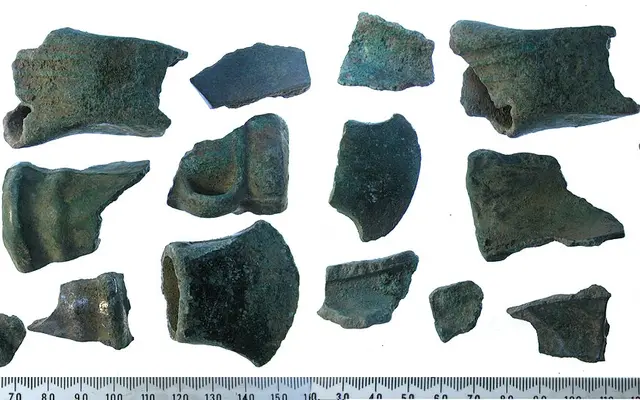
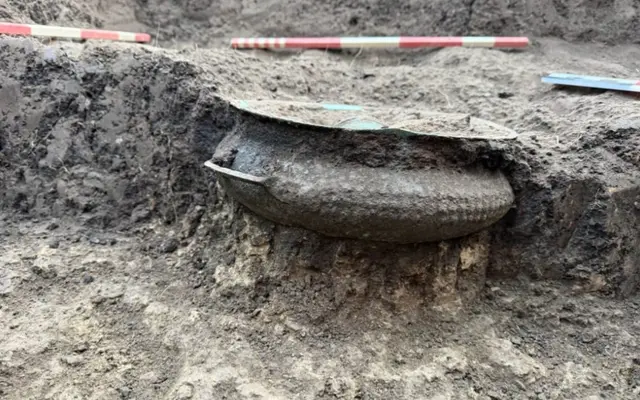
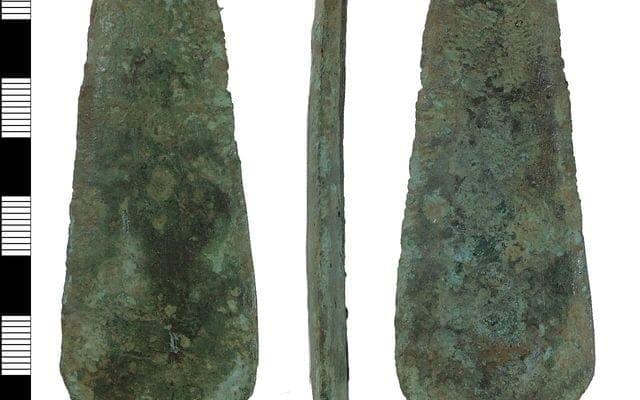
Thanks to this conduct, the deposit was excavated professionally by archaeologists from National Museums Scotland. Specialists recovered a second socketed axe, a large copper ingot and three fragments of clay moulds used to cast bronze objects. The complex is dated to the Late Bronze Age, between 1150 and 800 BC.
The copper ingot is intact and is the first of its kind in Scotland. In Britain, ingots are more common in the south, particularly along the southern coast, but none had ever been found beyond the border with England. This is an important piece of evidence: three thousand years ago, raw material was being imported into Scotland. Communities, therefore, were not merely re-melting existing objects, since new metal was arriving in the area.
The moulds are of particular interest too. For the Late Bronze Age, most surviving moulds were used to produce weapons or tools, whereas the Blyth examples are shaped and decorated to make small ornamental elements. Since the Peebles Hoard had been discovered two years earlier, scholars examining the fragments recognised the spiral and the outlines of the Peebles fittings.
Such a precise link between moulds and specific objects is rare for the Bronze Age, and this makes the Blyth case exceptional. Given the uniqueness of the Peebles fittings, according to sources it is highly likely that whoever buried the Blyth Hoard took part in producing some or all of them. The presence of the ingot makes the hypothesis even more intriguing.
The co-presence of metal objects and production residues is also rare in Britain and until now was unknown in Scotland. The Blyth Hoard therefore offers the opportunity to study the relationships between metal objects, production and deposition. The socketed axes and the ingot could represent raw material destined for new casting, such as the Peebles-style fittings. Whoever buried the hoard, one person or more, may have been a metalworker skilled in making moulds and casting.
For metal detectorists, the story is a concrete example of how prompt reporting and stopping digging at the first sign of a find allow archaeologists to document the context and obtain information that would otherwise be lost.