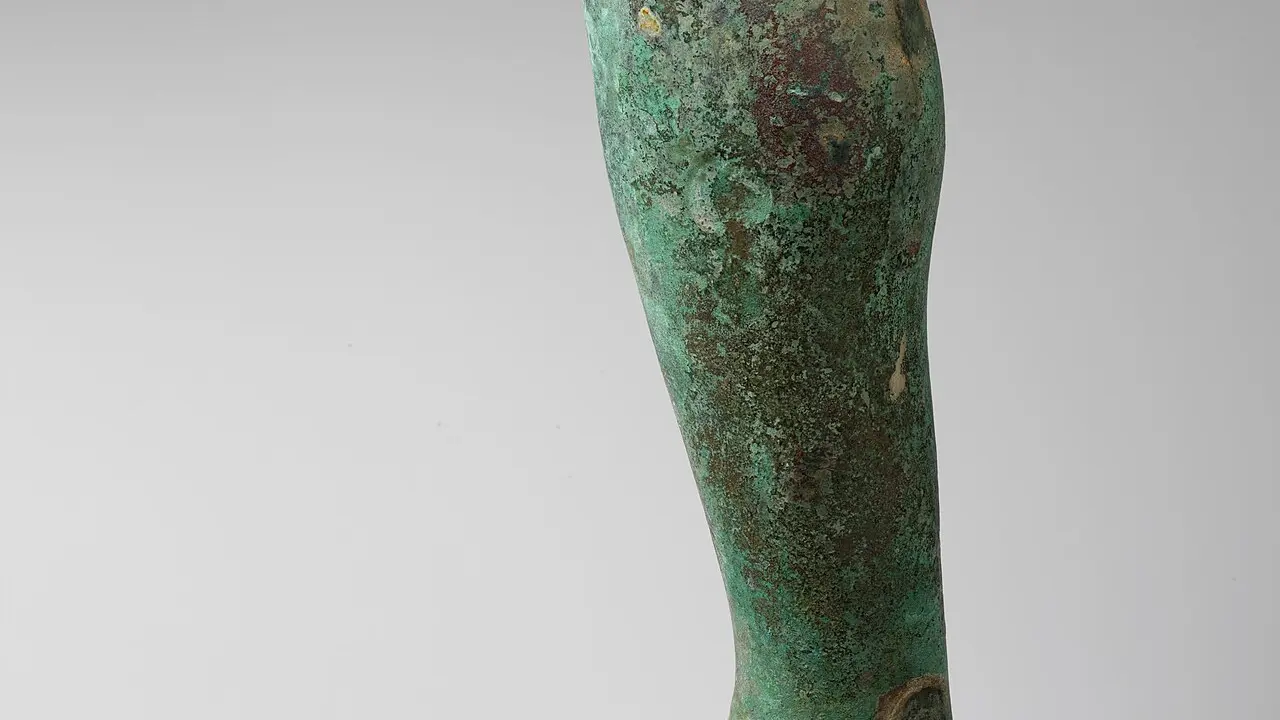
A large bronze leg, unearthed in a bog in rural Scotland more than two hundred years ago and left hidden in a storeroom owned by a duke, is helping to rewrite the history of the Roman Empire. The Guardian reports this in an article about the exhibition at the National Museum of Scotland in Edinburgh.
The find, known as the "Mislington leg", was brought to light in 1820. According to the source, it then remained for about a century in the "charter room" of Dalkeith House, near Edinburgh, one of the residences of the Duke of Buccleuch.
For a long time, antiquarians argued that it was war loot. The hypothesis was that it may have come from York, that it had been violently torn off by Scottish raiding tribes and carried north beyond Hadrian's Wall. In 1932, the scholar James Curle wrote that the circumstances that would have led to erecting such a statue north of the Great Wall were impossible to imagine.
Today, archaeologists instead believe that the gilded bronze leg comes from the Scottish Borders. It would have been part of a vast equestrian statue of the emperor Antoninus Pius, erected near Hawick after his armies had taken control of southern Scotland, around 140 AD. The piece bears strong similarities to imperial statues from other frontier regions.
The exhibition's lead curator, Fraser Hunter, believes that statues of this kind had a profound impact on Iron Age communities. In his view, the leg was not torn away: it was carefully removed and deposited where it was found 1,700 years later. Hunter notes that these works were visually dominant and appeared "truly alien", because naturalistic art was almost absent in the Iron Age and the idea of depicting a person was foreign to that worldview.
The exhibition, titled "Roman Scotland: Life on the Edge of Empire", is the largest ever devoted to the Romans in Scotland. According to the curators, it shows that the Romans had a far greater impact north of Hadrian's Wall than previously thought. They occupied large areas of the country, produced new works of art and influenced Scottish politics long after their withdrawal.
Among the new additions is a reconstruction of a richly decorated terracotta bowl from Inveresk, east of Edinburgh. There stood a large fort and a Roman town which, according to Hunter, were a centre of imperial power in Scotland during the Antonine period, from 142 to 165 AD. This was the second of the three phases of Roman occupation of the territory.
Hunter estimates that around 10,000 soldiers were stationed in southern and eastern Scotland. Among them were auxiliaries from areas corresponding to modern-day Romania and North Africa. Perhaps another 10,000 people followed them: wives, slaves and other members of the camp.
Associate curator Bethany Simpson explains that the bowl shows a unique combination of animal reliefs, with dolphins, deer and a stylised hunting dog. According to Simpson, it is found only at Inveresk, and nowhere else in Scotland or the United Kingdom. The museum also displays for the first time two very well-preserved stone altars of local manufacture, from a Mithraeum.
The case of the Mislington leg shows how much find contexts and documentation can matter. An object recovered over two centuries ago, and long misinterpreted, is once again a valuable source for understanding how Rome left its mark on northern Britain.