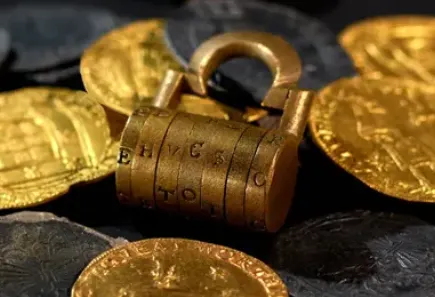
A padlock about four hundred years old, recovered off the coast of Wales together with the treasure of the Ann Francis wreck, has finally been opened. According to Live Science, researchers were able to decipher the mechanism using computed tomography (CT), without forcing it open in a way that could have damaged the find.
The padlock was considered an enigma precisely because of how it was built. The sources available to us describe the object as an artifact whose workings were mysterious, remaining locked for centuries after being returned by the sea along with the rest of the find. The Live Science article refers to a true “code” to be solved, that is, a locking system that could not be understood from the outside.
The method adopted by the scientists clearly shows how non-invasive imaging techniques are changing the work done on archaeological finds. CT allows an observer to examine the interior of a metal object layer by layer, identifying springs, gears and locking mechanisms without touching them. In the case of the Ann Francis padlock, this approach made it possible to understand how the lock worked and to open it.
For those who practice metal detecting, the story offers a few lessons. Objects recovered from marine or coastal environments are often heavily corroded and encrusted, and their outward appearance says little about their structure. An artifact like this, if found on the surface, would still require specific care: any cleaning or handling on one's own should be avoided, and the find should be reported to the competent authorities so that experts and laboratories can intervene with the appropriate tools.
Opening the padlock, however, does not close the matter. According to Live Science, the discovery leaves a mystery surrounding the find unresolved. The information available in the source we consulted does not allow us to specify further what question remains open, and for this reason we prefer not to speculate.
The case of the Ann Francis remains an example of collaboration between archaeology, diagnostic technology and finds linked to the sea. An object that had remained sealed for four hundred years was able to be investigated in a way that respected its integrity, adding a piece to the knowledge of the treasure that came ashore on the Welsh coast.
We will follow developments in this story and update the article should new verifiable details emerge about what the padlock contained or about what still remains to be explained. For further reading, the original article published by Live Science can be consulted in its archaeology section.
In short, the result confirms that scanning technologies have now become essential tools for studying the most delicate metal finds, especially when they come from submerged contexts or historic shipwrecks.