Horbourg-Wihr: Fifth-Century Germanic Graves with Swords and Garnets
Inrap archaeologists have uncovered a funerary complex near Colmar with weapons and prestige ornaments, dating to the second half of the 5th century.
November 6, 2026
ShareLink copied!
Immagine web
A funerary complex dating to the second half of the 5th century AD has been discovered at Horbourg-Wihr, in the Upper Rhine, a short distance from Colmar, France. According to Stilearte, the discovery is the work of archaeologists from Inrap, the Institut national de recherches archéologiques préventives. It offers a picture of a high-ranking community living through the period of transformation that accompanied the end of the Western Roman Empire.
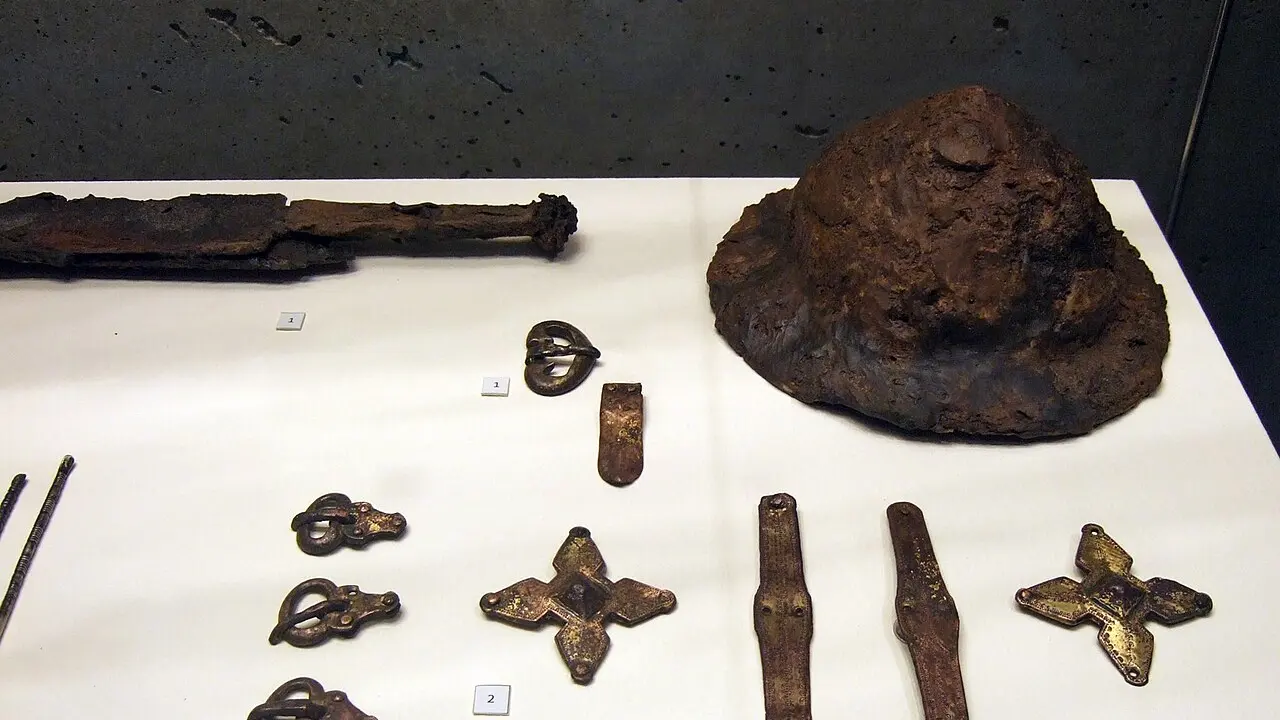
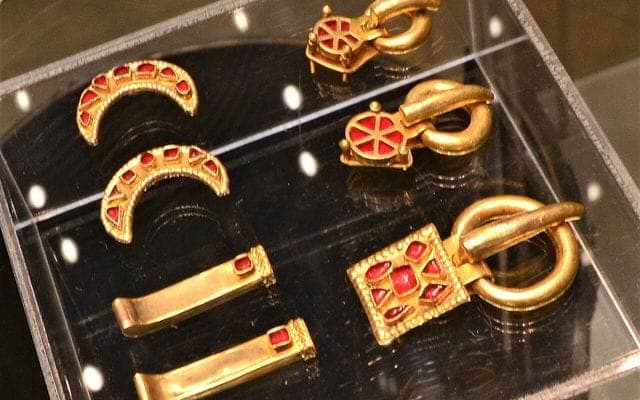
The most spectacular core consists of two male burials with military equipment of exceptional quality. They include swords, scramasaxes, shields and angons, together with decorative elements in gold and silver inlaid with garnets. Some of the swords have survived partly still in their wooden scabbards. Alongside these burials are others belonging to women, with bird-shaped brooches, glass necklaces and personal items.
The scramasax is a single-edged cutting weapon with a long, sturdy blade. The Italian name, scramasasso, derives from the French scramasaxe. It could be a kind of large combat knife or, in the longer examples, approach a short sword. It struck with a cutting edge and, depending on the blade, also with the point. It is very widespread in the grave goods of the Franks and other Germanic peoples.
The angon, by contrast, was a throwing weapon, a kind of javelin with a long metal point and barbed hooks along its sides. Those hooks made it difficult to pull the weapon out once it had lodged in a shield or in the body of an opponent. It is associated above all with the Franks and other Germanic military contexts, and its use is also documented in historical sources on early medieval combat techniques.
According to the source, the grave goods indicate individuals of high rank. They may have been groups of Germanic origin or foederati who had entered the structures of the Roman army. The presence of weapons alone does not yet allow this to be established with certainty. The objects nevertheless offer new evidence on settlement dynamics and on relations between different populations in the final phase of imperial authority in the West. For this reason, it is described as a page of Alsatian history that is still poorly documented.
The excavation was carried out in 2026 on behalf of the French State, through the Drac Grand Est. It arose from a preventive intervention linked to the construction of new housing. The site lies on the right bank of the Ill, in the territory of an ancient Gallo-Roman vicus near the Rhine limes, the frontier system that for centuries marked the eastern edge of the Roman provinces.
The site is also important for the sequence of its phases of occupation. Above the traces of an ancient settlement, archaeologists uncovered a funerary sector attesting to an organized human presence in the second half of the 5th century, while the political and military system of the Western Empire was changing profoundly.
The complex does not end with the two male depositions. It includes eleven burials of adults or adolescents close to adulthood, three depositions of younger individuals and two horse burials. The text of the available source breaks off before describing the distribution of the graves, so no further details on the organization of the area can be reported.
For metal detectorists, the case is a useful example of the value of context. Metal weapons and ornaments only have historical meaning if they remain in their original position, alongside the dead. Preventive excavation, carried out using a stratigraphic method, made it possible to read settlement, cemetery and grave goods together. A chance find removed without documentation would have erased precisely this information, and should always be reported to the competent authorities.
ADV
The AI assistant for metal detecting
Custom programs, restricted-area checks, ground recognition and much more.Try it free →Get the app