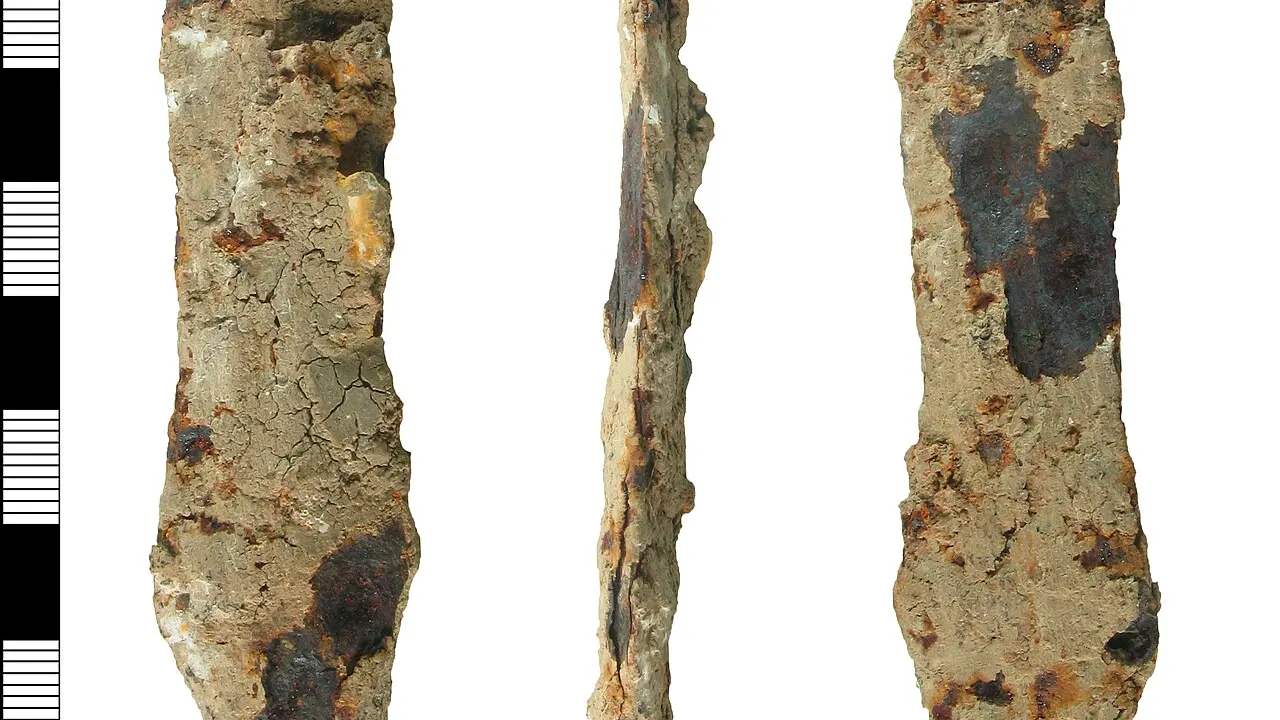
At the bottom of Lake Lednica, in the Greater Poland region, an unusually striking medieval weapon has resurfaced. According to Stilearte, archaeologists call it the “prince's spear”. Its surface combines gold, silver, copper, tin, zinc and lead, with different alloys and workmanship that create an unusual colour effect. The decorations wind around the structure of the weapon, forming spirals, triskelions and motifs that resemble beaks and claws. The object seems designed to impress through its appearance even before its military function. It is not known who wielded it, or whether it was ever used in combat. It may have belonged to a figure of very high rank, perhaps close to the Piast dynasty, or it may have been conceived for a representative or ritual purpose.
The lake lies between Poznań and Gniezno, about 35 and 15 kilometres from the site respectively. At its centre sits Ostrów Lednicki, an island that preserves traces of one of the main political and military centres of early Poland. Between the 10th and 11th centuries, a fortified residence linked to the Piasts, the dynasty that laid the foundations of the Polish state, developed there. A stone palace, a church, defensive structures and monumental bridges connected the island to the shores. Political power, religious activity and military organisation were all concentrated in this system. The discovery of four spears dates to the 2025 underwater campaign, led by the Centre for Underwater Archaeology of Nicolaus Copernicus University in Toruń, in collaboration with the Museum of the Early Piasts in Lednica. Scientific and journalistic attention has focused above all on the richest specimen. The expression “prince's” points to a possible link with the political and military elite, but it does not identify the owner. It has not been proven that it belonged to Mieszko I, Boleslao I or another member of the ruling family.
The chronology is important. Analyses of the wooden fragments associated with the weapons allowed a collective radiocarbon dating. The interval, with a 95.4% probability, runs from 993 to 1032 AD. The statistically most probable range lies between 1016 and 1030. The objects would therefore have ended up in the lake under Boleslao I the Brave, son of Mieszko I and the first Polish ruler to be crowned king, in 1025. The island's history is tied to the formation of the Polish state. Mieszko I consolidated power in the second half of the 10th century and accepted Christianity in 966. His son Boleslao strengthened the principality, developed diplomatic and military relations and obtained the royal crown. The weapons recovered from the waters are therefore material evidence of a phase in which military hierarchies and the structures of the new power were taking shape.
Hundreds of weapons lie around the find site, possibly belonging to warriors of the elite of the first Polish rulers. The question of why they were entrusted to the water remains open. The hypotheses cited by the source are an invasion, a battle or a ritual sacrifice. New metallurgical analyses, studies on the provenance of the materials and research into submerged fortifications are opening new paths towards solving the enigma. For metal detectorists, the case offers a lesson in method. A composite object made of many different alloys returns complex signals to a detector. Its historical value, however, emerges only from context, documentation and laboratory analysis. An underwater recovery of this kind requires scientific expertise and a specialised team. Radiocarbon dating of the associated wood, for example, provided information that the weapon alone could not have given.