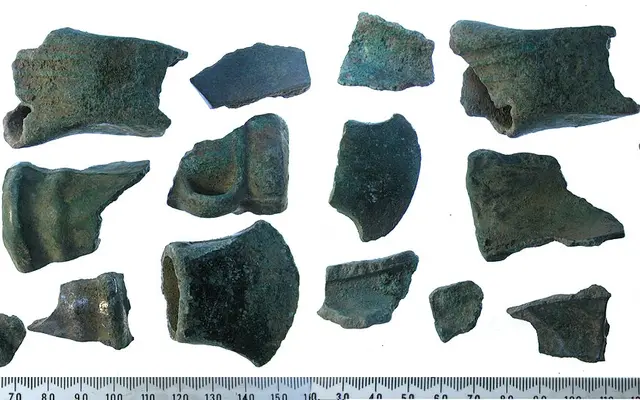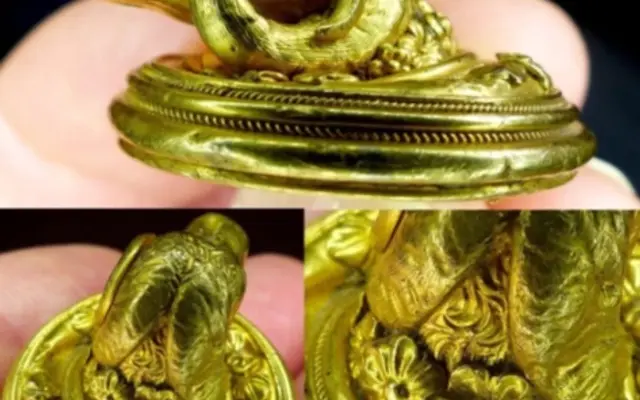
Fragments of a bronze Celtic helmet have been uncovered at Łysa Góra, a fortified settlement from the early Iron Age in northeastern Poland. The finds are reported by Archaeology Magazine, the publication of the Archaeological Institute of America, which in turn cites an article from Phys.org. The original scientific study was published in the journal Antiquity.
The site occupies a strategic position on the Orzyc River and near an area rich in amber. According to reports, this location allowed its inhabitants to control the flow of amber and other goods toward Central Europe. This is an important detail for understanding the settlement's role in long-distance exchange networks.
The helmet was crushed and had been thrown into a pit, together with an iron adze and a sickle. Similar helmets are known from burials of the Celtic warrior elite in France and Austria. The context of the find, therefore, differs from that of the tombs: here the object lies in a pit, associated with working tools.
Bartłomiej Kaczyński of the State Archaeological Museum in Warsaw described the helmet as “a symbol of power and direct proof of long-distance contacts.” According to Archaeology Magazine, however, the helmet in the pit is not the only clue: numerous fibulae and ring ornaments of Celtic type were also found at the site.
Taken together, these materials suggest that Celts may actually have lived at Łysa Góra. “Their variety suggests that a group of Celts lived at the site for about two generations,” Kaczyński explained. The hypothesis, then, is of a stable presence, though limited in time, rather than occasional passing visits.
This is the key novelty. Until now, it was believed that the inhabitants of Łysa Góra had only limited contacts with the Celts, linked to trade. The new data instead push researchers to revise this picture and consider a direct settlement of people of Celtic culture in the area.
For metal detectorists, the case offers a useful lesson. Bronze objects such as fibulae, ring ornaments and weapon fragments are often the first signs of far-reaching cultural contacts. Their scientific value, however, depends on their archaeological context: the pit with the helmet and iron tools is legible only because it was documented through excavation. An isolated find, removed without recording its position and associations, would lose much of this information. When finds of this kind are made, it is always advisable to report the exact location to the competent authorities.
The sources provide no further details, such as more precise dating, the dimensions of the helmet or the exact quantity of materials. For technical details, readers should refer to the article published in Antiquity, where the research is presented in its complete form.