Finding a ring is one of the most rewarding moments for anyone who practices metal detecting. It might be a wedding band lost on the beach, a silver piece forgotten in a garden, or a child's small ring recovered from a playground. According to the author of the American blog Metal Detecting Life, who reports more than 19 years of experience and thousands of rings recovered, success depends above all on three elements: the machine, knowledge of its signals, and the choice of locations.
Let's start with the tool. To search for jewelry you need a detector that is sensitive to small objects and has adjustable discrimination. As examples of mid-range models, the author cites the Garrett AT Pro and the Minelab Vanquish, which he considers suitable for many environments and different types of metal. There is no perfect machine for every situation, however: how well you know your detector matters more than the model itself.
This is where the ability to interpret the signal comes into play. Rings made of different materials respond differently, and the guidance that follows is based on the author's experience, gained mainly with American coins as a point of reference. Gold generally falls in the mid-range of conductivity. A small gold ring may give a signal similar to that of a pull tab from a can, while a larger one tends to produce a fuller tone, close to that of a penny.
Silver, which is highly conductive, gives instead a clear, high-pitched tone and a higher Target ID number. According to the author, its signals are usually sharper than those of gold and resemble those of a larger-denomination silver coin. Platinum is close to gold in conductivity, but its tone can sound a little softer. Again, the response varies depending on the detector model, so it should not be taken for granted.
This leads to the most practical advice: if your machine has a display, learn to read the Target ID ranges for different metals on your specific model. Manufacturers often show general indications for gold and silver on the display, as is the case with the Garrett AT Pro. Knowing these ranges helps you avoid digging up bottle caps and other trash for no reason, although the author admits he has done so many times. Reading the Target ID is still a clue, not a certainty: the values should always be compared with experience in the field.
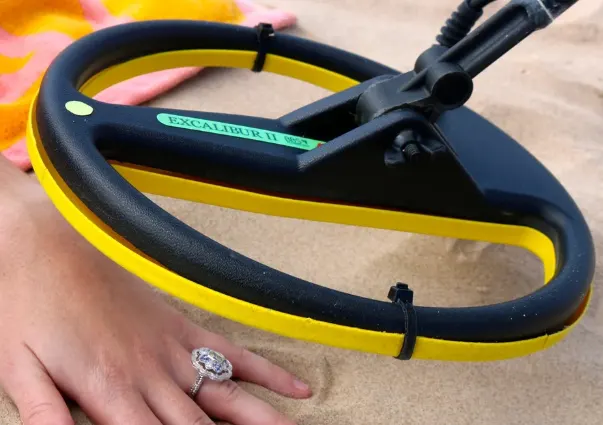
The second pillar is location. Rings get lost where people take them off, or where hands are wet and slippery, so the search should focus on high-traffic areas. Beaches, swimmable lakes and rivers are among the most promising spots. The author suggests sweeping the area where towels are laid out, the zones near lifeguard stations and shallow water, because rings are easily lost while swimming, fishing or applying sunscreen. If you go into the water, the detector must be waterproof.
Parks are also interesting places, especially picnic areas, spots in the shade of trees where people stop to rest, and children's play areas. The same goes for sports fields: spectators and players often lose jewelry during games and training sessions, so it is worth checking along the sidelines and around the benches. Along the edges of these spaces, where people stay longer, the chance of a find increases.
Then there are private gardens and vegetable plots, where a ring can slip off while gardening or planting flowers, as well as old farms and abandoned farmhouses. In both cases the author stresses a point that applies to any search: you need the owner's permission. Anyone searching in Italy should also remember that the rules on where and how metal detectors may be used are strict and must be checked before heading out, because the guidance in the original article reflects the American context.
In short, to find more rings, think like someone who loses them. Choose a place where people undress, play or work with wet hands, set up a machine that is sensitive to small targets, and study the signals of gold, silver and platinum on your own detector. A ring recovered and returned to its rightful owner, when possible, is often the most rewarding memory of a day of searching.