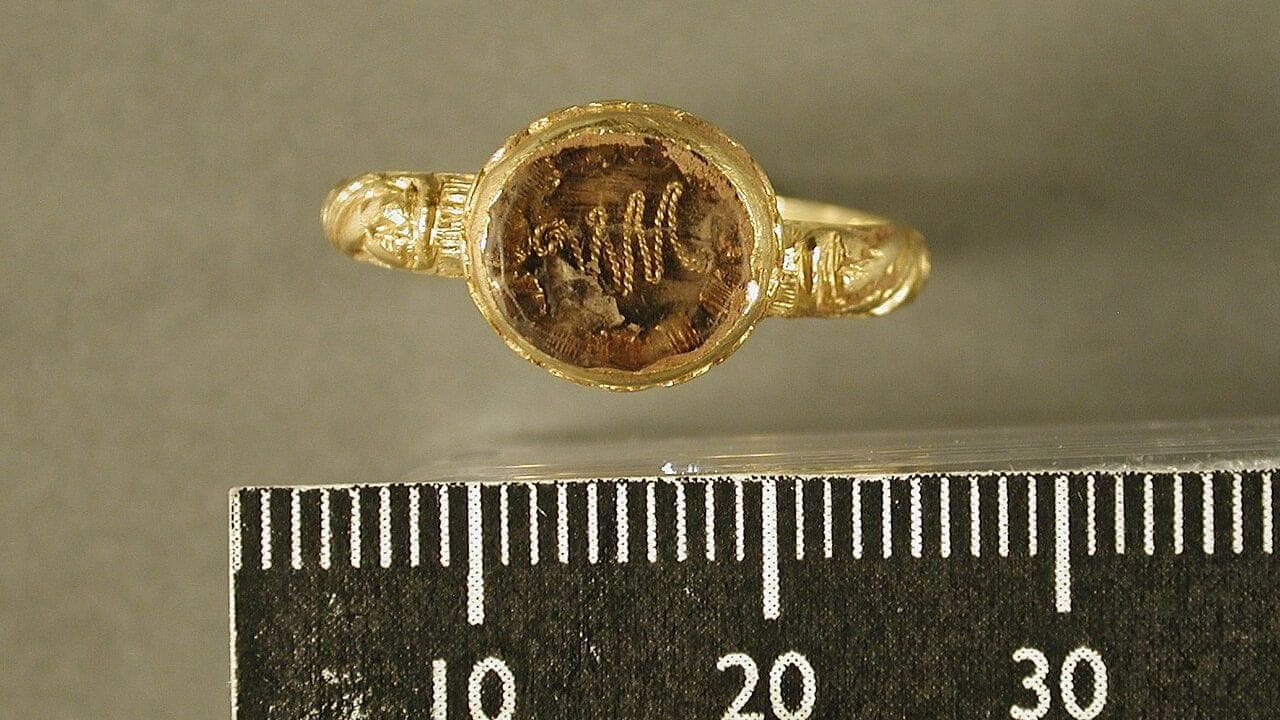
A metal detecting enthusiast has unearthed a gold and crystal ring about 370 years old on the Isle of Man. According to Live Science, the jewel may have been made in honour of a beheaded earl during the English Civil War. The find was made by detectorist Lee Morgan, who spotted the ring in the southern part of the island, located between Great Britain and Ireland, in December 2020. The object was then officially declared "treasure", the legal designation given to artefacts that meet certain archaeological criteria, by Isle of Man coroner Jayne Hughes on 19 April 2021.
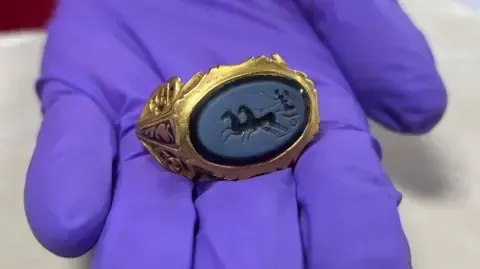
The object is a thin gold band with a diameter of 21.5 millimetres, topped by a crystal stone 12 millimetres wide. Beneath the crystal are two ornamental letters made of gold wire: the initials J.D. or I.D., as specified by Manx National Heritage, the body that protects the island's heritage. The two shoulders on either side of the stone are decorated with black enamel inlay.
Archaeologists date it to the late 17th century and identify it as a Stuart-period mourning ring (1603-1714). This type of jewel was sometimes distributed at funerals to commemorate the deceased, and it often bore the initials of the person being mourned.
If the first letter is a "J", the ring could have belonged to James Stanley, 7th Earl of Derby and Lord of Man, a supporter of the Royalist cause during the English Civil War. Allison Fox, archaeology curator at Manx National Heritage, explained in a statement that letters and documents of the period show Stanley signing himself "J Derby", so the initials JD would be appropriate. Fox also stressed that the ring is "of high quality", a sign of an object made for, or on behalf of, a person of high rank, a profile that fits the earl.
Stanley, also known as Baron Strange and Great Earl of Derby, supported King Charles I, who ruled England, Scotland and Ireland from 1625 until his execution in 1649. The sovereign's authoritarian rule clashed with Parliament, and the hostility led to a series of battles known as the English Civil War (1642-1651).
According to the reconstruction, the ring was probably made after Parliamentary forces executed James Stanley in October 1651, a few years after Charles I's death. Today a historical plaque on the Bolton Market Cross, in Churchgate, commemorates the earl with the inscription: "1651. James, Seventh Earl of Derby, beheaded near this spot". Again according to the Manx National Heritage statement, the jewel was most likely commissioned in his memory by his wife, Charlotte, Lady Derby.
The link to the earl therefore remains a hypothesis, however well supported: the initials can be read in more than one way, and there is no definitive proof of the owner's identity. The find nonetheless shows how much the work of metal detectorists can contribute to historical knowledge, especially when finds are reported and handed over to the competent authorities, as happened in this case.