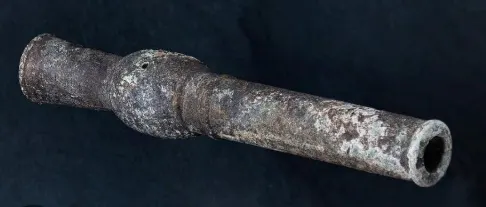
A small bronze object, uncovered during anti-personnel mine clearance on Mount Geumseongsan in South Korea, has been identified as the oldest known gunpowder weapon on the Korean Peninsula. According to The History Blog, the discovery predates the previous oldest firearm by at least 120 years, and perhaps by 180. The find dates to November 2023. A soldier using a metal detector spotted it while clearing the area where a hiking trail is planned on the summit. The zone has been off-limits since 1966, when an anti-aircraft battery was installed there, and the army is removing explosives from the ground to return it to the public. The object lay only about 10 centimeters (four inches) below the surface, beneath a rock.
The artifact is a Hwangja Hwatong, or "hand cannon with a yellow character." It is cylindrical, with a bulge about three quarters of the way along its length and a slightly flared end, wider than the opposite side. It measures 23.75 cm long, has a bore (internal diameter) of 1.66 cm, and weighs about 1.27 kg (2.8 pounds). The flared end was fitted onto a long wooden shaft. The barrel was then loaded with gunpowder and a projectile, which could be an arrow or a ball. Twenty-eight characters engraved on the handle and muzzle describe its manufacture in detail. The inscription reads: "In the twelfth month of the Jeongsa year, the Hwangja Hwatong was made. It weighs one geun and 14 nyang. The responsible official was registrar An Hyu-bo and the craftsman was Seok." It is the first small gunpowder weapon found in Korea that bears the name of the type, the date of manufacture, the weight, and the names of both the government official in charge and the craftsman.
The reference to a Jeongsa year narrows the dating to two possibilities: December 1377 or December 1437. In 1377, the Goryeo dynasty established its first state agency for armaments, under the guidance of the renowned inventor Choe Mu-seon, to counter naval raids by Japanese pirates. If the weapon instead dates to 1437, it would belong to the golden age of King Sejong the Great, who promoted an important standardization of artillery. In either case, the source reports, the hand cannon is the oldest verifiable firearm ever found on the Korean Peninsula.
X-ray and metallurgical analyses showed that the casting was made from a traditional bronze alloy of copper, tin and lead. Researchers observed that the tin content was kept strictly below 10 percent, a technical choice meant to give the barrel enough ductility to withstand the pressure of the internal explosion without shattering. Residual traces of silver and sulfur further point to medieval casting techniques, ruling out a modern replica. For metal detectorists, the story shows how a detector can bring major historical evidence to light. In this case, however, the search was military and aimed at safety, in an area contaminated by explosives. The artifact is now on display to the public for the first time at the National Palace Museum of Korea, until November 22.