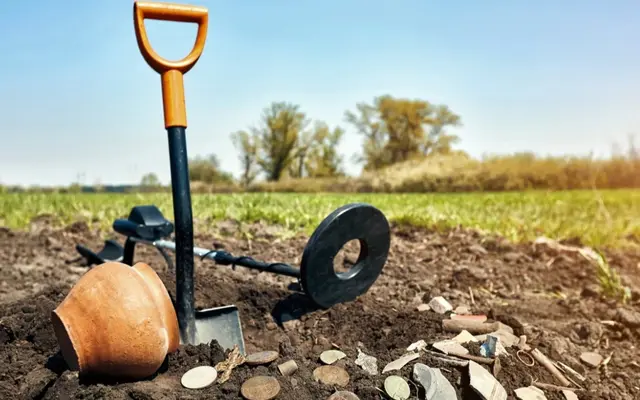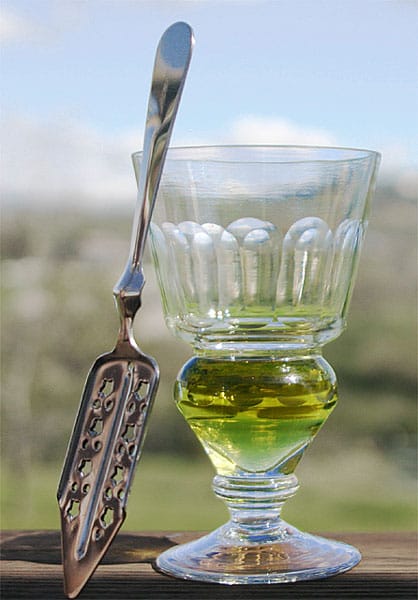
Anyone who goes out with a metal detector in France, especially in the countryside or in areas linked to the First World War, sooner or later digs up a flat, perforated and often bent metal object. According to Le Fouilleur Blog, in the vast majority of cases a perforated utensil of this kind points to the consumption of absinthe, a popular drink between the 19th century and 1915. It is the so-called absinthe spoon, tied to a precise social ritual.
The ritual involved resting a sugar cube on the metal spoon and letting it dissolve to soften the bitterness of the plant. The spoon of a typical example measures about 75 mm, a size designed to fully cover the opening of the specific glasses of the era. As for the motifs of the perforated section, the blog notes a certain variety, with star or lozenge designs, and a rather wide bowl.
The problem for anyone digging is that the object rarely surfaces intact. It often arrives in fragments or bent: according to the source, farm machinery and trampling in the trenches have altered the original shape, making it hard to identify at a glance. A careful examination of the structure, starting with dimensions and perforations, is therefore the way to reach a formal identification.
Materials also offer clues. Silver specimens are extremely rare and belonged to bourgeois luxury. Most finds, instead, are in less precious metals: brass, white metal and pewter are frequently encountered. The state of preservation depends greatly on the acidity of the soil and on the metal chosen by the manufacturer.
A separate case, of interest to military history enthusiasts, is that of aluminium objects. Being a soft metal that is easy to cut, it was used to make improvised utensils. These more rudimentary forms often correspond, according to Le Fouilleur Blog, to trench craft, made in the first months of the First World War, shortly before the formal ban on the drink. The source adds that at the front, due to the scarcity of standard accessories, French soldiers, the «Poilus», even made them from shell casings or mess tins.
The widespread distribution of these finds is explained by the success of the liqueur. The blog recounts that a family named Henriod, in the Haut Pays area, passed down a medicinal herbal recipe used against stomach and intestinal complaints. In 1797 Henri-Louis Pernod bought the secret of its production and launched industrial manufacturing in Couvet. Couvet, in Switzerland, and Pontarlier, in France, became the capitals of this industry.
Consumption soon moved beyond the medical sphere. Mass production flooded the market and spread tasting accessories into homes, inns and open-air guinguettes. According to the source, this explains the frequent finds even outside urban centres: between countryside picnics and breaks of farm workers, losing a utensil in tall grass or leaving it at the foot of a tree was commonplace, and today those spots are interesting targets for detectorists.
The history of absinthe is also intertwined with that of the French army. Again according to Le Fouilleur Blog, the conquest of Algeria played a driving role in its spread, as military doctors recommended it against malaria and dysentery. Officers brought the habit back to the mother country, encouraging its adoption in Parisian high society. Consumption then continued in the trenches of the Great War, until the ban.
In short, a flat, perforated and deformed find, with a bowl of around 75 mm and geometric designs, deserves to be evaluated as a possible absinthe spoon before being discarded as scrap. Material and the more or less refined shape help distinguish a civilian model from an improvised production at the front.