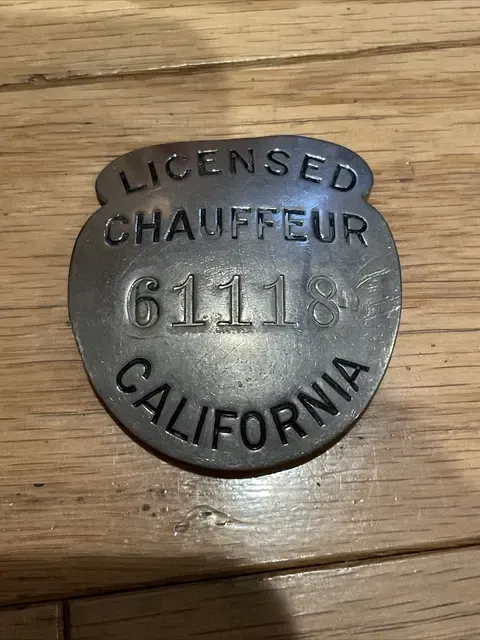
Among the transport-related finds a metal detectorist might unearth, chauffeur badges are among the most intriguing. According to Focus Speed, they are small metal plates, sometimes round, oval, shield-shaped or rectangular, with raised lettering such as "Licensed Chauffeur", "Registered Chauffeur" or "Professional Chauffeur". They may also bear a date, the name of the State and an individual serial number.
At first glance, someone unfamiliar with automotive history might mistake them for a company badge or an old piece of costume jewelry. In reality, they were an early form of professional identification, tied to the dawn of the automobile. The badge was a small metal license issued to anyone authorized to drive a motor vehicle for work or for pay. Collectors Weekly, cited by Focus Speed, describes them as metal licenses intended for qualified drivers of taxis and other paid automobile services.
The term chauffeur, in the early decades of motoring, did not refer only to the uniformed driver of period cinema. Depending on the jurisdiction and the period, the category was broader. The badge certified that the person had met the licensing requirements imposed by a state, a province, a county or a municipality.
Unlike a modern driving license, which lives in a wallet, many of these credentials had to remain visible while working. For this reason they were fastened to a jacket, uniform, cap or other visible spot with a pin, a screw-post or a clasp. This is a useful detail to keep in mind when identifying them: pin backs, threaded posts and other fastening systems are consistent with this function.
The historical context explains where these objects come from. Early automobiles traveled on public roads before governments had a uniform system for licensing drivers. The vehicles were noisy, mechanically complex and far faster than horse-drawn traffic, and communities soon began debating who should be allowed to drive them. Professional drivers, who spent more time on the road and carried passengers or goods for a fee, received particular attention. The badge was both license and instrument of public accountability: a passenger, a police officer or an employer could read its number and, potentially, report or identify the driver.
New York played an important role. According to the same source, in 1901 it became the first State to require vehicle registration, although at first owners supplied their own plates. As noted by the Iowa 80 Trucking Museum, New York was also the first to issue metal chauffeur badges, beginning in 1904. Similar credentials were later produced by many States and remained in use in some areas until the 1950s.
A historical reconstruction of New York's vehicle and traffic laws, cited by Focus Speed, explains that the regulations defined as a chauffeur anyone who drove a motor vehicle as a mechanic, as an employee or on behalf of others. Licensed chauffeurs were required to wear an oval badge while driving on public roads.
The phenomenon was not limited to the United States. Canadian provinces and municipalities also regulated professional drivers. Examples from the early automobile era survive from British Columbia, in brass or copper-finished metal, with contrasting letters and numbers. Archival correspondence about badge orders discusses shape, size and construction, a sign that the provincial government treated them as standardized official equipment. Collectors also come across later Canadian badges, from provinces and cities, with wording and requirements that, as in the United States, changed from place to place and from year to year.
For the metal detectorist, then, a find of this kind is worth more than its metal: its number, date and jurisdiction can link it to a specific era and set of regulations. The available source text breaks off before exploring identification and value, so here we limit ourselves to the elements described: wording, shape, fastening system, date, State and serial number.