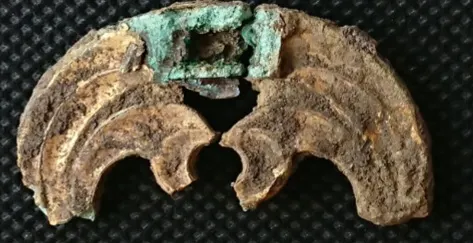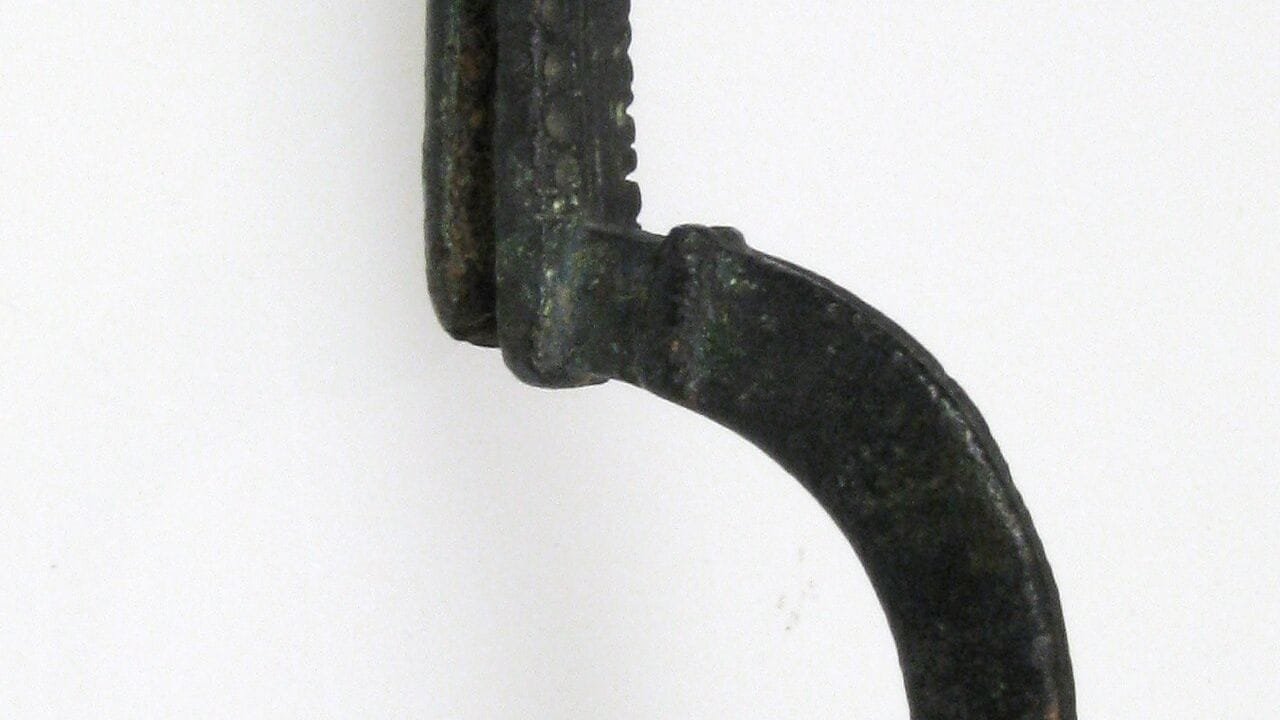
Cruciform brooches, also known as 'a balestra' (en arbalète in French), represent the technical peak of ancient clothing accessories between the 3rd and 6th centuries AD, according to Le Fouilleur Blog. They are recognizable by their thick bow and triangular spring cover. They were used to fasten cloaks such as the chlamys and, at the same time, signaled the administrative or military rank of the person wearing them within the imperial hierarchy.
The earliest versions were made from a single block of iron or bronze. Over time they evolved into more complex forms, with a protective spring cover and grooved decoration. To identify the variants from southern Gaul and understand how these styles spread across the Roman Empire, archaeologists use the classification of Michel Feugère, described in his work on the brooches of southern Gaul.
The oldest models attested in Gaul are the bare-spring types. These are fairly simple objects that gradually disappear during the 1st century. They can still appear in later archaeological contexts, such as sanctuaries or necropolises, a phenomenon the source explains by the frequent reuse of old objects by local populations.
Making these early examples was straightforward: the craftsman started from a single metal rod to produce the entire mechanism. After casting a rough blank, he stretched and hammered it to form the bow, catch plate and spring. The method gave the object considerable strength despite its slender appearance.
The expansion of the Empire in the 1st century radically changed production. The number of brooch types grew dramatically in Europe and the Middle East, and the emergence of specialized workshops made more advanced techniques and more sophisticated mechanisms possible, in response to growing demand.
Making a crossbow brooch required considerable metalworking skill. The craftsman prepared a bronze or iron rod and worked it in stages: hammering gave the bow its intended curve, while stretching the metal formed the moving parts, such as the pin. Some pieces, however, have a fully cast structure, which allowed more massive forms and complex ornamental details straight from the mold. Decorations were added afterward, with incisions or by removing material to create geometric motifs. The cord holder was sometimes a technical addition to stabilize the spring.
Between the 3rd and 6th centuries, the cruciform brooch went beyond its practical function and became a mark of rank. According to the source, only veterans of the army and officials of the imperial administration wore these models, and the richness of the decoration and the type of metal revealed a person's social position at a glance. The brooch fastened the cloak on the right shoulder, and its solid form ensured maximum visibility. Authorities also used it as a diplomatic gift or as a reward for services rendered, and the standardization of forms made it easier to recognize ranks across the various provinces.
This social function explains why similar ornaments appear in officers' graves, where the brooch accompanies the deceased as evidence of their career. Archaeologists rely on these finds to date sites precisely, and the presence of a brooch of this type often confirms the military or administrative nature of an ancient building.
For metal detectorists who work within the law, knowing these types helps them recognize a find and understand why it is important to report it: context and find location are what allow scholars to interpret the object's meaning.