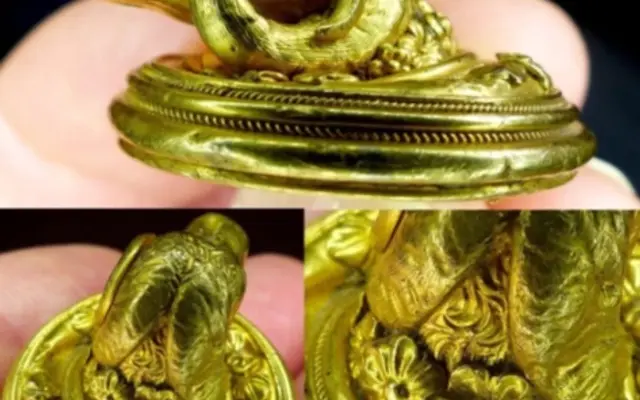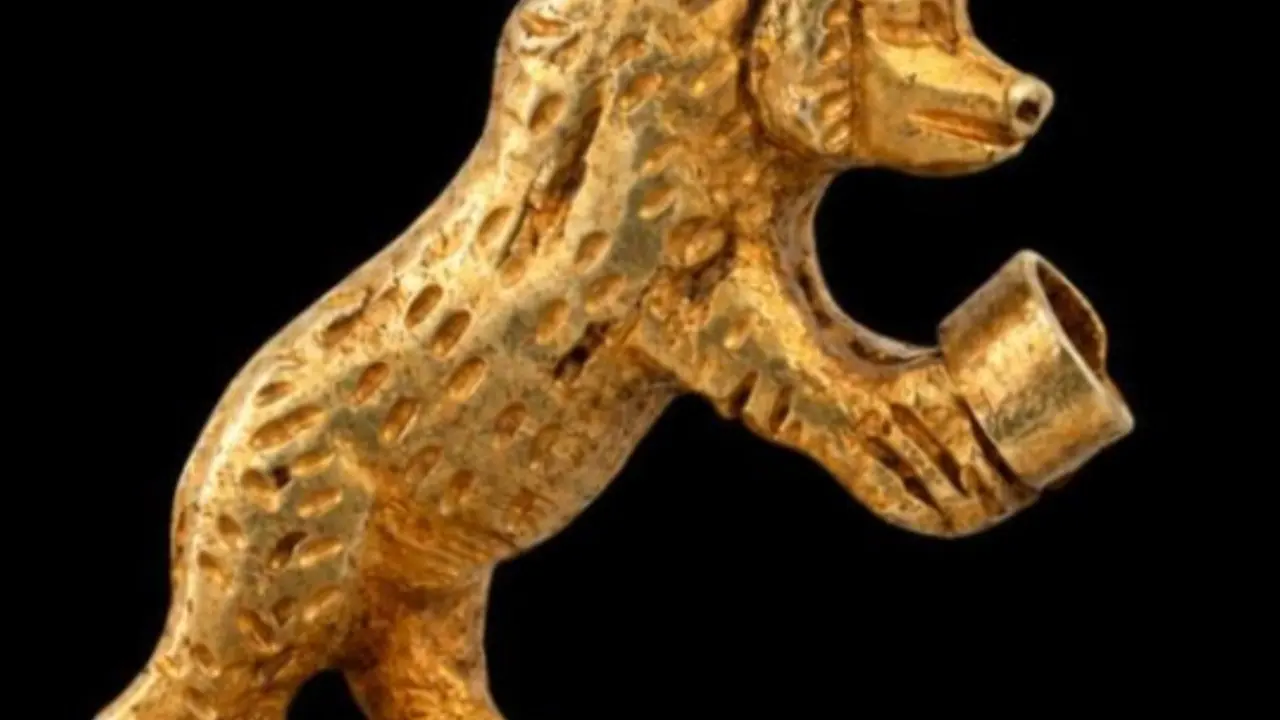
A small cast gold bear has been recovered from the Karagaily burial ground in southeastern Kazakhstan. According to Stilearte, which cites the news released on November 5 by the official portal of the Kazakh government, the discovery was made during an emergency archaeological excavation conducted in 2026 by the Almaty Museums Association, with the support of the city administration. The burial ground is located in the Nauryzbay district, within the urban area of Almaty, at the foot of the Trans-Ili Alatau range. The mound under investigation has a diameter of 25-26 meters and a height of about 2.5 meters: dimensions that place it among the funerary monuments of considerable size in the Central Asian steppe landscape.
The structure, however, had already been looted in antiquity. The looters had dug a deep cavity, a sort of plunder funnel reaching about three meters in depth, disrupting the original arrangement of the materials. The finds were therefore partly scattered, and it was not possible to immediately reconstruct their original position.
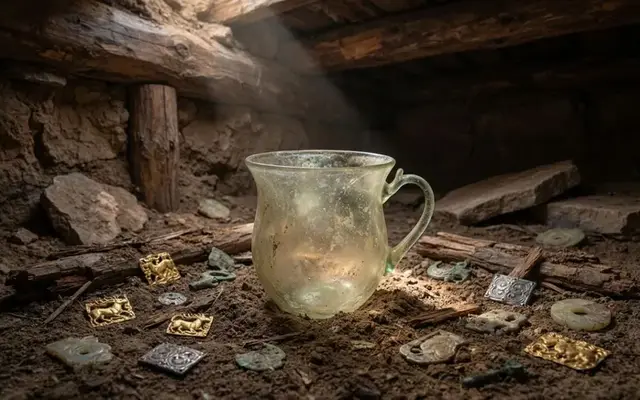
Among the recovered materials are fragments of Saka pottery, human bone remains, and the small gold object that caught the attention of scholars. The fact that it survived ancient treasure hunting is significant: today the artifact can be studied in a documented excavation context, something that is far from guaranteed for objects that escaped the looters.
The figure represents a bear and has small holes, which appear to have been used to attach it to a textile support. Archaeologists hypothesize that it was sewn onto a headdress, probably of ceremonial character. The hypothesis is plausible based on the characteristics of the element and on comparison with other zoomorphic ornaments found in Saka funerary contexts. However, the observation must be kept distinct from the interpretation: the holes are material evidence, while the headdress function remains to be verified through the technical study of the object.
The most interesting aspect is the choice of animal. According to the research leaders, the bear had not previously been documented in similar gold ornaments found in Kazakhstan. The director of the Almaty Museums Association, Lyazzat Sagyndykova, considers the find exceptional for the national heritage. She also stresses that it could help reconstruct the cultural connections that crossed Eurasia, from the Black Sea to the Altai.
To frame the discovery, it is worth recalling the figurative language of the steppe peoples. Between the end of the Bronze Age and the Iron Age, pastoral communities across Eurasia developed an ornamental repertoire in which animals played a central role. Predators, ungulates, birds of prey and sometimes highly stylized creatures appear on weapons, horse harnesses, plaques, garment appliques and headdresses. Archaeological research defines this phenomenon as animal style, or Animal Style.
The Saka were one of the main eastern components of the vast cultural complex conventionally referred to as the Scythian world. Their communities occupied territories that include present-day Kazakhstan, Kyrgyzstan, Tajikistan, parts of southern Siberia and regions of Central Asia. For those engaged in field research, the case offers a useful lesson. A context that has already been disturbed may still preserve materials of great value, but only a stratigraphic and documented excavation allows them to be read. The study of the small bear and the human remains found in the mound will now have to clarify how much of what is today hypothesis can become established fact.