About 2,000 years ago, a high-ranking individual linked to the Xiongnu nomadic empire was buried with great pomp in what is today northeastern Mongolia. According to Smithsonian Magazine, the tomb measures nearly 240 feet, or about 73 meters, in length. It is the largest of its kind discovered so far in the Asian country. Its exterior is imposing, but the interior is surprisingly small and shallow. Nonetheless, the burial contained objects that shed new light on the Xiongnu's relations with distant powers, including the Roman Empire and the Lelang Commandery. The latter was an administrative division of the Chinese Han dynasty, based in what is now Korea.
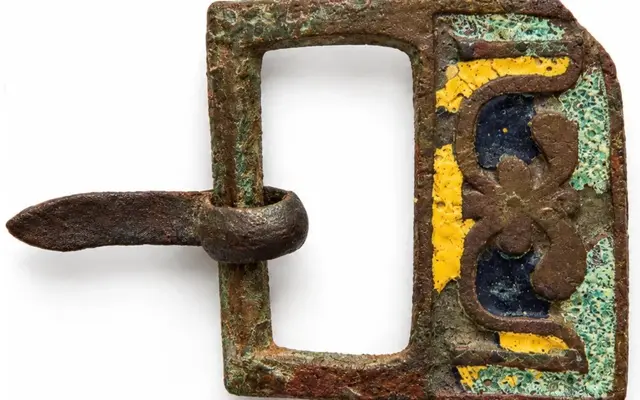
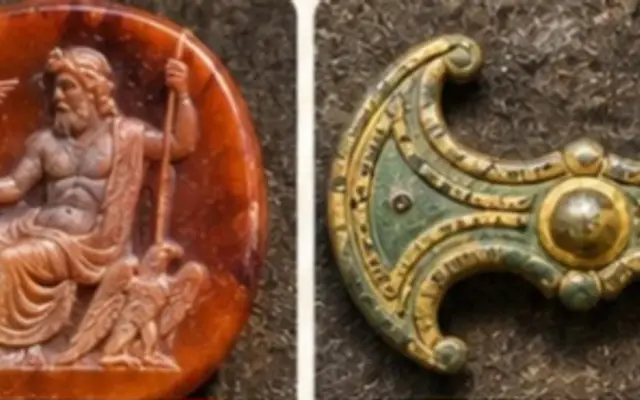
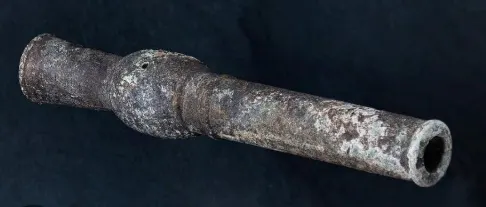
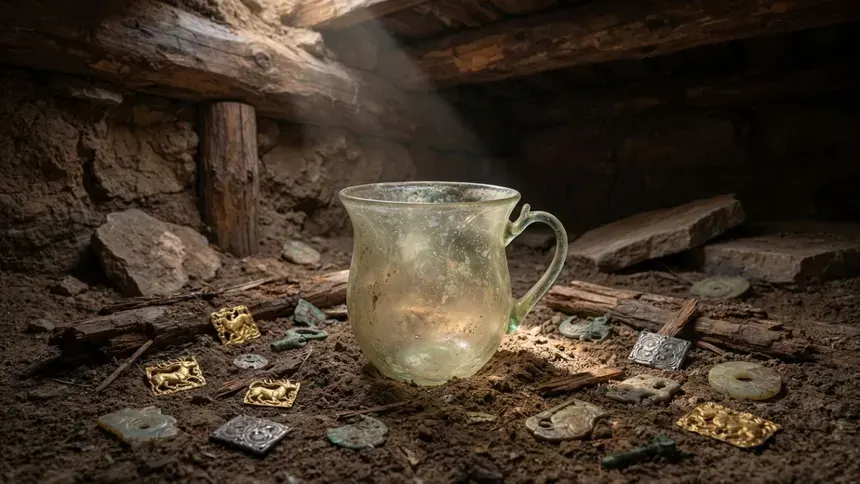
The excavation was carried out by three institutions: the National Museum of Korea, the Institute of Archaeology of the Mongolian Academy of Sciences, and the National Museum of Mongolia. They recently concluded four years of research on the burial, officially known as Tomb 160. It is located at Duurlig Nars, a Xiongnu necropolis with about 300 tombs. Archaeologists recovered 413 artifacts. Among them are a glass cup believed to be of Roman origin, a silver pendant shaped like a gourd that adorned a horse harness, a lacquered chariot, and 15 jade objects inspired by Han funerary goods.
The pendant recalls ornaments found in the tombs of Lelang, in present-day North Korea, but unlike those it has a crystal at its center. The jade objects have irregular shapes, with complex decorations carved on the surface. They are therefore distinct from the disc-shaped bi, which the Han prized as symbols of heaven. The National Museum of Korea stated in a press release, as translated by Seoul Economic Daily, that the excavation shows how the Xiongnu of two thousand years ago were part of a vast network of exchange, stretching from Rome to the Korean Peninsula. The museum expects it to become a turning point in extending Korean archaeology to Eurasia.
The variety of the grave goods indicates the high status of the deceased, who has not yet been identified. Researchers plan to analyze DNA from teeth and hair recovered from the coffin to determine sex and age. To build the tomb, ancient workers created a raised terrace surrounded by nine levels of stacked stones. The central chamber descends to a depth of almost 50 feet, about 15 meters. This is much less than comparable Xiongnu tombs in central Mongolia, which exceed 70 feet, or more than 21 meters.
According to the excavators, this reduced interior would reflect social changes between the late 1st and the 2nd century AD, when the tomb was built. At that time the empire was in decline, weakened by internal divisions and military pressure from the Han. The Xiongnu prospered in Central Asia between the 3rd century BC and the 2nd century AD. They controlled vast territories, Smithsonian recalls, citing Bruce Bower in Science News (2023), without building cities, creating central bureaucracies, or developing a writing system. Recent studies have called into question the traditional image of "barbarian" invaders.
A 2023 article in Science Advances suggested that elite Xiongnu women traveled to the empire's frontiers to consolidate alliances with local potentates. Co-author Bryan Miller, an archaeologist at the University of Michigan, described them as representatives of the imperial clan. He spoke of marriage alliances extended across the entire empire.