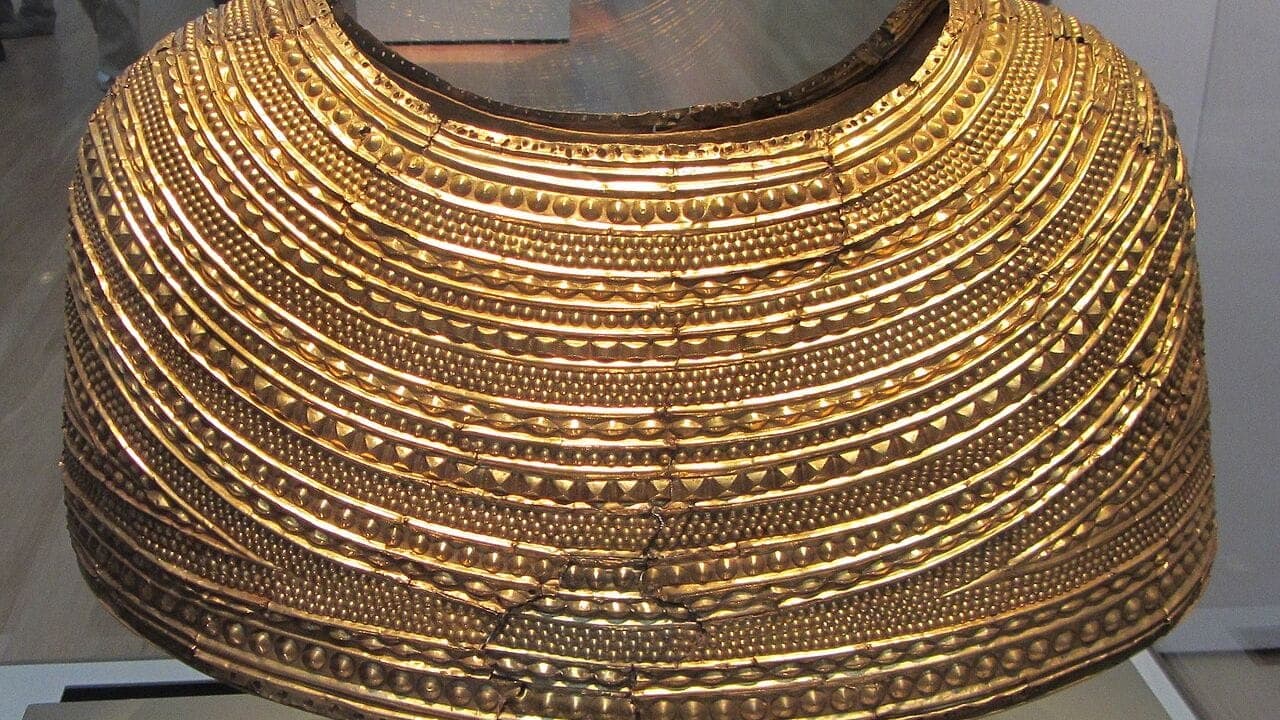
Among the most extraordinary gold artefacts of prehistoric Europe is the so-called Mold gold cape, a cloak-shaped ornament that, according to Live Science, is unique of its kind on the continent and may have belonged to a high-ranking woman.
The discovery dates back to 1833, when quarry workers unearthed an ancient burial mound at Goblins' Hill, near the town of Mold, in Wales. At the centre of the mound lay a stone-lined grave containing a fragmentary skeleton and the gold item, which over time had been crushed and broken into pieces. The British Museum, where the object is now displayed, considers it one of the finest examples of prehistoric goldwork ever found.
The cape belongs to the early British Bronze Age, a period between about 2500 and 1200 BC marked by a genuine metallurgical revolution: craftsmen moved from working flint to producing weapons and jewellery in gold, copper and bronze.
When it was found, experts suspected it belonged to a warrior, a chieftain or a religious leader, given its spectacular craftsmanship. However, as Benjamin Roberts, then curator of the European Bronze Age collections at the British Museum, told the BBC in 2010, once the fragments were reassembled, the object's small size suggested instead that it may have been worn by a woman or a child.
The cape measures about 23.5 centimetres in height and 46.5 in width, and weighs around 560 grams. In all likelihood, it was made from a single gold ingot roughly the size of a ping-pong ball. The metal was hammered into a very thin sheet, shaped into a cape and then decorated with motifs imitating beads or necklaces, as indicated by the British Museum.
The grave also yielded several hundred amber beads on the cape, which probably enhanced the golden effect of the whole. The perforations around the neck opening suggest that there was originally a lining of leather or another perishable material, which has since been lost.
When worn, the cape would have restricted the movement of the upper arms. For this reason, it is believed to have been a ceremonial accessory, linked to religious authority and used only on special occasions. However, it remains unclear why it was placed in a grave, and it is impossible to say with certainty whether the person buried was a man or a woman, because the skeleton was not recovered by the workers in the 19th century.
“The cape is unique: there is really nothing to compare it with anywhere in Europe,” Roberts told the BBC. “This makes it harder to understand why it was made and what it meant.”
The case of the Mold cape highlights how valuable contextual information can be: the loss of the skeleton and the poor documentation of the 19th-century excavation leave open questions that careful archaeological recovery might have clarified. For metal detectorists, it is a reminder of the importance of always reporting finds to the competent authorities, because the value of an artefact also lies in where it was found.