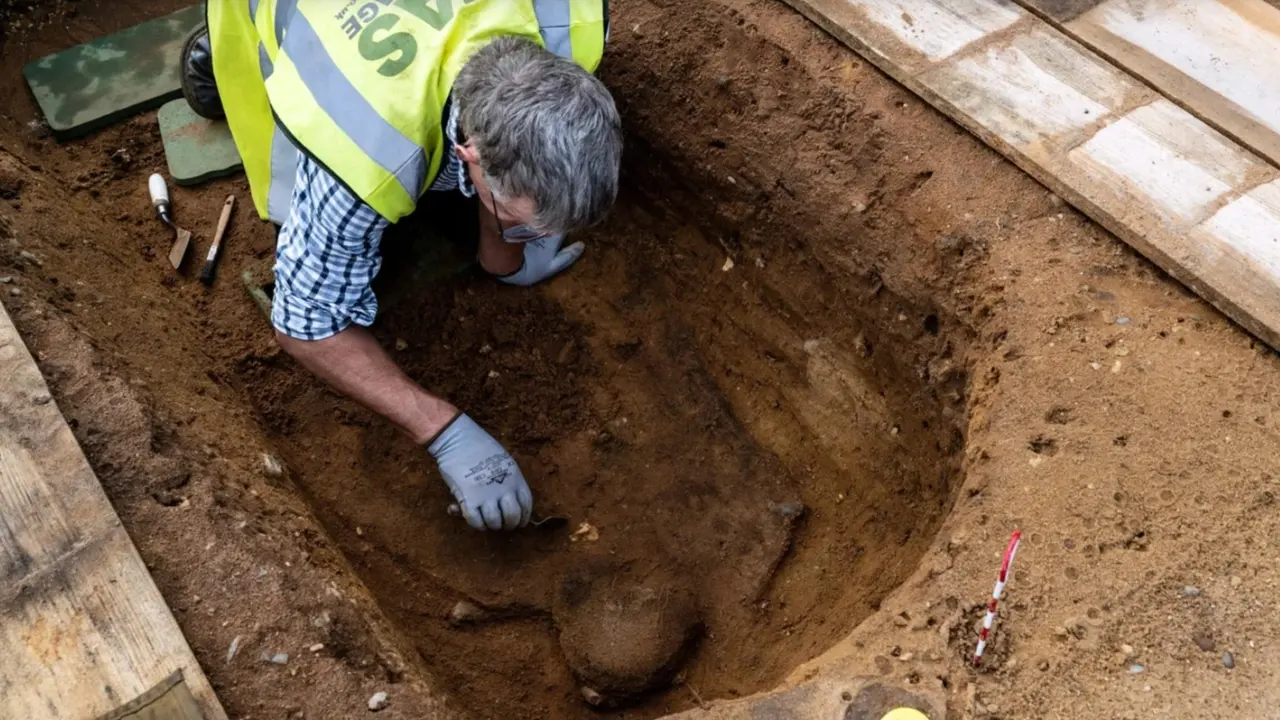
A new discovery has come from Sutton Hoo, one of the best-known archaeological sites of early medieval England. According to Live Science, in its archaeology section, archaeologists have unearthed another "sand body", that is, one of those ghostly remains that emerge in the sandy soil of the site. The article's headline describes it as a double burial.
The excavation lasted one month and was carried out together with the documentary series "Time Team". This is all the consulted source allows us to state with certainty: the text available to us is limited to a brief summary and provides no further details. We therefore do not know the date of the burial, its exact position within the excavation area, the identity of the deceased, or whether any grave goods were present.
The term "sand body" deserves an explanation, within the limits of what is generally known. The expression refers to the outlines left in sandy soil by bodies that have decomposed completely. In very acidic soils, bones often do not survive, and only a trace remains in the sediment. The source, however, does not go into how this burial was identified or documented, so we limit ourselves to reporting the news.
From the perspective of metal detecting, this discovery illustrates an important principle. Sites such as Sutton Hoo are protected and studied using stratigraphic methods, and their discoveries are valuable because every element is recorded in its original position. An object removed without documentation loses much of its historical significance. Those who practice metal detecting should therefore always act in accordance with current regulations and report any find of archaeological interest to the competent authorities.
We will return to this subject if new information becomes available, such as the date, soil analyses, or any objects associated with the burial. For now, the news confirms that Sutton Hoo continues to yield unexpected evidence, also thanks to the collaboration between archaeologists and popular media productions such as "Time Team". Readers who want to learn more can consult the original Live Science article, which remains the reference source for this news.